Smart mobs – more smart, less mob, says Rheingold

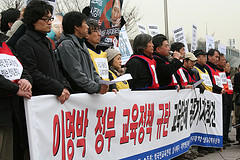
Korean political protestorsWeb anthropologist and elder statesman Howard Rheingold got invited to address South Korea’s citizen journalism website OhmyNews by video, in light of the protests currently ongoing there in opposition to the importation of US beef. The video and a transcript are available for everyone to see, and Rheingold has some sensible things to say about the Pandora’s Box of smart mobs:

A smart mob is not necessarily a wise mob.

The technology itself does not guarantee peace or democracy. It really requires a literacy. It requires an informed citizenry. Journalism plays a role in that. Journalism brings to the people news they need to know about the workings of the State. And it helps bring public opinion to the policy makers to know that they cannot make policy that goes against the majority of opinions of the citizens.

Wise words, for sure – but the inference is that Rheingold recognises that smart mobs are simply one emergent property of recent technological advances … and that the same technology, with a very slight adjustment of attitude or motive by its users, can be used for oppression just as easily as liberation. [image by hojusaram]

New technologies, same old problems.

Things can only get better

The sense that things are getting worse and worse is supported by the various imminent cataclysms of global warming, peak oil, antibiotic resistant diseases, fundamentalist terrorists, social collapse and an intrusive state.

However it seems people have been getting happier, from researchers at The World Values Society at the University of Michigan:

Economic growth, democratization and rising social tolerance have all contributed to rising happiness, with democratization and rising tolerance having even more impact than economic growth. All of these changes have contributed to providing people with a wider range of choice in how to live their lives—which is a key factor in happiness.

This is just fine and dandy. But when Tom Harris MP suggested that people should be grateful for their increased wealth (the UK) and freedom (many other places) he was mauled by the Press.

It is interesting that on the one hand people are predicting all the ills I mentioned above, and on the other you have Ray Kurzweil and the World Values Society pointing out that things are about to get a lot better and that people are feeling happier respectively.

I look forward to finding out who is correct.

[story via PhysOrg]

Donate to Strange Horizons – support quality free genre fiction on the web

Hey, y’know how we publish a free piece of fiction every month? Well, Strange Horizons has been publishing a free piece of genre fiction every week. Plus poetry, and non-fiction, and reviews. All of which they pay professional rates for. None of which makes them a profit, or pays the volunteer staff and editors in anything but kudos.

And they’ve been doing it for eight years.

When I sat down to think about how to make enough money to pay for Futurismic‘s fiction, I considered but rejected the idea of having a public funding drive – the main reason being that Strange Horizons already uses that model, and I didn’t want to divert any of the spare money in the genre fiction scene away from them.

So here on Futurismic you get ads, but Strange Horizons has no ads at all. Eight years of archived professional material, completely and utterly free to read and free of distracting commercial messages. It’s a genre fiction resource to which nothing compares, which has broken many great new writers into the scene, and we’re very lucky it exists.

Which is why I suggest you may want to consider popping over to Strange Horizons and donating a few dollars, especially if you’ve ever read anything on the site. And if you’ve never read anything there, now would be a great time to start.

And if you’ve got a blog, give them a little plug, just like this one. It doesn’t cost you anything, but it’ll mean a lot to them. There are even prizes and  incentives … but personally, I’m just doing this for the love. Strange Horizons is an inspiration to web publishers everywhere; long may she sail.

The Mosquitoes Are Coming!

mosquito flyerLiving in Wisconsin, the record rainfalls over the past month have become something of a concern. The biggest water-related concern Southeast Wisconsin – Milwaukee in specific – has had in the last 20 years is the cryptosporidium scare we had in 1993. Now, though, with nearly an entire summer’s worth of rain in just less than a week, we’re in trouble. Why? Mosquitoes. [picture thanks to basykes].

The biggest hazard with mosquitoes in Wisconsin in the West Nile Virus. With large – and I’m talking football-field-sized – ponds all over the area, it’s prime breeding grounds for large quantities of mosquitoes that carry the virus. The National Health Administration and the CDC have warned of a possible outbreak. It’s one of those concerns that a people don’t really think about, and it carries potentially lethal outcomes.

Many people are rebuilding after the devastating floods, and this will only be an additional burden. It’s one of those times when it’s nice to be advanced enough in medicine to deal with such large-scale problems.

Cast aside your iron for super-paper!

Stack of paperHere’s a little something I missed the other week: a Swedish research team are working to develop “nanopaper”, a material based on wood-pulp cellulose nanofibres that can be stronger than cast iron.

The new method involves breaking down wood pulp with enzymes and then fragmenting it using a mechanical beater. The shear forces produced cause the cellulose to gently disintegrate into its component fibres.

The end result is undamaged cellulose fibres suspended in water. When the water is drained away Berglund found that the fibres join together into networks held by hydrogen bonds, forming flat sheets of “nanopaper”.

So what, you may be thinking. Well, as Charlie Stross suggested, if the current generation of 3D-printing/fabrication systems (like RepRap) swapped the soft plastics they currently extrude with for the nanopaper formula:

“… the future may turn out to be made of papier maché.”

Anyone have any idea how recyclable this cellulose nanopaper would be by comparison to plastics or steel? [image by Tina Raval]

Presenting the fact and fiction of tomorrow since 2001