Moving beyond turning food into fuel

800px-Straw_Bales Producing biofuels from food crops is beginning to look like maybe not the greatest idea.

What does look like a good idea is producing biofuels from agricultural and forestry residue: straw from cereal crops, stover from corn, and left-over wood from lumber operations. After all, every tonne of grain is generally accompanied by another tonne of residue, which for now is generally baled, burned, or simply chopped and mixed back into the soil. (And some of it does need to remain on the land to prevent erosion and maintain soil nutrient levels, but vast amounts could be harvested.)

Research is underway and pilot plants being built to convert this “lignocellulosic” material into biofuels, and things are looking better for it all the time. For example, scientists from Michigan State University have created a genetically modified corn plant that contains three enzymes enabling the stem and leaves to be more easily converted into ethanol. One, from a microbe that lives in hot spring water, cuts cellulose into large pieces; a second, with a gene from a naturally occurring fungus, breaks the large cellulose pieces into sugar pairs, and the third, which is created by a gene taking from a cow’s stomach, breaks the sugar pairs into simple sugars easily convertable into ethanol. Current methods of converting the cellulose from agricultural residue are expensive because the enzymes have to be purchased and added during the process.

Better yet, University of Massachussetts researchers report they’ve made a breakthrough in the development of “green gasoline,” a liquid identical to standard gasoline created not from petroleum but from biomass sources like switchgrass, poplar trees, and straw and stover:

For their new approach, the UMass researchers rapidly heated cellulose in the presence of solid catalysts, materials that speed up reactions without sacrificing themselves in the process. They then rapidly cooled the products to create a liquid that contains many of the compounds found in gasoline.

The entire process was completed in under two minutes using relatively moderate amounts of heat. The compounds that formed in that single step, like naphthalene and toluene, make up one fourth of the suite of chemicals found in gasoline. The liquid can be further treated to form the remaining fuel components or can be used “as is” for a high octane gasoline blend.

“Green gasoline is an attractive alternative to bioethanol since it can be used in existing engines and does not incur the 30 percent gas mileage penalty of ethanol-based flex fuel,” said John Regalbuto, who directs the Catalysis and Biocatalysis Program at NSF and supported this research.

“In theory it requires much less energy to make than ethanol, giving it a smaller carbon footprint and making it cheaper to produce,” Regalbuto said. “Making it from cellulose sources such as switchgrass or poplar trees grown as energy crops, or forest or agricultural residues such as wood chips or corn stover, solves the lifecycle greenhouse gas problem that has recently surfaced with corn ethanol and soy biodiesel.”

You can read more about the latest efforts to produce “green” fuels from the parts of crops we don’t need to feed a hungry world in “Breaking the Chemical and Engineering Barriers to Lignocellulosic Biofuels: Next Generation Hydrocarbon Biorefineries,” a report sponsored by the National Science Foundation, the Department of Energy and the American Chemical Society.

And perhaps best of all, another set of researchers believes they’ve got a revolutionary process for producing hydrogen from biomass, which might eventually lead us all to the Nirvana of the hydrogen economy.

(Image: Shaun MItchem via Wikimedia Commons.)

[tags]biofuels, alternative fuels, ethanol, agriculture[/tags] 

Designing for the Apocalypse

OK ladies and gents, please give a warm welcome to our second new non-fiction columnist here at FuturismicSven Johnson.

Future Imperfect - Sven Johnson

Sven is what I might call a philosopher of design (although I image he’ll hate me having done so in public). In his inaugural column he gets all eschatological on our asses and asks whether, as a species, we collectively design our own doom. Continue reading Designing for the Apocalypse

CERN brings supergrid internet to the world

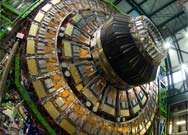
The CMS detector at CERN will process huge volumes of data every secondIn addition to searching for the ‘God’ particle that is the Higgs, CERN have been making a vast ‘supergrid’ to transfer the vast volumes of data created by the LHC supercollider every second to the universities studying it around the world (currently including myself). The sheer amount of data at the LHC – around 15 Petabytes a year – means a whole new system has been made to spread it to other institutions outside of the collider in Switzerland.

The grid still has some issues to work out but is showing signs of real potential to blow the current internet out of commission in a few years. The grid uses fibre-optic connections and high speed routers to transfer data. It could be as much as 10,000 times as fast as current broadband, allowing movie-sized files to transfer in seconds. Of course, this technology is currently only in use in the world of High Energy Particle Physics but, like the World Wide Web before it, what is invented at CERN tends to propagate out to the rest of us before too long.

[via The Times, image via CERN]

Dr. Michio Kaku: humans are almost Kardashev Type I

Science fictional city concept artOur sf-nal brothers-in-blog over at SF Signal have managed to score an interview with the occasionally controversial but always entertaining pop-science writer Dr. Michio Kaku.

The SF Signal gang ask Dr. Kaku a bunch of questions (including what he thinks about Mundane SF, believe it or not), but what I found most interesting was his response when asked whether humans stood a chance of becoming a Kardashev Type I civilisation:

“I see evidence of our historic transition from a Type 0 civilization to a Type I civilization. For example:

  • English is rapidly emerging as the most likely candidate for a planetary language.
  • The internet is an emerging Type I telephone system.
  • The EU, NAFTA, etc. are the seeds of a planetary economy.
  • A planetary culture is gradually emerging, based on youth culture (e.g. rock and roll, rap), fashion, movies.

But there is also a backlash against this historic transition. Anything this monumental is bound to create a counter force. These are the terrorists (who instinctively dislike a planetary civilization, which is necessarily multicultural, scientific, progressive, and tolerant). Also, we have the forces of chaos and destruction, such as nuclear proliferation and designer germs.”

So rock music is a sign of an advanced civilisation? I feel vindicated! 🙂

More seriously, it seems Dr. Kaku is cautiously optimistic about our progress so far – perhaps uniting in opposition to the “forces of chaos” will crystallise us into a Type I planetary civilisation?

That said, Karl Schroeder isn’t convinced by the Kardashev Scaleit’s inherently homocentric, meaning that what applies to us hairless monkeys is unlikely to apply to any other species. So perhaps we’re trying to classify the unclassifiable?

I love the smell of philosophy in the morning! [image by Shayan]

Could the credit crunch bring the end of globalisation?

I Can Haz Bailout?That’s one of the reasonings in a Guardian article today entitled ‘Toxic Shock: how the banking industry created a global crisis’. With policymakers unsure about what to do, many regulators are starting to get tougher with their requirements, which will make credit less abundant. As much as $1 Trillion dollars could have been lost in the crisis, and that number could rise. In the short term, it’s likely to lead to difficulties in loans. In the longer term, reregulation and tighter lending standards will change the shape of the world economy.

That’s not to say the economy is totally without worth at the moment. Wired’s latest issue has a series of 9 articles on positive business trends in 2008, including open source software and ‘Instapreneurs’ that make their products with virtually no lead time in a manner very much like in Futurismic’s April short story, ‘Mallory’ by Leonard Richardson.

[via the Guardian and Wired, photo from I Can Haz Cheezburger via Shiny Things]

Presenting the fact and fiction of tomorrow since 2001