Friday Free Fiction for 28th March

So, how was your Easter weekend? I was having a high old time of it at Orbital, this year’s incarnation of the British National Science Fiction Convention – which probably explains why I’m still exhausted now! But no matter – free fiction waits for no one. So let’s bring it on …

***

Just the two from Manybooks.net:

***

This week the VanderMeers celebrated New Weird Wednesday to mark the launch of their anthology, er, The New Weird.

In free fiction terms, that means you get a free downloadable PDF version of Jay Lake’s “The Lizard of Ooze. The good Mr Lake has also recorded a podcast version of the same story, so you can hear it exactly as its author intended it.

***

Tachyon Publications (publishers of the above-mentioned The New Weird, as it happens) offers Michael Swanwick‘s Hugo-nominated “A Small Room in Koboldtown” as a PDF download.

***

Pyr is offering a Sampler eBook containing “sizable excerpts” from Joe Abercrombie‘s Before They Are Hanged, Kay Kenyon‘s A World Too Near, Theodore Judson‘s The Martian General’s Daughter, Robert Silverberg‘s Son of Man, David Louis Edelman‘s Infoquake, and Mike Resnick‘s Stalking the Unicorn and Stalking the Dragon.

***

Gwyneth Jones is planning a redesign of her webspace. In the interim, she has set free two stories: “The Fulcrum” and “The Voyage Out“.

***

Via BoingBoing we discover that …

“… Night Shade Books has just made Jon Armstrong‘s novel Grey available as a free download. This stunning “high-fashion dystopia” has been nominated for the John W. Campbell Memorial Award.”

***

Fantasy And Science Fiction Magazine have posted Benjamin Rosenbaum‘s “Start The Clock” over on their blog.

***

The nice people at Eos are getting into the spirit by sharing two pieces of short fiction that are in the running for a Hugo this year:

Two of my personal favourite authors right there, and two stories I’ve not yet read. Result!

Eos also has the Hugo-nominated novel The Yiddish Policemen’s Union by Michael Chabon available for online browsing. Our cup brimmeth over!

***

Via the relentless Cole Kitchen (who doesn’t even have a website I can link to in thanks, poor fellow):

Scott Sigler‘s new horror novel Infected is available as a free PDF download from the Random House Web site, but only until March 31.”

That’s a pretty small window, folks, so get on over and slurp that file down. You can always read it later, right? Cheers, Cole!

***

Here’s a new addition to the free fiction sidebar: AtomJack Science Fiction Magazine.

The content is hidden behind a Flash frontpage, but it looks like there’s a good few back issues there. If you go take a look and fancy writing a review, drop us a line!

***

And finally, Friday wouldn’t be Friday without the Flash Fictioneers, now would it?

First the catch-up entries from last week that arrived too late for me to include – both of which, to my shame, were posted by wi-fi from elsewhere in the same hotel as me! Shaun C Green was obviously pretty discomforted by the foyer service if “Deadblogging” is anything to go by, and Neil Beynon was feeling “Crushed“. Travel will do that to you.

And here’s something from a new recruit: Clive Birnie invites you to “Open The Doors“.

And now we move on to the fresh material –

There’s more Jay Lake goodness in the form of the ultra-short “Smoke“, while Greg O’Byrne goes over the word count with “The Bard And The Girl“, but that’s OK – we’ve all done that once or twice.

The majority of the UK chapter (arf!) of the Fictioneers did a flash fiction writing workshop at Eastercon, and some of the results have surfaced today:

***

That’s your lot for this week, boys and girls – don’t forget to send us your plugs and tip-offs for next week. In the meantime, have a great weekend!

Won’t somebody think of the robots?

robot horse Jamais Cascio is a sensitive soul; he doesn’t like seeing beasts of burden being abused and pushed around. Even robotic ones:

“My reaction to seeing this robot kicked paralleled what I would have had if I’d seen a video of a pack mule or a real big dog being kicked like that, and (from anecdotal conversations) I know I’m not the only one with that kind of immediate response. True, it wasn’t nearly as strong a shocked feeling for me as it would have been with a real animal, but it was definitely of the same character. It simply felt wrong.”

This throws an interesting light on the “robot rights” debates that keep surfacing. While I think we can all agree that a non-sentient machine doesn’t require the vote or union-mandated coffee breaks, this sort of psychological reaction to machines with a visual semblance of life may cause problems in early-adopter workplaces. [image by TwoBlueDay]

After all, even battle-hardened US Army colonels have been known to balk at sending machines to their doom.

More advances lead towards smaller, flexible computing

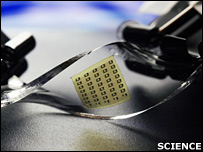
Flex those… silicon chips…A couple of neat new advances in computing this week. The first is an amazing flexible silicon chip designed by US researchers. The components of the chip are applied onto a thin layer of plastic, at first glued down to a substrate. When the circuit is completed, the glue is disolved and the plastic peels away a flexible chip. The researchers think that removing the traditional blocky form of a chip allows the bendable material to be used in many new applications such as brain implants or smart clothing.

“Silicon microelectronics has been a spectacularly successful technology that has touched virtually every part of our lives,” said Professor John Rogers of the University of Illinois at Urbana-Champaign. “In many cases you’d like to integrate electronics conformably in a variety of ways in the human body – but the human body does not have the shape of a silicon wafer.”

Meanwhile, Japanese scientists working on the developing technology of printing circuitry like an inkjet printer have developed a technique they believe is good enough to print TFT computer monitors. With all the components of a computer getting smaller and easier to manipulate, the days of the traditional shape of a desktop tower are surely numbered…

[ image and stories via BBC technology]

To sleep, perchance to dream…

labmice A long-time staple of science fiction has been the concept of suspended animation. It’s one of the ways to get around the immensely long travel times astronauts heading to the outer planets or other solar systems must endure. The usual SFnal approach has been “cold sleep,” where the suspended animation is achieved by means of extremely low temperatures: a kind of cryogenic suspension, with undefined futuristic technology somehow prevent cell damage and death in the human icicles.

Turns out, there just might be another way: low doses of hydrogen sulfide, the stinky gas that is responsible for the unpleasant odor of rotten eggs, and which is fatal in large doses, can, in small, controlled doses, safely and reversibly depress both metabolism and cardiovascular function in mice, producing a suspended-animation  like state (Via EurekAlert):

In all the mice, metabolic measurements such as consumption of oxygen and production of carbon dioxide dropped in as little as 10 minutes after they began inhaling hydrogen sulfide, remained low as long as the gas was administered, and returned to normal within 30 minutes of the resumption of a normal air supply. The animals’ heart rate dropped nearly 50 percent during hydrogen sulfide adminstration, but there was no significant change in blood pressure or the strength of the heart beat. While respiration rate also decreased, there were no changes in blood oxygen levels, suggesting that vital organs were not at risk of oxygen starvation.

Of course, it’s always a large and fraught step from mice to humans, but if this discovery is transferable to humans, it could be used to allow organ function to be preserved when oxygen supply is limited, such as after a traumatic injury, the researchers say. the next step will be to study the use of hydrogen sulfide in larger mammals. It’s possible, they say, that in larger mammals hydrogen sulfide could be delivered via intravenous drugs, which would prevent lung toxicity.

Warren Zapol, MD, the chief of Anesthesia and Critical Care at Massachusetts General Hospital and senior author of the study, sums it up: “This is as close to instant suspended animation as you can get, and the preservation of cardiac contraction, blood pressure and organ perfusion is remarkable.”

Start booking those flights to Alpha Centauri!

(Image: Wikimedia Commons)

[tags]medicine, suspended animation, mice, space travel[/tags]

Presenting the fact and fiction of tomorrow since 2001