Scientists create dynamic holographic display

3ddisp_hol Scientists from the University of Arizona have figure out how to make holographic displays, viewable without special eyeware, that can be erased and rewritten in a matter of minutes. (Via PhysOrg.)

Dynamic hologram displays could be made into devices that help surgeons track progress during lengthy and complex brain surgeries, show airline or fighter pilots any hazards within their entire surrounding airspace, or give emergency response teams nearly real-time views of fast-changing flood situations or traffic problems, for example…and no one yet knows where the advertising and entertainment industries will go with possible applications…

The prototype display is only four inches by four inches and only comes in red, but larger displays in full colour are considered possible. The researchers are aiming for a one-foot-by-one-foot display next, then a three-foot-by-three-foot display. Eventually they hope to be able to display life-sized holographic images of humans that can be updated every few minutes.

Watch a video here.

The researchers point out that a great deal of data is lost when three-dimensional information, such as that collected by an MRI or CAT scan, is displayed in two dimensions on a flat computer monitor. As they say, “…when we develop larger, full-color 3-D holograms, every hospital in the world will want one.”

And two minutes after the first one is installed, hospital staff will be referring to the room it’s placed in as the “holodeck.”

(Image: University of Arizona.)

[tags]medicine,optics,holograms,technology[/tags]

Can shorter books save fiction?

small-stack-of-books A blogger at The Guardian wonders whether the decline of interest in reading could be slowed by reversing the trend for bigger longer books. [Via SF Signal] [image from stock.xchng]

“Readable in a couple of hours, a novella demands far less time than a full-length novel: you can get through them in the same amount of time it takes to watch a film or two reality television programmes. If you read one in bed you can actually finish it in one go, as opposed to reading the same few chapters repeatedly because you keep forgetting what you covered the night before.”

Perhaps she has a point; she also mentions that writing novellas forces the writer to be more concise and economical with words in much the same way as the short story form.

I guess this is a reiteration of the “burst culture” argument – the idea that as our culture speeds up, we only have the attention span to deal with shorter works. But will a change of format reverse the trend, or is the reading decline a generational phenomenon with more complex roots than simple attention span?

How would you “save the novel”? Does the novel need saving?

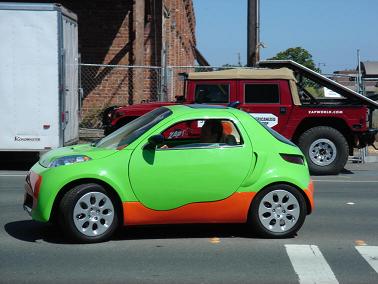
Brazilian ultra-compact cars running on ethanol, petrol, natural gas or electricity

The dinky Obvio in front of a less efficient example of automobile construction…

Lotus and Brazilian car manufacturer Obvio have a number of versions of cute VW Beetle-esque cars that run on any combination of ethanol, petrol or natural gas. They also have optional upgrades to become plug-in electric vehicles. They have a very consistent design style and the car even features an inbuilt ‘carputer’ with GPS, details on nearby locations such as restaurants and virtual instrumentation. You can also use the console as a normal PC. The engine uses continuously variable transmission (CVT) rather than distinct gears which aims to cut down on fuel use.

The Obvio 828 is projected for sale at around $14,000 and the more sporty Obvio 012 is projected at $28,000 although the electric versions are currently a lot more.

[thanks to Alex Thorne for the link, picture via the Obvio website]

My book is out, and I’m giving it away

Cover art for Marseguro by Edward Willett I’d like to interrupt our regular Futurismic programming to announce that my new science fiction novel Marseguro is now out from DAW Books and available from fine (and probably even some not-so-fine) bookstores everywhere, with a fabulous cover by Steve Stone. Not only that, I’m giving it away!

First, the book. You can read the first two chapters online here, and watch a video trailer here. Here’s the cover blurb:

Marseguro, a water world far distant from Earth, is home to a small colony of unmodified humans known as landlings and to the Selkies, a water-dwelling race created by geneticist Victor Hansen from modified human DNA. For seventy years the Selkies and the unmodified landlings have dwelled together in peace, safe from pursuit by the current theocratic rulers of Earth–a group intent on maintaining human genetic and religious purity.

Then landling Chris Keating, a misfit on any world, seeks personal revenge on Emily Wood and her fellow Selkies by activating a distress beacon taken from the remains of the original colony ship. When the Earth forces capture the signal and pinpoint its origin, a strike force, with Victor Hansen’s own grandson Richard aboard, is sent to eradicate this abomination.

Yet Marseguro will not prove as easy to conquer as the Earth force anticipates. And what Richard Hansen discovers may alter not only his own destiny but that of Marseguro and Earth as well…

Now, the contest: I’m giving away signed copies of the book this month to mark its release, and I’ve set aside one just for Futurismic readers. If you’d like to put your name in the hat for the draw, please send me an email at edward(at)edwardwillett.com, and mention Futurismic in the subject or body. This contest will remain open until February 17; I’ll make the draw February 18.

Of course, you’re also welcome to enter the non-Futurismic version of the contest, in which I’m giving away one book a week. You can find details on my blog, here.

I now return you to normal posting.

[tags]science fiction, novels, contests, promotion[/tags]

Science cities: a social experiment

Photo:  www.sciam.com Why is Silicon Valley the way it is today?  Was it inevitable?  Was it something in the water, or the spirit of the people living there that turned it into the technology engine of the world?  More likely, for different reasons a few tech companies set up shop there, and as they grew and broke apart, more and more startups came into being, driving technology, aided by the close proximity to other companies.

That’s the concept Duke University neuroscientist Miguel Nicolelis is hoping to exploit in his native Brazil.  Nicolelis hopes to create ‘science cities’ across the poorest regions of Brazil, that would act as the grain of sand in a pearl, bringing new businesses that would attract professionals, as well as schools that could train the local populace for research jobs.  The idea is that each city would be dedicated to a specific area of research.  Funding has accelerated, from both private donors and the Brazilian government.  A proof-of-concept neuroscience city was started in 2003, which contains research labs and will begin offering science and art classes to local children this year.

While its intriguing and ambitious, I’m rather skeptical that this will work.  We’re a long way off from being able to understand such complex social interactions, let alone being able to manipulate them.  On the other hand, I’d love to be proven wrong and see a string of science pearls spring up across Brazil.

(via SciTechDaily) (image from Scientific American website)

Presenting the fact and fiction of tomorrow since 2001