Reionisation and the future of telescopes

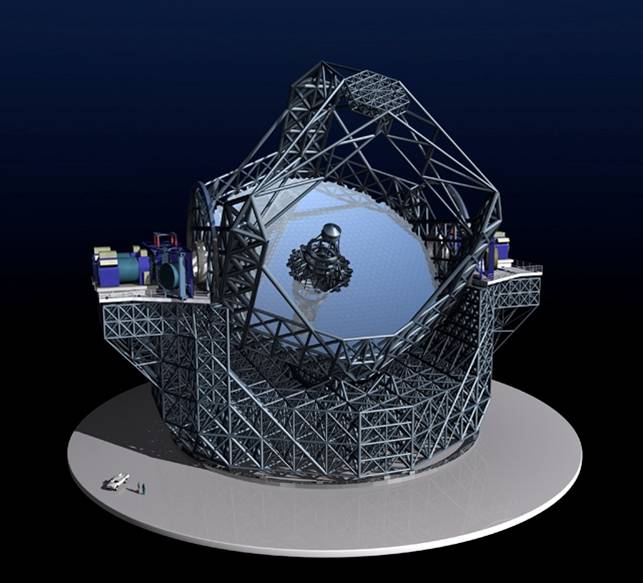
The 42m European Extremely Large Telescope will be a feat of engineering ingenuityAs astronomers look further back in time, they need more powerful, higher resolution instruments. As well as the search for extrasolar planets, one of the key areas the new technology will be looking at is the epoch of reionisation, some one billion years after the big bang. 400,000 years after the big bang, the universe cooled enough to become opaque, so that very little light was being emitted for us to observe. Later the universe began to change and objects like stars and galaxies formed. The heat from these first objects began ionising the neutral gas of the universe, creating more stars and galaxies in bubbles of hotter regions that eventually spread to form the reionised universe we see today.

Some of the designs for new telescopes are incredible. The picture shows the E-ELT, one of the new designs of Extremely Large Telescopes (anything over 20m in diameter). The small white shape in the bottom left is a car! The awesome James Webb Space Telescope will launch in 2013 to replace the Hubble Telescope. Its mirror and tennis court-sized sunshield unfold in space once it reaches its home orbiting L2, some 1.5 Million km from Earth. ALMA, LOFAR and SKA will links tens or even thousands of smaller radio telescopes together as one massive array, stretching out across continents. The next decade will truly be a revolution in the devices astronomers use to study the sky.

[This is a version of a talk I gave as part of my masters course at Bristol University last week]

Playing games with time

Timewarp Time has a strange attraction for many people – it’s the one dimension that we can perceive but can’t control. But we can hack at the edges of it, like the Time Nuts: a 400-strong geek clade who collect high-precision atomic time-pieces. If you find you never have enough time to spend with your family, you may want to look into their methods – it’ll help you scrape up a few precious extra nanoseconds. [Awesome ‘shopped image by fdecomite]

Other people are trying to map time, instead – MetaFilter points out Miomi, a web2.0 startup with the tagline “user generated history” that aims to round up all the information in the world and assemble it into one coherent browsable time-line. Insert your own joke about conspiracy theorists and alternate history writers here.

On the subject of writers and time, the relentlessly provocative and controversial Mundane SF blog reminds us of DeSmogBlog’s “100 Year Letter” project, and decries the fact that science fiction writers seem to have taken no interest in it at all. Of course, they may simply not have know about it – this is the first I’ve heard of it, at least – but the Mundanistas lay a much weightier charge:

“… here, in 2007, the Science Fiction community has abandoned the future; or the future has abandoned it and gone on its merry way, following the laws of physics and thermodynamics with absolutely no consideration for our fantastic dreams. What a shame.”

What do you think – is it science fiction’s duty to deal with contemporary issues, or is it just for escapist purposes?

[tags]time, clocks, history, mundane, science fiction[/tags]

New Toshiba batteries recharge to 90% in 5 minutes

Rapid charge, long lifetime, no explosions. Where’s the catch?Toshiba has reported that it plans to launch a new range of SCiB batteries in March 2008 that charge up to 90% capacity in just five minutes and have a lifetime of 5000 charges without much reduction in charge (an effective lifetime of 10 years). The two versions, 2.4V and 24V, shouldn’t explode either, which is always a bonus. Although this battery is designed primarily for the hybrid car and electric bicycle market, as Engadget and DailyTech comment this would be incredible in the laptop market…

[via Engadget, image by Toshiba via DailyTech]

Humans are evolving faster than ever

Evolution fairground sign Thanks to the magic of the wire services, this story is all over the web like a rash – you can read the abstract of the paper that’s caused the hoo-haa on the blog of John Hawks, one its authors.

But the nutshell quote is this one:

“The massive growth of human populations has led to far more genetic mutations, and every mutation that is advantageous to people has a chance of being selected and driven toward fixation. We are more different genetically from people living 5,000 years ago than they were different from Neanderthals.”

As an early commenter points out on the inevitable MetaFilter thread, faster evolution doesn’t mean we’re improving as a species, because evolution selects for ‘reproductive fitness’ rather than any quality that we might describe as being ‘better’ from a rational point of view.

But it’s an interesting story nonetheless; I’d always thought evolution was a glacially slow process. I guess we’ll have to wait and see what the implications are … not to mention the spin that the ‘Young Earth’ folk will try to put on it. [Image by KevinDooley]

[tags]human, evolution, anthropology, biology[/tags]

Another barrier to space colonization: the common cold

With the US, Japan and China all actively talking about permanent settlements on the Moon and Mars, not to mention the prolonged stays of astronauts on the International Space Station, attention is being focused on a well-known but little understood fact: the human immune system actually degrades in weightlessness.

The human immune system, which [is] as complex as the central nervous system, includes an arsenal of responses to invading bacteria, viruses and other pathogens – ranging from first responders such as neutrophils and microphages to more sophisticated T-cells and B-cells that act on a molecular level. Although research into the workings of these infection-fighters during space missions remains limited – because of technical problems with collecting samples in space, very limited crew time and, more recently, deep funding cuts – [many] key infection-fighting molecules appear to be less available to people in space.

Not only are people more susceptible to sickness inducing microbes in zero gravity, but it also appears that some microbes, such as salmonella, become significantly more virulent in weightlessness.

Presenting the fact and fiction of tomorrow since 2001