Potentially life-supporting planet found

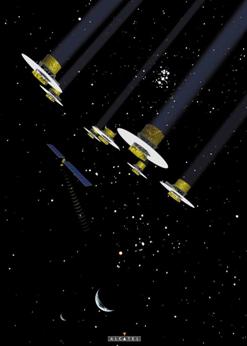
The four space-based 3 metre telescopes of DARWIN will work together to find other planetsAstronomers have discovered a planet in the 55 Cancri system that orbits constantly in what is know as the ‘habitable zone’ of the solar system. Although the planet is a gas giant some 45 times the size of Earth, there’s a good chance one of its moons might have liquid water and hence encourage the development of earth-like life. Planets are found by studying their transits across the light of a star. By studying the amount the star dims when the planet crosses, the size of the planet can be estimated. This is limited to larger planets currently but future missions like the Kepler and Darwin projects may be able to find rocky planets like our own.

The search for ‘exoplanets’ outside our solar system is hitting its stride and regularly more are found. Whilst the planets found to date are all ‘Jupiters’ like the gas giants further out in our home system, we know that Jupiter, Saturn, Neptune and Uranus all have large satellites. If any of these were in the habitable region where Earth is, the possibility of liquid water and hence bacterial life would be likely. If 55 Cancri did support life on one of its moons it would resemble the world of Coyote in Allen Steele’s excellent series.

[via the guardian, image of Darwin project via Astronomy Online]

Looking at you looking at me – attraction and narcissism

Love statue, New York City Cynicism and romance aren’t the best of bed-fellows … which may go some way to explaining why I’m still a bachelor. Still, gripes aside, the cynical part of my always gets a warm glow when science manages to debunk another myth about the mystical sanctity of love – like when I read that new research suggests "love at first sight" is actually a function of narcissism rather than a bolt from the blue:

"Social signals about how attracted someone else is to you actually seem to be quite important," [Jones] said. "You are attracted to people who are attracted to you, and that shows attractiveness is not just about physical beauty."

Lucky for me, eh? That knowledge should keep me warm through the long winter nights. Now, where’s my violin … [Image by Binkley27]

[tags]psychology, love, romance[/tags]

Cirrus cloud disappearance may dampen global warming

Cirrus clouds high in the atmosphere lock heat into the EarthThe self-adjustment of the science consensus tends to make it reliable – credible research is promoted and those not backed out by evidence fall. So if the scientific consensus thinks global warming is a problem, I’m inclined to believe them. However, sometimes real science offers some positives, like today. Researchers at UAHuntsville’s Earth System Science Center found that the amount of heat-trapping Cirrus clouds in the atmosphere decreases rather than increases as global temperatures go up. High altitude clouds like Cirrus ones tend to trap heating escaping from the atmosphere, amplifying any existing warming (low altitude clouds tend to have the opposite effect by reflecting sunlight back into space).

It was expected that as temperatures rose, more evaporation would lead to more clouds. Studies of smaller warming and cooling cycles in the tropics showed that actually higher temperatures created less Cirrus clouds, encouraging a cooling period in reaction to the added heat. This negative feedback system is an exciting discovery and could cut the amount of temperature rises in global warming models by as much as 75%. It’s not a get out of jail card and it would still be prudent to work on a worst-case scenario basis but this kind of mechanism could give us the time needed to adapt to a lower carbon economy.

[via ScienceDaily, image by acewill]

Rise of the giggling robots: toddlers accept robot as a peer

gigglingrobot Researchers at the University of California San Diego have discovered that it doesn’t take much to get toddlers to accept a robot as just another kid. (Via New Scientist.)

They put a 60 cm-tall robot called QRIO (pronounced “curio”) into a classroom with a dozen toddlers (video here) and programmed it to giggle when its head was touched, to occasionally sit down, and to lie down when its batteries dies. A human operator could also make it look at a child, or wave as one went away. Over several weeks, the toddlers began interacting with QRIO pretty much the same way they did with other toddlers. They’d even help it up when it fell, and when its batteries died and it lay down,  they’d cover it with a blanket and say “night, night.” (Awwww….)

There’s been a lot of recent research on trying to make the robot-human interaction better. Researchers have also taught a robot to dance to a beat, or to a partner’s movement, and are working on giving robots a sense of humor. Add in the martial-arts robots of a few years ago and that robot that conducted a Beethoven symphony, and you’ve got to think a true pass-for-human android a la Blade Runner may not be all that far away.

Whether you think that’s a good idea may depend on how much you took Terminator to heart.

(By the way, this is also the topic of my newspaper science column this week.) (Photo: J. Movellan et al., UCSD.)

[tags]robots, androids, artificial intelligence[/tags]

Psychology researchers inadvertently enable Second Life spam-bots?

giant laptop in Second Life A group of UK based psychology researchers were interested in seeing how Second Life users reacted to invasions of personal space within the virtual world. So, they developed a way around the built-in limitations that Linden Lab put in place to prevent software-controlled avatars being deployed, enabling them to send an avatar on autopilot to interact with other residents and record their reactions.

To which your response might be "so what?" – especially if you’re skeptical about Second Life to start with, which is not an uncommon stance. But as the heads-up on SlashDot points out, what can be done by psychology researchers in the name of science could just as easily be done by spammers seeking a automated method of advertising in the metaverse … which would seem to reinforce the adage that no platform will ever remain completely immune to spam techniques. Still, at least in SL you can always teleport away from an annoying avatar, which is more than you can do when confronted by a Scientologist or insurance hawker in the high street … [Image by PsychoAl]

[tags]metaverse, Second Life, spam, software, psychology[/tags]

Presenting the fact and fiction of tomorrow since 2001