Sad books are bad books?

Via MetaFilter: The Happy Endings Foundation "believes children’s books should only have happy endings. It urges parents to buy positive books for their children."

Now, that would be a lot less laughable if it weren’t for the fact that it’s just a bizarre kind of astroturf marketing ploy for the Lemony Snicket series. But as a life-long book junky and former public library employee, I am aware of how pervasive is the school of thought that believes all books should end (relatively) happily.

What do you think? Are unhappy endings just a reflection of reality, or should fiction strive for the positive?

[tags]fiction, stories, endings[/tags]
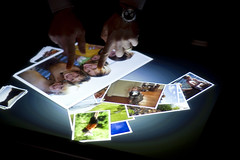
Multi-touch computer as an expensive coffee table

It seems like the time is ripe for new technology in the way we view media and interact with computers.  First we saw wearable monitors, and now Microsoft’s come out with a tabletop touch screen with a range of applications.  The Microsoft Surface will be available only to companies at first, so it’s got applications for ordering food, a map function to help you find your way in a mall or hotel, and a jukebox function compatible with the Microsoft Zune ("subject to DRM restrictions, of course").  Possible home functions include Paint, a photo application, and a sort of jigsaw puzzle where each piece displays part of a movie and you must arrange them in the proper order.

At a launch price of $5,000-$10,000, it’s just as well your average Joe won’t be able to buy it.  But Microsoft hopes the price will come down as demand grows and technology gets cheaper.  And when it gets cheap enough, I’ll be there ready to play at being John Anderton (without the cops chasing me, of course).

(image from kjd)

Edelman dissects the Bourne Trilogy

David Louis Edelman, author of Infoquake, has an excellent blog post today about what Matt Damon and Paul Greengrass’ work on the Bourne trilogy of films implies about the American view of its own government. The complicated paranoia of current world events and the question of how far do you break the rule of law to get the bad guys is one of the key moral choices of the new millenium and near-future SF writers like Edelman are an important part of understanding what’s going on now and what’s going to happen in the future.

[via Pyr editor Lou Anders’ blog]

Using biometrics to identify potential terrorists

Airport Security Ever look at the guy next to you in the lineup at airport security and wonder, "Is he a terrorist?" Well, scientists at the University at Buffalo are working on automated systems to help answer that question before those questionable individuals ever get on the plane–although, unlike you, their suspicions hopefully won’t be fueled by a mistrust of bald men with earrings or the fact your ex-wife’s mother looked just like that before she started smashing your prize collection of Star Wars figurines.

Instead, the system will track faces, voices, bodies and other biometrics against "scientifically tested behavioral indicators" to provide a numerical score of the likelihood that an individual may be about to commit a terrorist act. (Via Science Daily.)

Smile for the camera! But not as if you have something to hide… (Photo from Wikimedia Commons.)

[tags]security, biometrics, terrorism, technology[/tags]

Craig Venter invents artificial life?

gene.jpg

I’ve posted about developments in synthetic life before, here and here. It now appears the human genome pioneer Craig Venter has invented an artificial life form:

Craig Venter, the controversial DNA researcher involved in the race to decipher the human genetic code, has built a synthetic chromosome out of laboratory chemicals and is poised to announce the creation of the first new artificial life form on Earth.

The announcement, which is expected within weeks and could come as early as Monday at the annual meeting of his scientific institute in San Diego, California, will herald a giant leap forward in the development of designer genomes. It is certain to provoke heated debate about the ethics of creating new species and could unlock the door to new energy sources and techniques to combat global warming.

Presenting the fact and fiction of tomorrow since 2001