(Yet another) reason why biofuels may not be the answer

In addition to worries about driving up food prices around the world, especially in developing nations, there comes a study from Nobel Prize-winning scientist Paul Crutzen that biofuel may be even worse for us than fossil fuels.  The team calculates that biofuels can release 50-70% more carbon dioxide than fossil fuels, as well as release roughly twice as much nitrous oxide (N2O) as previously thought.

I think the problem here is that everyone is looking for a way to maintain their current standard of living and not admit that this level of energy usage will have to decrease.  The funny thing is, it’s not all that difficult to reduce the usage, if only just a little.  I think it’s actually more difficult to get your car converted to biodiesel than biking/walking to nearby places and not leaving lights on.  But that’s just me.

(via SciTechDaily) (image from neilsphotoalbum)

Update: Apologies, I misread the news report. I should’ve found the original paper first. It turns out that Dr. Crutzen found that N2O was marketdly increased, and if the environmental effects of N2O were converted into how much cooling CO2 would do, it comes out to be the afore-stated 50-70% increase. Which is a lot. Dr. Crutzen also stated he did not take into account the fossil fuel required to power the agricultural process (plowing, harvesting, etc), not did it take into account any beneficial co-products. He only focused on N2O production. It seems there is also some controversy about the efficacy of the calculations used. Please see the paper here(pdf).

Is space the third option?

Out here, noone can here you scream for more resourcesIn a move that will excite many science fiction fans, a political scientist from Norway has suggested there may be a third way to solve the coming environmental problems of the21st century: Space. He posits that there are two theories for sustainable development. One, Ecologism, aims for a post industrial era of lessened use of carbon and requires a change in the way our current political and social climate works. The other is Environmentalism which aims to keep life much as it is, only using funds to develop, repair and nurture the environment. However, he thinks that by tapping into the resources offplanet, it may be able to solve the Earth’s issues. Reading the brief it seems like very much a political rather than scientific hypothesis but there’s definitely a place for space in the coming time when resources become scarce – we just have to know where to look.

[from science daily, photo by Hubble Creative Commons]

A plan for carbon dioxide extraction

Cloud-strewn sky Two chaps from Columbia University have published a scheme for chemically extracting carbon dioxide from the atmosphere by passing it through a "chemical sponge". Critics of the scheme point out that the extraction process would be powered by electricity, and that we’d be better off cutting down the amount of greenhouse gas emissions we produce rather than looking for ways to recapture them. I’m no climate scientist, so I can’t pass judgement on which is the better plan … but at least there’s evidence that the prizes like Richard Branson’s Earth Challenge get people thinking about solutions to the big problems. [FuturePundit] [Image by Ju-X]

[tags]environment, atmosphere, carbon dioxide, extraction[/tags]

Space travel without propellant

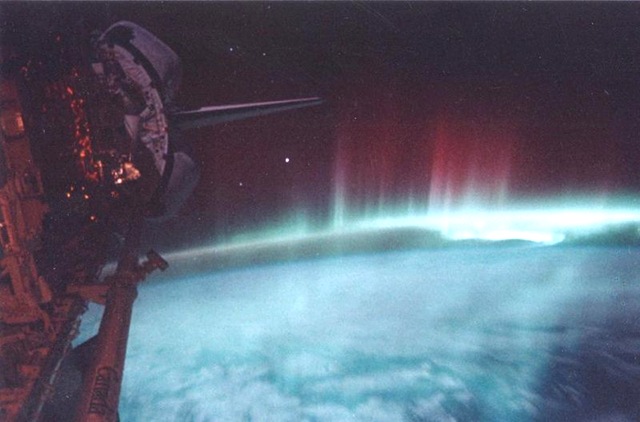
800px-Aurora-SpaceShuttle-EO

"Fuel? We won’t need no stinkin’ fuel for our spacecraft!" might be the motto of the Cornell Planetary Magnetic Fields Propulsion research team. Led by Dr. Mason Peck, the team envisions spacecraft that would be able to surf planetary magnetic fields, requiring little if any propellant. The effect to be harnessed, known as Lorentz forces, is small, so the spacecraft would likewise have to be small: imagine a swarm of millions of craft, each the size and mass of a single silicon wafer, gathering information, providing communications, or creating a distributed-aperture telescope kilometres in diameter. Such tiny, lightweight craft might even be perfect for the first trip to another star system. (Via Centauri Dreams.)

Hey, at 1/10th light speed, Proxima Centauri is only 43 years away… (Photo from NASA via Wikimedia Commons.)

[tags]space travel, propulsion, spacecraft, technology[/tags]

News flash: space germs can kill

From the Department of Science that Scares Me comes this little piece on salmonella sent to space that came back more dangerous than before.  The researchers describe it as a mutation that allowed the bacteria to survive in a certain kind of environment – microgravity – that fortuitously allowed them to be more effective (read: deadly) in organisms.

Thanks for giving me something more to worry about.  Sheesh!

(via DailyTech)

Presenting the fact and fiction of tomorrow since 2001