“We all like to congregate at boundary conditions. Where land meets water. Where earth meets air. Where bodies meet mind. Where space meets time. We like to be on one side, and look at the other” – Douglas Adams
***
Perhaps the concept of the border goes right back to the most basic bits of biology. Imagine yourself in the primordial soup of a young Earth, and look around: barring the physical limits of the sea itself as it thrashes against rocks (which in this instance counts as the edge of the perceivable universe, beyond which is beyond imagining), the only walls you can see are the cell membranes of the crudest lifeforms, each tiny critter an independent fiefdom of security and gathered resources, a little living city-state. And even here, even this early, we see the necessity of border permeability; food must be brought into the city for it to survive, so the walls must allow for that passage, as well as for the expulsion of the toxic and unwanted.
Some evolutionary biologists hypothesise that the earliest stages of single-celled life consisted of symbiotic mergers. It might well be that mitochondria and chloroplasts were originally independent bacterial lifeforms that finagled themselves through the walls and into the security of one of those little city-states, wherein they discovered that their own unique abilities would improve the lot of their adopted home; there we have the hopeful narrative of the economic migrant, born before even the first multicellular lifeforms.

And what a border the surface of the sea must have been to the first creatures to contemplate it – as challenging, unassailable and inhospitable as the border between the atmospheric envelope of Earth and outer space seems to us now, if not more so. We’re drawn to borders, challenged by them, inspired or intimidated by them. They are a function of our sense of identity, a mapping of ourselves onto the world around us. We understand their necessity, and yet we dream of transgression, of the meadow on the far side; the grass is always greener in the other guy’s stash.
The work of British science fiction author Chris Beckett is full of explorations of that contradictory tension between manning the city walls and sneaking through the postern gate, in either direction (because to leave the city is only to enter another territory). As climate change, post-growth economics and the inevitable evisceration of the nation-state make a mockery of map and territory alike, the questions he asks will only become more relevant.*
***
Given its harrowing history, it seems almost inconceivable that you could meet a Berliner who resented the loss of the Wall. And while no one but a last lingering few folk with a hard-on for the authoritarianism of the past (so much less subtle and velvet-gloved than that of today) would ever wish for a return to the oppression and hypocrisy that the Wall symbolised and enforced, it doesn’t take a long stay in that fine city for you to encounter the symptoms of a nostalgia for division. It’s probably clearest (and most commercially viable) at the level of aesthetics; there was a successful campaign to resist the replacement of East Berlin’s distinctive Ampelmännchen walk/don’t-walk signage characters, for instance, and – much as in any major city – the tourism industry makes money from tying ribbons around things dug up from the boneyard of the not-so-distant past. Sepia photography, the patina of age… these things have an authenticity that we find to be rare in the altermodern swirl of our mediated lives, an authenticity we seek to overlay on our experiences here at the cutting edge of time.

(I can get an infinitely reproducible copy [reproduced from Wikipedia under Fair Use terms; please contact for takedown if required] of the iconic shot of Conrad Schumann leaping the checkpoint barricade within seconds of googling for it, but the symbolic buttons it presses get pressed much harder when one buys it as a postcard from a shop on Unter den Linden before sitting down among the glistening new constructions of Potsdamer Platz 2.0 to scribble a suitable message on it and send it to a friend back home. Geography has a residual emotional power, even when we think it doesn’t, or shouldn’t… and time is just another dimension of the map.)
But I encountered a different, deeper sense of loss among the Berliners I met – a contradictory thing that baffled (and sometimes angered) people as they tried to explain it to me across the pocked no-man’s-land between our native languages. We shouldn’t discount the possibility that I have misinterpreted what I was being told, of course, but the sense I got was that while no one misses the cruel and arbitrary physical schism of the city, they miss the sense of unity that the schism gave them. Berlin was once united in its hatred of the Wall; as such the Wall became a huge part of Berlin’s sense of identity. The euphoria that accompanied its dismantling is long gone, leaving behind the unscratchable itch of a once-hated phantom limb. Formerly united by their division, Berliners are now divided in their responses to their unity; their discussions of contemporary civic politics now include the same gripes about zoning, gentrification, class and race as any other big European city, but there’s always an underlying sense that, even if the Wall was a horror, it at least made things simple: you always knew where you stood, even if you didn’t necessarily want to be stood there.

***
China Miéville’s novel The City & The City reminded readers of Berlin, the Gaza Strip, and many other brutally divided territories, past and present; indeed, the ease with which the book could map onto the politics of postmodernity is a testament to Mieville’s powerful command of metaphor. But there is a crucial difference: Miéville’s twin cities share the same physical space, and for the most part there is no physical or material obstacle between one city and the other. Indeed, the mapping of the two cities – and the necessity of unseeing the city that you do not belong to, and all the people in it, despite them sharing the street or building or park with you – is entirely the work of the citizens themselves. Besźel and Ul Qoma are one city, at least in the crudest architectural sense, but their mutual invisibility is rigorously policed and enforced.
Miéville strongly yet politely resists attempts to canonise any single reading or interpretation of his books, but given the inescapable facts of his staunchly Marxist politics and life-long love for England’s ancient capital city, we can make an interesting case for TC&TC as a model of a schismatic London – the same class-riven metropolis that erupted in riots earlier this year. (I can’t take credit for that interpretation, though it was astonishingly obvious in hindsight after I saw it made by Owen Hatherley, who himself saw it made by a commenter elsewhere.)
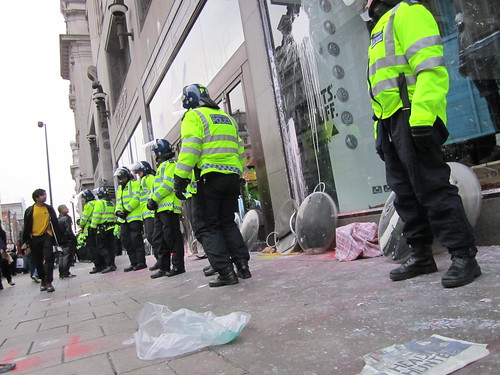
As Hatherley and others have noted, Paris has long had “no-go” underclass neighbourhoods prone to violent car-burning unrest, but they are geographical outliers, their inmates unable to easily attack anything other than the squalor that surrounds them. For more reasons than one could ever list – historical, political, economic – London is marbled with strata of class, the privileged living cheek-by-jowl with the poor. Physical borders would be impractical, expensive… and so Londoners soon learn to unsee those places and citizens who do not belong to their own city. (The same doubtless applies to many British cities, including my own hometown of Portsmouth, which has been so often described as a Northern industrial city that somehow ended up in the South that no one knows who said it first; I dare say it applies in many other countries, too. We’ll notice which ones, soon enough; keep an eye on the headlines.)
There are streets you don’t walk, shops you don’t use, pubs you don’t drink in, people you don’t acknowledge; the borders are powerful, and they cascade down to the scale of individual citizens in fractal complexity, but they only exist only in the collective, by an unspoken consensus. When enough decide to abandon or defy that consensus, a liberating permeability offers itself, and the underlying fragility of the city-as-system is laid bare, its viscera exposed, twitching in the dirt of the street like the victim of a Ballardian mugging. Within the city are many cities, interwoven or entangled, sometimes at detente, sometimes at war; an organism so complex and poorly understood that, as medicines for the body civic, contemporary politics and economics look little more rational than leeching and the balancing of bodily humours. If we have a long-term future as a species, the city will be an ever-larger part thereof; its diseases must be studied, lest we treat only the symptoms while we watch the patient die.
***

Cats are territorial animals, but their conception of territory is four-dimensional. Where a dog works on the theory that its back yard is always its back yard, accessible only to pack-mates (of whatever species, honorary or otherwise), cats make allowances for their greater ability to get past physical obstacles by timesharing their favourite locations. That spot on the corner of the garage roof might be a young tom’s turf until the midday sun makes it more desirable, at which point it becomes the fiefdom of the local bruiser; as the sun moves on, so does the boss, and the residual warmth gets soaked up by someone else; then, at 3am, the whole breadth of the roof might become a hybrid of nightclub, knocking shop and backyard fight venue.
It’s a lot like the way we share cities, isn’t it?
***
Donning our speculative techno-urbanist hats for a moment, we can assume that once augmented reality navigates its way rightwards across the Gartner hype cycle and gains widespread adoption, the post-geographic schisming of physical space will become even more normal, with Miéville’s metaphorical act of unseeing becoming one component of a multitude of possible layered maps of the city. Offended by rotting Brutalism, or the glistening thrust of postmodern monstrosities in the heart of the city? Then choose a layer where they do not exist, and never see them again. Do the same with the homeless, or the rich; choose to swap the iconic London buses for steam-driven robot elephants, or to swap brown skins for a lighter (or a darker) shade; see the city of the Reformation as Sam Pepys would have seen it, bumbling down a side-street to some secret assignation; see the Londons of Warren Ellis and Paul Duffield’s Freakangels, or Ballard’s Drowned World, or Moore’s From Hell; see a city, see any city, see every city. Geography is just the screen, the Canonical City, the hardware on which we run the software of urban life: we project the city on to it, drawing our borders in the gaps as instinctively as we draw the line between me and you, between Us and Other.
A metaphor too far? I disagree; I’ve seen and participated in layerings of exactly that sort in my own home town over the years, and I expect the same happens wherever people may be found – but the complexity of manifestation is a function of population. The layers are cultural, and they’re spooled out in realtime on the wetware between our ears. My city is not the same as your city.
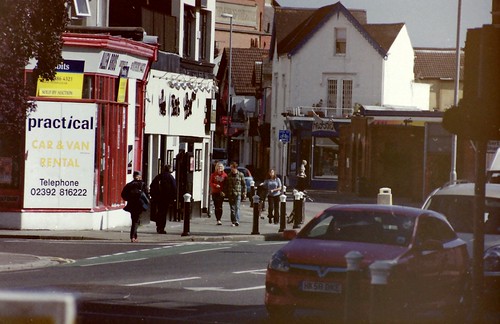
When I walk down Albert Road, nominal main drag of Portsmouth’s unevenly distributed bohemian quarter (as in London, geographical constraints to expansion have led to a patchwork demography), my cultural affiliations and long period of residence determine the things I notice most: the second-hand bookstores; that flat-above-a-shop where I once DJ’d to a full room at 5am on a summer morning in 1996 before the police turned up and impounded the sound system; that guy sat eating lunch by the window of Little Johnny Russell’s, who was in a band that a friend once played bass for; the plastic nick-nacks and Spongebob lunchboxes in the window of Passionfish, one of the few indie stores that’s been a going concern since before I moved here, and which has employed at least a dozen of my friends; and of course the Wedgewood Rooms, the music venue that has employed and entertained a hefty tranche of P-town bohemians over two and a half decades.
Each journey I take has different highlights of attention, of course, but to a tourist passing through on their way to the historic dockyards or the Gunwharf “shopping experience”, it’s just a narrow and somewhat grubby strip of pubs and takeaways, devoid of places to park. Perception is reality. My Albert Road – our Albert Road! – is not your Albert Road, but all the Albert Roads – actual, virtual, fictional, possible – are anchored to that same physical space. You can’t touch the borders, can’t spray your name on them, but you can see them if you sidle up to them just right: try dressing a tad too metrosexual on beer’n’curry Wednesdays at The King’s Arms, maybe, or elbowing your way to the bar of the One Eyed Dog at 10pm on a Friday night while wearing a Square Mile suit.
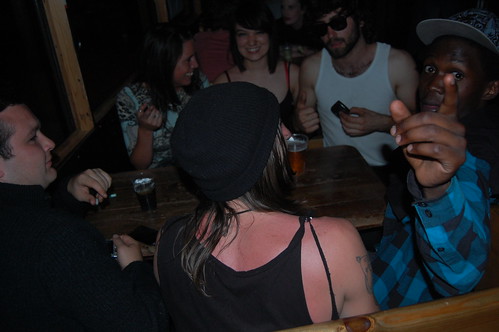
That sharp hard glint of who-the-fuck-are-you in the eyes of the other customers?
That’s your border, right there.
***
For every wall we build in the world, we build one that matches in our hearts.
***
* In the interests of full disclosure, Chris Beckett is a client of mine, but I was a fan of his writing before that was the case.
With the exception of the Conrad Schumann image (which I ganked unashamedly from Wikipedia) the above images are linked to their originals as found on Flickr. The London riot cops were found using the indispensable Compfight search engine; some are my own, and the rest are by my good friend and erstwhile bandmate Rusty Sheriff.

