What’s the Cantonese for “Sprawl”, anyway?

Via Tobias Buckell comes news that China is planning to merge seven cities into one unified industrial-urban megaregion, complete with a high-speed rail transport infrastructure:

The “Turn The Pearl River Delta Into One” scheme will create a 16,000 sq mile urban area that is 26 times larger geographically than Greater London, or twice the size of Wales.

The new mega-city will cover a large part of China’s manufacturing heartland, stretching from Guangzhou to Shenzhen and including Foshan, Dongguan, Zhongshan, Zhuhai, Jiangmen, Huizhou and Zhaoqing. Together, they account for nearly a tenth of the Chinese economy.

I’ll let Tobias put that into perspective for us:

Some online have noticed that pretty soon China will have 260 million or so people all within one hour’s train ride of each other.

Imagine the entire population of the US all being within an hour commute of each other.

Uh-huh.

Conspiracy debunking checklist

Via David Brin, here’s Michael Shermer with a sort of Occam’s Razor checklist for assessing the validity of conspiracy theories.

While some conspiracies are genuine, most of the more popular ones are the result of our very fortuitous evolved ability to extrapolate patterns from limited data sets, which was a great survival tool back in the days when we roamed a savannah full of stealthy fast-moving predators. Its utility has been somewhat limited by the advance of civilisation producing an environment that’s significantly less threat-laden… which is clearly evidence of the Illuminati’s plan to emasculate us and bind us in servitude to defunct Babylonian deities with a taste for blood and gold (and blood-covered gold). Crafty bastards.

Anyway, that checklist:

The more that [the theory] manifests the following characteristics, the less probable that the theory is grounded in reality:

  1. Proof of the conspiracy supposedly emerges from a pattern of “connecting the dots” between events that need not be causally connected. When no evidence supports these connections except the allegation of the conspiracy or when the evidence fits equally well to other causal connections—or to randomness—the conspiracy theory is likely to be false.
  2. The agents behind the pattern of the conspiracy would need nearly superhuman power to pull it off. People are usually not nearly so powerful as we think they are.
  3. The conspiracy is complex, and its successful completion demands a large number of elements.
  4. Similarly, the conspiracy involves large numbers of people who would all need to keep silent about their secrets. The more people involved, the less realistic it becomes.
  5. The conspiracy encompasses a grand ambition for control over a nation, economy or political system. If it suggests world domination, the theory is even less likely to be true.
  6. The conspiracy theory ratchets up from small events that might be true to much larger, much less probable events.
  7. The conspiracy theory assigns portentous, sinister meanings to what are most likely innocuous, insignificant events.
  8. The theory tends to commingle facts and speculations without distinguishing between the two and without assigning degrees of probability or of factuality.
  9. The theorist is indiscriminately suspicious of all government agencies or private groups, which suggests an inability to nuance differences between true and false conspiracies.
  10. The conspiracy theorist refuses to consider alternative explanations, rejecting all disconfirming evidence and blatantly seeking only confirmatory evidence to support what he or she has a priori determined to be the truth.

Just for fun, why not run this checklist aginst the “anthropic climate change is a manufactured hoax!” theory? We could make it into a game – first one to ten-out-of-ten is a cat’s-paw to the Left-Marxist conspiracy for the advancement of a less convenient world!

Publishing and piracy: more Mamatas

How timely! An SF Signal Mind Meld post on “the future of publishing”… featuring a rather dystopic but all-too-plausible worst-case-scenario from Cheryl Morgan, and another serving of brutal truth from Nick Mamatas:

Piracy will always be with us, and in the end it’ll just be figured into the cost of doing business; ebook prices will come down to a more reasonable level and piracy will be a problem along the lines of shoplifting. Writers will be more likely to license World English rights rather than territorial rights for their books to make them more widely available to readers who pirate out of fannish desperation.

I also anticipate at least one of the major publishers crumbling back into its component imprints, which will actually be a good thing–indeed, it’ll be the thing that will allow ebooks to come down to the $3-5 price range. There’s a lot of whining about how print costs are only 10% of the cover price of a book, so ebooks prices can only sink so low, but the plain fact is that publisher overhead, specifically in the forms of Manhattan real estate and payouts to distributors with giant warehouses, are both utterly superfluous and easily eliminated. The major houses are pigs and some of them are going to die.

[…]

It won’t be bad, unless you’re one of the few people making money right now with mindless hackwork. If you are the 2010s will be your decade to suffer as the rest of us have suffered these past thirty years.

Ouch. Compare and contrast to Gordon Van Gelder’s “I dunno” shrug, which – while honest – smacks more than a little of an ostrich impersonation; F&SF, I’d remind you, still doesn’t accept electronic submissions.

The World sinks into the sea

Another installment in what seems to be an emergent and ill-defined thematic series of Bubble-era vanity projects decaying in the wake of Collapsonomics! Even more ambitious and hubristic than Japan’s Huis ten Bosch, Dubai’s artificial entertainment archipelago, modestly named “The World”, is crumbling away amidst contractual wranglings and other forms of development hell:
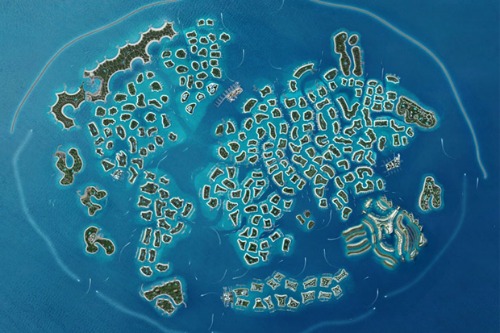
The World, Dubai

According to evidence cited before a property tribunal and discovered by the Telegraph, “erosion and deterioration” of the World has been found, with state-run developer Nakheel admitting that the project is “in a coma”. Graham Lovett, speaking on behalf of Nakheel in the tribunal, said: “This is a ten-year project which has slowed down,” but maintained: “this is a project which will be completed.”

Nakheel is part of Dubai World — the conglomerate owned by the gulf state — which was bailed out of $25 billion worth of debts at the end of 2009. The tribunal was set up to hear the cases that emerged from the separation of the companies involved. One of those companies is Penguin Marine, who bought the rights to offer boat travel to the islands — of which all but one are uninhabited. (Greenland, if you’re curious.)

Although Nakheel claims that 70 percent of the islands have been sold, investors have had trouble financing any further work. As a result, while Penguin Marine is paying a million dollars a year to Nakheel, it’s getting very little business, so is trying to exit the contract.

Penguin claims that work on the islands has “effectively stopped”, with Richard Wilmot-Smith, speaking on behalf of the company, telling judges in the tribunal that the islands’ sands are eroding and that the channels between them are silting up. Nakheel disputes this, saying: “Our periodical monitoring survey over the past three years didn’t observe any substantial erosion that requires sand nourishment.”

Now there’s a setting for a novel… where are you, J G Ballard, now that we need you the most?

Presenting the fact and fiction of tomorrow since 2001