This topic started brewing in my head at Worldcon in Montreal, as I sat in on a panel on 3D printing by Tom Easton. 3D printing isn’t new to me, and the speed at which it’s advancing shouldn’t have been a surprise. However, it did shock me a bit. I found myself dreaming of 3D printers for a few days. After all, I could already buy one. Continue reading 3D Printing: a world of design
Tag Archives: 3D-printing
Welcome to the 3D economy
 Jamais Cascio appears over at Fast Company once again, this time talking about the desktop manufacturing revolution, which seemingly becomes a less science fictional prospect by the week. The shift in plausibility is noticeable in the concerns raised: consider a still-distant technology like nanoassemblers or sentient AI, and you’ll get the species-killer existential risks – grey goo, say, or a hard unfriendly singularity. Ubiquitous fabbing is inevitable enough to be raising more realistic and (by comparison) small-scale concerns… like what the hell it’s going to do the economy. [image by Zach Hoeken]
Technologies that shift production from being atom-dominated to being bit-dominated tend to follow similar trajectories. With both laser printers and, later, CD/DVD burners, the first wave of “creative destruction” came when the prices dropped to the level where the devices were affordable by small businesses; the second, bigger wave came when the prices dropped to a level affordable by general households. Now, laser printers and CD/DVD burners are just about free in a box of cereal–and, for many of us, the production and consumption of text documents and music has moved to entirely digital formats.
If 3D printing follows a similar trajectory, we may not be likely to see a massive shift to entirely digital “products” any time soon, but we could well see a shift to more local–even desktop–production. There’s no guarantee, of course, that 3D printing system prices will crash in the exact same way as laser printers, or that individual households will decide that desktop manufacturing is appealing. Local manufacturing seems a good bet, however, for a variety of reasons. There’s a particularly strong sustainability argument around local manufacturing, from the rising tide of “localism” philosophies (from food to media), to the ability of 3D printing to extend the useful life of manufactured goods by making new parts (as Jay Leno does for his vintage cars). The sustainability argument will become especially powerful once cheap overseas-produced goods reflect rising costs for fuel and carbon. And local manufacturing via 3D printing, even if limited to simple consumer items, has the potential to disrupt incumbent manufacturing, shipping, and retail industries.
If we do see 3D printing follow the footsteps of laser printing, however, the results could be profound. Desktop manufacturing offers the potential for the ultimate “maker” culture, where commercial products are bought off of iTunes-like online stores and printed at home, while eager hardware hackers play with design tools and open-source hardware systems to make entirely new material goods. Lurking in the background, of course, is the potential for design piracy — what one writer termed “napster fabbing,” back in the era when Napster was scary.
It remains to be seen what actually happens, but severe disruption of the status quo is pretty much a given. What do you think – will ubiquitous fabbing usher in a utopian future of happy people making interesting stuff, or a world crammed with cheap and poorly-made junk?
Fabbing becoming price-competitive
Via Fabbaloo comes news that big businesses are starting to wake up to the savings they can make with 3D printing and rapid prototyping technology. Granted, this is a press release from a company that makes 3D printers, but the solid numbers that they’re quoting with respect to shoe giants Converse speak more loudly than the corporate back-patting:
Converse says its ZPrinters can produce a shoe model in two hours, or nearly 30 times faster than an ABS printer. ZPrinting has also helped:
- Eliminate eight annual trips to Asia for design consultations at a cost of up to $12,000 per person for each trip;
- Cut tooling costs from $350,000 in 2006 to $150,000 in 2008 by using ZPrinted models to winnow designs; and
- Transform the way the company does business by bringing 3D shoe models to key accounts and producing models on demand.
“We’re seeing new prototypes in hours and cutting weeks off our design cycle,” said Bryan Cioffi, manager of digital product creation at Converse of N. Andover, Mass, USA. “Last night’s sketches become tangible color models that we can pass around at this morning’s meeting. Our ZPrinter has become a prototyping center in its own right, and it’s helping us get better products to market more quickly for less money.”
That technology is itself becoming cheaper by the month, so we can expect many other manufacturers to clamber aboard the fabbing train as they attempt to rebuild after the economic slump.
But that same capability may actually spell the doom of corporate giants like Converse. After all, when every town has a 3D print-shop, why pay Converse for a new pair of trainers that they’ve designed when you can just clone their basic design files from a torrent, make some unique tweaks and print out a custom sneaker of your own for a comparable (or perhaps even lower) price?
The fabbing economy looks just fine
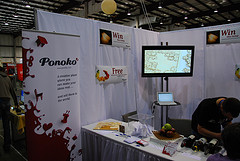 Despite the desperately fixed-grinned hand-waving from Downing Street and Washington, signs of economic improvement seem pretty scarce on the ground.
But commercial fabbing company Ponoko seems to be doing fine – so fine, in fact, that they’re trying to draft volunteers to help them keep up with explosive demand at their new San Francisco outlet. [image by tom.arthur]
In response, Fabbaloo asks whether “we hear the sound of the 21st century industry emerging” – and while it’s too early to be sure, I think they may be right.
New resin for growing flesh
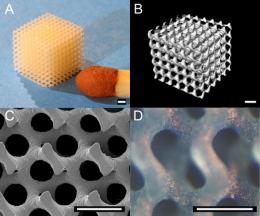 Researchers at the University of Twente have developed a biodegradable resin that can be used to create precise replicas of forms within the body around which new tissues can be grown:
The resin can be given different properties depending on where in the body it is to be used. Cells can be sown and cultured on these models, so that the tissues grown are, in fact, produced by the body itself. The new resin has been developed by Ferry Melchels and Prof. Dirk Grijpma of the UT’s Polymer Chemistry and Biomaterials research group. An article on this breakthrough will be appearing in the authoritative specialist journal, Biomaterials
The method used to recreate the specific forms is called stereolithography, the improvement in this system is that the resins have hitherto not been biodegradable. This means:
If, for example, a child has a heart valve disorder, a 3D digital image of the heart valve can be created using a CT scanner. The model in the stereolithograph can be copied exactly with the new resin. If the structure is made porous, the child’s own cells can be placed on it. This porosity also gives nutrients access to the cells. Ultimately, after the carrier structure has broken down, only the natural tissue remains.
Which is a rather wonderful development.