Tag Archives: agriculture

Your vat-grown burger will be ready in a decade, sir

brunch burgerWe’ve mentioned the potential of vat-grown meat here before, but I thought it worth bringing up again in light of an article at Wired UK that goes into more technical detail about the processes involved in growing cultured muscle for human consumption. [image by Marshall Astor]

“We’re developing a very simplified version of what we know as meat,” he explains. “The cells are grown in this dish within a growing medium and this unit is where they receive the electrical stimulation. These electrodes ensure there is an electrical current – about 1Hz – passing through the cells. To make these skeletal cells develop into muscle, they need to be constantly exercised, just like in the body.” This, he explains, is one of the scientific hurdles for in vitro meat that has not yet been fully addressed. “We can convert stem cells into skeletal muscle cells; however, turning them into trained skeletal muscle appears to be a little harder.”

They seem pretty confident about having a commercially viable product within a decade or so… but it’s probably going to delight the tastebuds about as much as the food you get on budget airlines:

“I don’t think we will spend a whole lot of time trying to replicate the taste of meat, though – that will be artificially added later. The food industry is already expert at enhancing taste – creating the right texture is the Holy Grail.”

Why complicate matters, adds Post, when you can nurture skeletal muscles to produce a simple, lean meat? Strip away the connective tissue, blood vessels and fat – as many of us do when we prepare a chicken breast prior to cooking it – and you’re left with a lean fillet of meat which consists of, roughly, 75 per cent water, 20 per cent protein and three per cent fat. Post believes that we are not too far away from producing this kind of meat on a commercial scale – ten years, perhaps. Convincing in vitro steaks and chops are probably a few decades away.

I guess the problem here is that the stuff will never sell until it comes out cheaper than real off-the-hoof meat. Once that price point is reached, however, I suspect the take-up rate will skyrocket.

Bucky Fuller would be proud: geodesic urban agri-architecture

We’re starting to see a lot of these urban agriculture concepts cropping up (arf!); the Plantagon is (or, rather, might be) a geodesic dome containing a spiral ramp covered with fresh-grown foodstuffs, and its designers believe its food output would pay for its construction.

Plantagon: geodesic urban greenhouse

According to Plantagon, the farm “will dramatically change the way we produce organic and functional food. It allows us to produce ecological [food] with clean air and water inside urban environments, even major cities, cutting costs and environmental damage by eliminating transportation and deliver directly to consumers. This is due to the efficiency and productivity of the Plantagon greenhouse which makes it economically possible to finance each greenhouse from its own sales.”

No word on how exactly the Plantagon system works, but the company says that consulting engineering firm Sweco has helped untangle the technical kinks of the project. Plantagon hopes to have its first vertical farm up and running within three years.

Call me cynical, but I doubt the Plantagon as it appears here will ever make it into production. That said, the sheer number of urban agriculture concepts that are being kicked around at the moment suggests that there’s enough interest in the idea for it to become a reality at some point in the relatively near future… once pragmatism and the harsh economic truths of the world beyond the drawing-board brainstorm have shaved down the budgets a little bit, perhaps. [image by Plantagon]

Or maybe the construction of urban farms will be started in blazes of publicity and viridian glamour, only for the funding to be pulled (or embezzled, or just plain “lost”) half-way through, leaving huge Ballardian lumps of unfinished futurism lying around on the urban landscape, waiting to be colonised and turned into squelettes

GM crops and the war on poverty

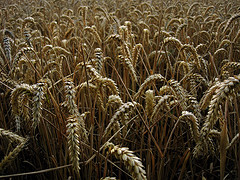
field of wheatOver at The Guardian, Professor Mark Tester stands up to say that genetically modified crops are an essential component of the struggle to erase world poverty and hunger:

GM crops are not the answer to this shameful global situation, but I argue strongly that they provide another tool, another option to try to address the problem. And I do not think those of us sitting in comfortable wealth have a right to deny people the opportunity to improve their production of food. The technology is just that, a technology. Like nuclear technologies (radiotherapy or nuclear weapons) or mobile phones (communication or bomb triggers), how we use it is the main issue. I hope that the plants we have generated provide a subtle use of GM technology that will allow some positive benefits for the developing world.

He’s quite correct, of course; as we mention here quite often, the morality of a tool comes from the hand that wields it. And therein lies the rub: while GM crops have the potential to improve the lives of those less fortunate than ourselves, they can also be (and allegedly are) used to paint them into an economic corner for the purposes of maximising profits – selling farmers the only seeds that will survive the pesticides which you also manufacture, for example. [image by James Wheare]

I don’t know how it is in the States, but here in the UK GM crops are a hugely sensitive topic with a sharp polarity of opinion that has been amplified by propaganda, celebrity campaigning and emotional button-pushing from both sides of the debate. Such extreme viewpoints actually end up clouding the issue; somewhere in the shades of grey is a way to use genetic modification safely for the benefit of everyone, but until we start meeting each other half way we leave the field wide open for both poverty and profiteering to continue.

Back to the land for Japan’s newly unemployed?

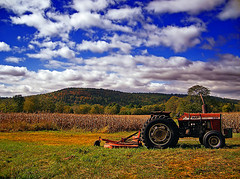
tractor on farmlandTimes are tough all over the world thanks to the economic implosion, and Japan is definitely feeling the pinch of its worst recession since the post-war years.

One of the proposed solutions is to funnel the growing number of recently unemployed back into the agricultural sector, which is predominantly comprised of an aging demographic; going ‘back to the land’ seems to hold a certain nostalgic romance for the urban dispossessed, but it’s a tougher gig than many of them expect it to be:

Despite the popularity of the training programs and of the government’s longer, one-year farm internships, many young people end up returning to cities, unable to adjust to life in the countryside. Last year, Fukiko Oshiro, a farmer in western Okayama prefecture, hired five workers from cities like Osaka, including a couple of former salesmen, to work at her nursery and fruit farm. She said she has already lost three of them.

“These young people think it’s their right to come and impose on us,” said Ms. Oshiro as she surveyed her busy farm stand recently. “They have no idea how much work we put in to teach them.”

I remember a similar romance with simple lifestyles lived close to the land emerging in the wake of the recession of the early nineties here in the UK; I suppose it’s inevitable that when modern life lets you down you start looking for alternatives, and looking backward is always easier than looking forward.

Japan’s aging agricultural sector may have the need (if not the desire) for an influx of new young hands, but in places like the UK and the US things are very different; I can’t see either government coaxing young people back into the fields as a solution to unemployment. But perhaps that urge for a simpler life will express itself in other ways – remember the small footprint communes setting themselves up in the bargain-price foreclosed properties of Detroit?

There’s plenty of land out there – more so in the States than the UK, granted, and not all of it suited to being lived on – and it may tempt people with the old dream of self-sufficiency. But that dream tends to pass over the degree of sheer physical labour that the lifestyle demands, alongside the other pressures that are slowly driving us towards wholesale urbanisation; many may still decide to try, but few will stay the course, perhaps.

Is self-sufficiency a dated idea unsuited to a networked globe, or does it still have valid lessons for us? [via MetaFilter; image by Nicholas T]

A cure for honey bee colony depopulation syndrome (a.k.a. colony collapse disorder)?

799px-Honeybee-cooling_cropped This could be encouraging news (via Science Daily):

For the first time, scientists have isolated the parasite Nosema ceranae (Microsporidia) from professional apiaries suffering from honey bee colony depopulation syndrome. They then went on to treat the infection with complete success.

In a study published in the new journal from the Society for Applied Microbiology: Environmental Microbiology Reports, scientists from Spain analysed two apiaries and found evidence of honey bee colony depopulation syndrome (also known as colony collapse disorder in the USA). They found no evidence of any other cause of the disease (such as the Varroa destructor, IAPV or pesticides), other than infection with Nosema ceranae. The researchers then treated the infected surviving under-populated colonies with the antibiotic drug, flumagillin and demonstrated complete recovery of all infected colonies.

More information on Nosema ceranae can be found at Bees for Development, which notes:

In short, we demonstrate that Nosema ceranae probably jumped host from Apis cerana to Apis mellifera within the last decade and that it has spread remarkably rapidly. It is found nowadays in the western honey bee in North and South America, the Caribbean, across Europe (from south to north and west to east) and Asia. Only on the islands of Ireland and New Zealand have we looked but found only Nosema apis. We lack samples from Africa, Australia and the UK to state anything about those locations. However, given its rate of spread and occurrence even on isolated islands of the Danish archipelago, it is quite possible that Nosema ceranae is, or will soon be, spread worldwide.

The new Spanish study can be found here.

There has of course been a huge debate over what could be contributing to the depopulating of honey bees (with cell phone radiation one of the more “out there” proposals), a serious concern because of the important role the bees play in the pollination of crops, fruit and wild flowers. This is the first time this particular parasite has been identified as the primary cause of the problem in professional apiaries, and the fact those apiaries were successfully treated is encouraging. As the principle researcher, Dr. Mariono Higes (who has been exploring the connection between Nosema ceranae and colony collapse disorder for several years), puts it, “Now that we know one strain of parasite that could be responsible, we can look for signs of infection and treat any infected colonies before the infection spreads.”

Of course this doesn’t mean that other factors could still be at play, but solving even a part of the problem is an encouraging step forward.

(Image: Wikimedia Commons.)

[tags]bees, colony collapse disorder, biology, parasites, agriculture[/tags]