Tag Archives: computer games

Grand Theft Auto IV – Exploring the Mundane

Blasphemous Geometries has turned its attention to computer games, and for its first foray into that sphere Jonathan McCalmont takes a look at the hugely popular Grand Theft Auto IV. How does its reproduction of life’s bitter mundanities strengthen its appeal, and what does that say about the reality it reflects?

Blasphemous Geometries by Jonathan McCalmont

###

As the first Blasphemous Geometries column to look at an individual video game, it makes sense for me to start at the top with one of the fastest-selling games of all time. Grand Theft Auto IV is, paradoxically, the sixth game to appear in the series and the eleventh game to appear as a part of the wider GTA franchise. Since its release in April 2008 it has been festooned with awards and prizes and it remains one of the highest ranking games to feature on the net’s various review aggregation sites. It is not my intention today to toss another garland onto the already swollen heads of the GTA IV developers; instead, I want to use the game to demonstrate an idea. Continue reading Grand Theft Auto IV – Exploring the Mundane

Post-postmodern fiction? Dear Esther, and game engines as narrative engines

We were talking just a few days ago about the narrowing gap between traditional storytelling and computer games. Well, here’s something that seems to have bridged the two to create a hybrid artform: Dear Esther is a Half-Life mod that’s a sort of first-person virtuality narrative with a degree of interaction but no ‘traditional’ gameplay goals.

Dear Esther screenshot

Lewis Denby guests at Rock Paper Shotgun, and explains the potential of level modding for new expressions of creativity:

In a way, that it would be this sort of amateur creation to have such an effect makes sense. The mod scene has the potential to be a land of limitless creative opportunity. You’re not restricted by publishers’ requests, or the demands of your perceived audience, or your own barely competent technology. You’ve an enormous blank canvas to paint on, and all that holds you back is your imagination.

The real big deal here, though, is that 3D game engines can theoretically produce experiences that film, audio and the written word combined still fall short of; the interactive element is the key, producing a sense of emotional engagement that a ‘static’ work cannot replicate. Back to Denby, who suspects it’s the untapped potential for producing a negative emotional response that’s important:

I love my Marios and what-have-you as much as the next person, but I still feel games have an incredible untapped potential for negative emotions. Some have tried – Braid stands out for having a bloody good go – but we’re still a little too comfortable with enjoying everything we play. Any stretches of sadness in this medium tend to be restricted to self-indulgence or vapid tearjerker fare, and even they invariably make way for happy endings and bunny fluff.

Dear Esther rejects pretty much every notion of what videogames should do, and instead presents a profound look at what they could be doing. They could be telling stories that, while unforgiving and upsetting, exist within a format that no novel or film could ever reproduce. Stories that take clever audiovisual amalgamation for granted and go the extra mile, allowing the player to explore a tangible world that they would never otherwise be able to visit. In a sense, Dear Esther is pretty much non-interactive: nothing you do changes the course of the fiction, and there’s no element of challenge to speak of. But in another, far more accurate sense, the interaction is totally key. It’s your journey – whoever “you” are – and the intimacy heightens every emotion censor in your poor, overloaded brain. After watching me finish Dear Esther, my girlfriend asked me what it was I’d been playing. I turned to answer her, only to find I couldn’t speak. No words arrived. None mattered.

Of course, not everyone will want a harrowing immersive experience – think of the number of people who bemoan the lack of happy endings in modern novels – but there’s nothing to say that the form has to be negative in character. But it’s that potential, that opportunity to produce and manipulate both ends of the emotional spectrum, that demonstrates we have yet to see even the infancy of this hybrid artform.

I rather suspect that this could provide a great way for powerful fiction writers to reach a massive new audience that traditionally ignores dead-tree media. Who knows – it might even usher in a return of the writer as something more than a small-font credit line at the end of a movie or TV show. [via BoingBoing; Dear Esther screensot borrowed from Rock Paper Shotgun under Fair Use terms, please contact for immediate takedown if required]

Charles Stross on the future of gaming

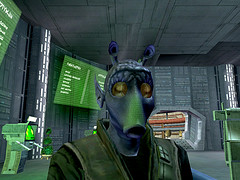
Star Wars MMO game screenshotThe Zeitgeist strikes again – it appears that this week is going to throw up lots of stuff about computer gaming. Here’s a counterpoint to Sven’s dispatch; a transcript of a keynote speech that Charlie Stross gave to the LOGIN 2009 games industry conference yesterday.

In the next five years we can expect semiconductor development to proceed much as it has in the previous five years: there’s at least one more generation of miniaturization to go in chip fabrication, and that’s going to feed our expectations of diminishing power consumption and increasing performance for a few years. There may well be signs of a next-generation console war. And so on. This isn’t news.

One factor that’s going to come into play is the increasing cost of semiconductor fab lines. As the resolution of a lithography process gets finer, the cost of setting up a fab line increases — and it’s not a linear relationship. A 22nm line is going to cost a lot more than a 33nm line, or a 45nm one. It’s the dark shadow of Moore’s Law: the cost per transistor on a chip may be falling exponentially, but the fabs that spit them out are growing pricier by a similar ratio.

Something like this happened, historically, in the development of the aerospace industry. Over the past thirty years, we’ve grown used to thinking of the civil aerospace industry as a mature and predictable field, dominated by two huge multinationals and protected by prohibitive costs of entry. But it wasn’t always so.

Go read the whole thing; Stross swiftly and plausibly draws a line from the present to the future two decades hence, a future where the audience demographics for gaming have shifted to include the vast majority of the population, and the technology platforms that games run on are small, portable and ubiquitous. [image by st3f4n]

The future of fiction is games

computer game end-screenWe’ve already heard arguments to the effect that computer games could become the ‘new frontier’ for fiction writing and storytelling, but they’ve usually come from the games or fiction communities themselves. It seems the idea is starting to get some traction beyond the ghettos, though – here’s a reviewer at the Daily Telegraph responding to a new game based on Dante’s Inferno:

Dante’s Inferno may not herald a new era in literary gaming, but connoisseurs of story could do worse than watch the area for developments. A recent survey of American teenagers revealed that 97 per cent of the consumers of the future now play video games.

What’s more, certain independent games are entering a phase – familiar to historians of jazz, comics and indeed 20th-century literature – of vigorous experimentation with techniques of narrative. (An evening with the frightening and baffling The Path, rather like an Angela Carter story siphoned through The Sims, will show you what I mean.) And with book sales falling, it may not be long before prose writers jump ship for a medium that offers some of the most exciting possibilities of the new century.

It’s happened before. Veterans of home computing in the Eighties and Nineties may recall knotting their brows over the game of The Hitchhiker’s Guide to the Galaxy, written by Douglas Adams himself. Adams also wrote Bureaucracy, a game in which the paper-shuffling protagonist’s most pressing task is to avoid succumbing to a brain haemorrhage from stress. And the veteran sci-fi novelist Harlan Ellison delivered I Have No Mouth, and I Must Scream, a game whose vision of eternal torture remains more shocking than most of its high-resolution descendants.

No surprise to see science fiction writers cropping up in the discussion – though whether that’s because they’re generally a more forward-thinking type of writer or because they’ve always had to struggle to find new markets is a moot point.

And, of course, computer gaming is still a medium in its infancy by comparison to the novel, song or poem – not to mention one that inherently has vast potential to absorb other media into itself. It doesn’t take a huge mental leap to imagine much of the consumer media we enjoy today being reparsed into more interactive forms; my only hope is that is doesn’t shake down to the levels of banality that tend to define television, the previous game-changing media technology. [image by blakespot; story via TomorrowMuseum]