Tag Archives: crime

Gross $4,000 a day with Viagra spam

Ever wonder why the flood of emails plugging funny-shaped blue pills for gentlemen shows no sign of relenting? The simple answer is that enough people keep clicking on them to make it an extremely lucrative business – according to Ars Technica, a detailed trawl of sales ledgers reveals that pharmaceutical affiliate spam networks can pull in $4,000 a day of orders:

Samosseiko discovered a wide-open PHP backend to GlavMed that contained evidence that the company is indeed set up to benefit largely from spammers. This involves e-commerce software for spammers to launch their own GlavMed copies or to simply set up domains that redirect to GlavMed. Additionally, some of the documents Samosseiko discovered were sales records, giving a glimpse into the purchasing behavior of GlavMed’s targets.

According to the sales records from GlavMed, there were apparently more than 20 purchases per day per spam campaign, with GlavMed claiming a 40 percent commission on each sale. With an average purchase of around $200, that adds up to over $4,000 total per day per campaign (or $1,600 for GlavMed).

Those are the sort of figures that would make even the most moral code-monkey think hard about trading in their sysadmin cubicle for the easy life. It’s abundantly clear that no amount of effort is ever going to stop people clicking on spam emails, and while the market is willing to line people’s pockets to the tune of hundreds of dollars a day they’re not going to stop coming… all the while funding other organisations with more nefarious aims and purposes.

This also highlights the problem with nation-states in a networked world restricting certain products and services to their citizens, as recent adventures in attempting to restrict online gambling sites has demonstrated. As geography continues its slide into irrelevance, attempting to ban something that’s openly available anywhere else in the world becomes an exercise in bombastic futility that does little beyond undermining your credibility and authority.

Perhaps opening up legal avenues for the purchase of the more popular and controversial pharmaceuticals is the answer? After all, serious thought is being given to relaxing prohibition on more dangerous drugs as it becomes clear that their restricted availability plays into the hands of criminals… why not make the drugs safer for consumers by controlling quality and distribution, and hobble an easy income stream for the underworld?

That said, there’ll always be something that people want to buy but can’t; I guess it’d be a case of finding where the tipping point between easy profits and risk of operation is. Then all we’ll be left with are dodgy refinancing offers and invitations to see fallen pop stars in the buff…

So, how long is it going to be before I have to lock the comments on this post to block the flood of pingbacks? Place your bets, ladies and gents, place your bets…

Dutch prisons to close; not enough inmates

prison cell doorThe recession’s hurting all sorts of industries, it appears – the Dutch Justice Ministry has announced its intentions to close some prisons and slash 1,200 jobs, because there just aren’t enough criminals top fill the cells.
During the 1990s the Netherlands faced a shortage of prison cells, but a decline in crime has since led to overcapacity in the prison system. The country now has capacity for 14,000 prisoners but only 12,000 detainees.

Deputy justice minister Nebahat Albayrak announced on Tuesday that eight prisons will be closed, resulting in the loss of 1,200 jobs. Natural redundancy and other measures should prevent any forced lay-offs, the minister said.

The overcapacity is a result of the declining crime rate, which the ministry’s research department expects to continue for some time.

Apparently they’re considering importing detainees from Belgium in order to keep the jobs open… perhaps we’ll see more outsourcing of prison services in the years to come? Steal a car, see the world…

What differences in prisoner conditions might exist between countries with more incarceration than they can handle and those with space to spare? What underlying attitudes or legal frameworks are contributing to that lowering crime rate, and how might they manifest in the prison industry, if at all? [image by abardwell]

It’s also interesting to note that I’m currently sat in a country whose prison system is full to bursting and whose crime rate is allegedly spiralling, but the Netherlands is the country with the relaxed attitude to soft drugs like cannabis – isn’t that exactly the opposite of the way the legislators tell us these things should work?

Recycled plastics make crims harder to catch

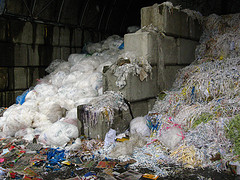
heaps of plastic for recyclingThe increasing prevalence of recycled plastics in the manufacturing industry – doubtless due in part to the currently-struggling Chinese trash-trawling industry – means that a lot of everyday objects are now made from what you might call “mongrel plastics”, a blend of different chemicals with similar physical properties. Which is good news… unless you’re a detective who needs to lift fingerprints from the stuff, that is.

The recycled products may look similar, but the physical and chemical properties differ so widely from the plastics they replace that the techniques honed over recent decades to lift fingerprints off plastics are no longer effective, he says.

Traditionally plastics were made from just one or two chemical building blocks, arranged in a predictable structure. But even plastics with just a trace of recycled feedstock become much more complex. Although consumers are encouraged to separate their plastics for recycling, the resulting plastics are inevitably more of a mongrel product than the pedigree plastics they replace.

Now there’s a nice little rogue state niche industry waiting to be exploited – custom mongrel plastics that defy forensics efforts. The cost of hiring an out-of-work plastics geek would be offset by the higher prices you could charge to your secretive customers. [image by meaduva]

Crowdsourced crimebusters – first border-jumpers, then bank robbers

We’ve already seen how the public has been drafted in to help bust people trafficking across the US/Mexico border; turns out that law enforcement agencies in Arkansas and Texas are using web mashups to enable members of the public to track down the perps of other forms of crime:

Law enforcement agencies have longed relied on the press and the public to help catch crooks, of course. And some departments, like the NYPD, upload their “wanted” posters. But BanditTrackerArkansas.com — and its sister site for Texas, BanditTracker.com — are a little different and a little more sophisticated. Descriptions of the suspect and the crime are paired with pictures from the bank’s surveillance cameras, both indoor and out. The whole thing is then plotted on a Google Map.

The scheme seems to be in its infancy at the moment, but I doubt it’ll stay that way for long; budget restraints will mean a continued shortage of law enforcement officers, but there’ll probably be no shortage of people willing to do their bit to nab the baddies.

Somehow, I find this a lot less sinister than the border-watch systems; it smacks of a more honest sense of community. That said, it also has greater potential for some quick and dirty hacking, whether it be to protect a criminal from pursuit or to frame someone innocent…

Democracy and punishment – Asian executions and Czech castrations

gallowsNew Scientist ponders whether the arrival of true democracy will put executioners out of business in Asia:

The biggest obstacle to ending executions in Asia is politics, not culture. Often, the trigger for a decline in capital punishment is a degree of democracy and an easing of authoritarianism.

[snip]

… this suggests that the main explanation for high execution rates in certain Asian countries is the authoritarian politics of their leaders. As the region continues to develop and become more democratic, we expect the executioner to become a vanishing species.

That, of course, presumes that the move toward more democratic government is universal and irreversible; that’s not a bet I’d be keen to make until I’ve watched the economic events of the next decade or so, personally.

Capital punishment may be on the decline overall (at least officially), but over in Europe the Czech Republic has caught the attention of other countries with its policy that allows judges to sentence certain types of sex offender to chemical castration. The Council of Europe defines it as a form of torture, but other lawmakers aren’t so keen to exclude it from the statute list permanently:

The Czech Republic has allowed at least 94 prisoners over the past decade to be surgically castrated. It is the only country in Europe that uses the procedure for sex offenders. Czech psychiatrists supervising the treatment — a one-hour operation that involves removal of the tissue that produces testosterone — insist that it is the most foolproof way to tame sexual urges in dangerous predators suffering from extreme sexual disorders.

[snip]

Now, more countries in Europe are considering requiring or allowing chemical castration for violent sex offenders. There is intense debate over whose rights take precedence: those of sex offenders, who could be subjected to a punishment that many consider cruel, or those of society, which expects protection from sexual predators.

Punishments of all types raise questions of societal ethics, and with a subject as sensitive as sexual crimes it’s inevitable that opinions are going to be sharply divided. At the risk of channeling Focault for a moment, though, I’d point out that there’s a connection between executions in the Far East and chemical castrations in central Europe – they’re both ways of appealing to (and manipulating) mob sentiment. Given the threat of global political instability in the near future, I suspect we’ll be seeing more physical punishments on statute books, not less. [latter story via MetaFilter; image by Scott Clarke]

At what point does a mutilation become a just punishment? Is chemical castration going to be more effective at preventing sex offences, or making it look as if something is being done about sex offences?