
Tag Archives: culture

Doug Rushkoff blogging at BoingBoing

Douglas RushkoffThose of you who follow the Double-Boing may have noticed that they’ve started getting guest bloggers on board again. This week sees a visitation from Douglas Rushkoff; there are few thinkers and writers that I would recommend without reservation, but Rushkoff is one of them. [image from biography page of Rushkoff’s website]

He’s written (sometimes with great influence) on politics, cyberculture, religion, ethics, finance, viral marketing, reality hacking and all sorts of other stuff, and he never fails to come up with something challenging. So if you’re not a regular BoingBoing reader, I’d suggest grabbing the RSS feed, if only for this week. Here’s a snippet from his ‘Open-Source Democracy’ post:

Back when everyone was thinking about digital democracy as some sort of voting scheme or mass feedback polling operation, I wrote a short book called Open Source Democracy in an effort to extend people’s thinking beyond elections to include participation in civics. Yes, we have representatives, but they’re only good as their ability to respond to the needs that come from the bottom up.

Rushkoff’s a blogger in his own right, and a novelist too. More recently he did an excellent comic-format series on DC Vertigo called Testament – Old Testament fables meet dark near-future corporate dystopia. Recommended.

Dreaming about Sarah Palin

palinWe live in such a media-saturated age it’s rather surprising that we don’t have shared dreams more often. Because it’s Friday afternoon where I am, here’s a link to a Slate.com’s Your Dreams (and Nightmares) About Sarah Palin: She hands you a $20 bill. She marries you. She tells you to kill all the animals in the zoo. She’s your barista.
It’s a highly nonscientific (a-scientific?) survey of dreams readers have had since — Sweet Gene Vincent, was it only a week ago(Disclaimer: I have not had a dream about Sarah Palin.) My favorite from the Slate article (hardly the most Freudian of the batch, either):

“In my dream, I was with a group of people watching the election results on television. However, pundits weren’t announcing the results. Both candidates and their VP picks were sitting on two couches in a room full of journalists/pundits. McCain and Palin were on one couch, and Obama was on his couch with his VP pick, but it wasn’t Joe Biden, it was a woman in an emerald-green ball gown. In a way she resembled Doris Kearns Goodwin. What stood out to me is how insignificant McCain appeared. All attention, a spotlight even, was on Palin. It was like McCain was a sad old man on a park bench, and Palin was just soaking up all of the energy in the room. She seemed to be a magnet for all of the energy in the room—a bit like a Dementor from Harry Potter. Obama and his Doris Kearns Goodwin look-alike VP were also relatively insignificant, but not as much as McCain. Obama smiled graciously the entire time. At some point, Tim Russert‘s disembodied head appeared through a doorway in the room where I was, and I started to cry. Tim didn’t say anything, he just floated there observing the group. One of the journalists/pundits in the room was overheard whispering, ‘It’s McCain!’ It wasn’t an official announcement, but he let it slip, and it was true—McCain won the election.

“But McCain just sat there not moving. Palin stood up and started queen-waving. Obama got up to shake her hand—graciously—and Doris Kearns Goodwin sat on her couch, as I was sitting on my dream-couch, crying.”

[Sarah Palin in Kuwait by asecondhandconjecture]

Reinventing the Top 40 music chart

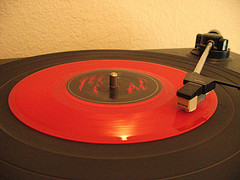
Red vinyl record on a turntableOne of the biggest cultural gaps between me as a teenager in the nineties and my parents was our understanding of how music worked as a diverse cultural landscape. To them, the Top 40 charts told you what was best, what was universally popular. To me, the same chart was a pretty good guide to what a certain demographic thought was best – a deluded demographic that certainly didn’t include me. Ah, the arrogance of youth… [image by Jono Rotten]

And this was long before ripping and burning, iTunes, Napster and MySpace, of course. So little wonder, then, that you can count the number of people who find the old-fashioned chart run-downs relevant on the fingers of one hand. Stepping into the void are IBM and the BBC, with a plan to make music stats more detailed, accurate and interesting to individuals with different tastes. Take it away, TechDirt:

Rather than assuming there’s just one single chart to rule them all, the system lets you create custom lists for a better understanding of more niche-targeted music. So, say, if you wanted to know who’s hot on YouTube and Last.fm in the indie and punk worlds among US listeners between the ages of 20 and 30, you can create just that list. Or, as per Will’s suggestion, you could find out what female Emo fans between the age of 15 and 20 are talking about on Bebo — and get that list.

Technologically this is just another web2.0 data mash-up, but I think it’s interesting from a cultural point of view because it derails the still-common complaint that the world is developing into a homogeneous monoculture, and demonstrates that narrowcast media like the internet encourages diversity rather than suppressing it.

Of course, you could argue that the tribal nature of music fandom is symptomatic of a Balkanisation of culture, in much the same way as genre fiction fandom… in which case we should probably go to a gig together and have a very drunken argument about it. 😉

An Exercise in Trend Recognition

For this edition of Future Imperfect, Sven Johnson has been grasping towards something which may or may not be there to grasp.

Future Imperfect - Sven Johnson

If you spend any amount of time straining through global news and pop culture, you’ll probably have had a similar sense of unseen patterns waiting to be discovered. But, Sven asks, what exactly occurs the moment before trend recognition? Continue reading An Exercise in Trend Recognition