Tag Archives: democracy

Europe in 2030: An Optimist Predicts

small worldSo you want an optmistic vision? How about a vision named after Voltaire’s absurdly optimistic hero?

Publishing “Candide’s Garden” in Spielgel Online, Wolfram Eilenberg, who teaches international studies at Indiana University, advances this bracing hypothesis:

Anyone who now wants to talk about the future of Europe must first grasp the fact that we are — at this moment — experiencing a European utopia that has been cultivated for millennia.

The dogma-free, democratic marketplace of ideas, for which Socrates gave his life in Athens, is today a communicative reality in which hundreds of millions of citizens are actively taking part.

Eilenberger, who it turns out is not Dr. Pangloss after all, warns of big changes ahead, but he believes the European Union is well-positioned to weather them. We are entering an age of instant information accompanied by a scarcity of fuel, food, and water.

Put simply, the world will become bigger again.

… Instead of a globalized world economy that crosses continental barriers with ease, we will see continental autarchic zones being formed that will be shaped by the military defense of the basic resources available in each zone. We will thus see the logic of imperial expansion replaced by an aspiration to autarchic inclusion (already the EU strategy). The internal market of each zone will reassume economic primacy. This process does not have to end in war. It could well take an ordered course and lead to a multipolar equilibrium, the stability of which — like that of the Cold War — is guaranteed by an awareness of what military options are not available.

OK, that is sounding a good deal less optimistic. “Does not have to end in war” could mean “may well end that way.” But Eilenberger believes the EU is well positioned to weather these changes:

In cultural terms, Europe is equipped with a plurality of languages that lends itself to innovation as well as a global lingua franca: English (though by 2030 Spanish will be the European Union’s second main language). It is not burdened by any politically effective fundamentalisms, and Europe’s communications and transportation infrastructure leads the world. The thesis of a relative optimum also holds in demographic terms.

As for the USA – well, it’s up to those of us who live there, and our willingness to adapt.

An entire way of life, including the country’s suburban landscapes, will have to be fundamentally restructured. Today it is estimated that this inevitable process of economic and infrastructural renewal — one that will certainly also present new opportunities — will take at least twenty years to complete and, as is already becoming evident, will follow the process of reorientation to internal markets characteristic of autarchic zones. Furthermore, the already irreversible linguistic and cultural Hispanicization of its southern regions means that the United States will face greater integration challenges than will Europe with its smaller Muslim minorities.

Put in more positive terms, the way the United States develops will depend crucially on its readiness to consciously Hispanicize itself and — together with Brazil — to see itself in the long term as the strongest link within a pan-American community.

Which underlines the need to improve our discourse. Europeans, you should hear what our Confederate Party says about you, not to mention about people who speak Spanish. (Oops, is calling Republicans mean names the best way to improve our discourse? Self-criticism to follow. Could just be the reaction of an American with Euro-envy.)

I have no idea whether Eilenberger is right, but it’s a well-thought-out, wide-screen argument that he lays out. We need more of that in science fiction, too.

[Image: JasonRogersFooDogGiraffeBee]
The Iranian elections: is democracy viral?

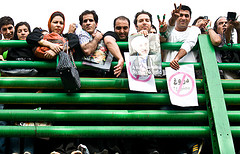
Iranian election protestorsThe past weekend’s hot news story is still smouldering strongly today: the Iranian elections (and the resulting landslide victory for incumbent president Ahmadinejad) have resulted in accusations of vote fraud (which isn’t entirely surprising) and street riots and protests from supporters of the principle opposition candidate, Mir Hossein Mousavi. Throw in some state censorship in the form of social networking websites and text messaging services being blocked, and you’ve got a story that’s not entirely unfamiliar in recent years. [image by Shahram Sharif]

Of course, I have no idea whether or not the election was rigged or not, though I have my suspicions. What interests me most about this story is how it paints a very different picture of Iran to the one we’ve been fed in the last decade or so. Far from being a monolithic Islamic state in thrall to Ahmadinejad, there’s evidently enough support for reform to threaten the incumbents; after all, a mere handful of angry reformists does not a riot (or an electoral recount) make.

How long this has been the case is beyond my knowledge, and I wish I had the time and opportunity to research it further. But the ubiquitous presence of peer-to-peer communications (and their inevitable censorship by the state) is telling, and I find myself wondering if perhaps the talk about democracy being a viral concept has some weight to it after all. Have services like Twitter and Facebook simply given a voice to those already opposed to the incumbent Iranian government? Or have they acted as a catalyst, enabling a population whose access to information and discussion was previously more closely controlled to see that there are alternatives within their grasp?

These aren’t questions with simple answers, of course, and there are many other factors at play in a world where everything is changing faster than ever before. But I think it’s fair to suggest that the internet is one of the strongest disruptive forces on the gameboard, especially in countries where state control of media has been far more crude and heavy-handed than here in the privileged West.

I fully expect we’ll be seeing a lot more stories like this from developing nations in years to come, as affordable communications technology pulls aside the heavy curtains of the state… it’s good news for oppressed citizens, certainly (at least in the short run), but for global stability? Maybe not so much.

Online democracy and the tyranny of the minority

The internet is the greatest potential enabler of genuine direct democracy ever, right? Well, not necessarily.

David Adams at OS News points out that recent high-profile gaming and crashing of internet polls (most notably the pwnzorage of Time Magazine by the 4chan hordes) should be taken as a caution; online direct democracy opens the gates to the tyranny of the minority, he says.

One of the dangers of direct democracy has always been that the majority of people can band together to persecute an individual or smaller group using legitimate voting, such as voting for confiscatory taxes on a wealthy individual, or restricting the civil rights of a minority ethnic group. This is called “tyranny of the majority.” That’s why no country practices direct democracy. There always needs to be a constitution to enumerate essential rights, a court to ensure that the constitution is obeyed, and a representative structure such as a legislature to insulate the nation’s laws from the whims of the voters. A tyranny of the minority is when a vote is open to anyone, but because not enough people are engaged politically, or not enough people know about it, a small group can organize itself to make a surprise assault on the poll and exert disproportionate influence.

Hmmm. Surely those marginalised by said poll would hence become more aware of the potential for engagement with the system as a result? And if the barriers to participation are so low, surely they’d be unlikely to be trounced the same way twice? But back to Adams:

… let’s assume for a moment that we could come up with a system that only allowed for legitimate votes, and we could have 100% confidence in that fact. Let’s assume that this system enabled votes to be easy to cast and easy to count. This system would probably work fine for big, high-profile elections like the presidency and congress, because the candidates and the parties are already doing everything they can to mobilize their troops to vote for their person. Where the tyranny of the minority would come into play would be the smaller races, such as school board, county sheriff, and other local ballots. These are races that are much more easily swayed by an organized group that represents a small minority of the voters but can swing the vote their direction if they’re determined enough. This is something that happens already every election, with manual voting, but with electronic voting, it would happen much more. I’m afraid that with remote e-voting, coupled with every more useful and popular regional and local social networks, Stephen Colbert would win every election in the country.

Frankly, looking at the roster of self-serving chumps we call a government here in the UK, I’m not entirely certain having Colbert in power for a while wouldn’t at least be a refreshing change, if not a political and historical turning point. I can see where Adams is going with this, but I’m a great believer in the old saw that every generation gets the government it deserves, with the corollary that we’re currently governed by shysters because we left the door wide open to them.

Maybe the early years of a direct and participatory democracy would usher in some terrible single-interest wackadoos and bigots (though I’m not entirely sure how much difference we’d notice), but I think it would also make everyone else think “well, if it’s that easy to get someone elected, we’ll give ’em a run for their money next time round”. End result – a more engaged electorate using a more democratic system. And while that’s admittedly a blue-sky scenario, I think it acts as a balance to Adams’ pessimism; it’s too early to write off the potential of the internet to reinvigorate democratic processes just because a few magazines and websites got chumped by script-kids. [via SlashDot]

Democracy and punishment – Asian executions and Czech castrations

gallowsNew Scientist ponders whether the arrival of true democracy will put executioners out of business in Asia:

The biggest obstacle to ending executions in Asia is politics, not culture. Often, the trigger for a decline in capital punishment is a degree of democracy and an easing of authoritarianism.

[snip]

… this suggests that the main explanation for high execution rates in certain Asian countries is the authoritarian politics of their leaders. As the region continues to develop and become more democratic, we expect the executioner to become a vanishing species.

That, of course, presumes that the move toward more democratic government is universal and irreversible; that’s not a bet I’d be keen to make until I’ve watched the economic events of the next decade or so, personally.

Capital punishment may be on the decline overall (at least officially), but over in Europe the Czech Republic has caught the attention of other countries with its policy that allows judges to sentence certain types of sex offender to chemical castration. The Council of Europe defines it as a form of torture, but other lawmakers aren’t so keen to exclude it from the statute list permanently:

The Czech Republic has allowed at least 94 prisoners over the past decade to be surgically castrated. It is the only country in Europe that uses the procedure for sex offenders. Czech psychiatrists supervising the treatment — a one-hour operation that involves removal of the tissue that produces testosterone — insist that it is the most foolproof way to tame sexual urges in dangerous predators suffering from extreme sexual disorders.

[snip]

Now, more countries in Europe are considering requiring or allowing chemical castration for violent sex offenders. There is intense debate over whose rights take precedence: those of sex offenders, who could be subjected to a punishment that many consider cruel, or those of society, which expects protection from sexual predators.

Punishments of all types raise questions of societal ethics, and with a subject as sensitive as sexual crimes it’s inevitable that opinions are going to be sharply divided. At the risk of channeling Focault for a moment, though, I’d point out that there’s a connection between executions in the Far East and chemical castrations in central Europe – they’re both ways of appealing to (and manipulating) mob sentiment. Given the threat of global political instability in the near future, I suspect we’ll be seeing more physical punishments on statute books, not less. [latter story via MetaFilter; image by Scott Clarke]

At what point does a mutilation become a just punishment? Is chemical castration going to be more effective at preventing sex offences, or making it look as if something is being done about sex offences?

Will Obama usher in the age of Digg democracy?

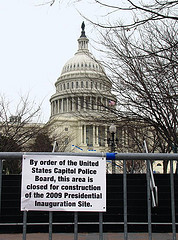
inauguration site construction notice, Washington DCOne of the more interesting sections of the Change.gov website built by the incoming Obama administration is the Citizen’s Briefing Book. It’s essentially a kind of Digg-like system where registered users can pick policies and issues to vote upwards or downwards on an ordered list, the idea being that the matters that matter the most will rise to the top, presumably to have attention paid to them by policy makers. [image by ajagendorf25]

It’s an intriguing idea, very typical of the Obama crew, and a tentative step toward a more atomised and participatory form of democracy that might effectively engage those who, traditionally, have been least engaged by politics in recent times. The downswing being, of course, that it’s effectively a crude kind of popularity contest, as Steven Johnson pointed out at BoingBoing:

Right now, the top three most popular proposals are: 1) Ending Marijuana Prohibition, 2) Bullet Trains and Light Rail, and 3) An End To Government Sponsored School Abstinence Programs. In other words, what the people want are stoned kids having sex on bullet trains. Sounds about right to me!

To be totally clear, those are three policies that – were I an American citizen – I would certainly support; it’s just that given the current state of the world in general and the US in particular, I don’t think they are really the hot-button issues that most need to be addressed…

Of course, the Citizen’s Briefing Book is only a type of polling mechanism rather than a direct lever on the policy machine. I only hope for the sake of all Americans it doesn’t become as farcical an echo-chamber of petty idiots as the Downing Street Petitions site. Or Digg, for that matter.