
Tag Archives: design

Predicting future technologies with Eric Drexler

chipEric Drexler describes how you can apply scientific methods to assess the lower bounds of the capabilities of future technologies:

A subset of the potential capabilities of future levels of technology can be understood by means of a design process that can be described as exploratory engineering. This process resembles the first phase of standard design engineering (termed conceptual engineering, or conceptual design), but it serves a different purpose

In the early 20th century, a missing fabrication technology was the combination of engineering expertise and metalworking techniques (among others) that were required to build large aerospace vehicles. The physics of rocket propulsion, however, were well understood, and the strength and weight of large, well-made aluminum structures could be estimated with reasonable accuracy.

On the basis of exploratory engineering applied to this kind of knowledge, engineers who studied the matter were confident that orbital flight could be achieved by means of multistage chemically fueled rockets.

This was an element of Drexler’s Engines of Creation I found especially compelling: that we should base our ideas of future technologies not on what we already have, but what lies within the bounds of what is possible by physical laws as we understand them.

[image from quapan on flickr]

I don’t know how to drive it, but it looks pretty wild

Concept cars are rather like science fiction – in that they never quite come true, and they say more about the time in which they’re designed that the time in which they would supposedly exist.

But that’s half the fun of designing them, I guess, and it looks like there’s still plenty of folk in the auto industry’s blue sky labs who know how to dream big… or who play a lot of computer games. Pink Tentacle has a bunch of concept vehicle drawings (or rather renderings) from Mazda, Toyota, Nissan and Honda that look like a mash-up of Akira, Wip3out and Stephan Martiniere; if this is what the freeways of 2050 will look like, crossing the street is going to be a crazy experience.

Mazda Motonari RX vehicle concept

That’s the Mazda Motonari RX; to quote Pink Tentacle:

The vehicle drives sort of like a street luge. Acceleration and direction is determined by two armrest mounted control points, and the vehicle’s exoskeletal frame shape-shifts in accordance with the position of the driver’s arms and legs when enveloped in the seat. Four omnidirectional wheels allow 360 degrees of movement, and the tread expands or contracts to suit the driving conditions. A “haptic skin” suit consisting of millions of microscopic actuators enables the driver to experience the road psycho-somatically while receiving electrical muscle stimulation from the onboard AI guidance system (or other remotely located drivers).

No mention of how much a tank of gas will cost… though Toyota’s design apparently sidesteps the issue by being “powered by pollution”.

There’s a certain irony implicit in the automobile industry being one of the last bastions of sleek’n’shiny futurism in these times of bright green thinking; I’d love to see streets full of things like this, but I’m not going to hold my breath.

Ambulances of the future

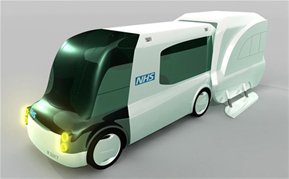
sc_shellSome elegant concept design for ambulances of the future, produced by the Royal College of Art and Engineering and Physical Sciences Research Council here at the BBC:

The idea of emergency on-the-spot community treatment was introduced by the government in 2001. However, experts say research into new technologies needed to support this new role is still lagging.

Mr Thompson continues: “We are looking at enabling technologies to help ECPs do their job.”

One such design is called the shell concept. It has a removable ‘shell’ that can slide off the main vehicle to create an expanded treatment space, or left on the scene for extended periods of time.

Other proposals include a soft continuous silicone interior which morphs to the shape of the patient and allows for infection control as well as a deployable tent allowing 360 degree access to patients.

[image by Rui Gio from the Royal College of Art]

Design and SF: an essay on intersection

spiral_designJulian Bleecker has written a fascinating essay on the intersection of science fiction and design and how they cross-pollinate, and how SF design (mostly movie-oriented) influence actual design, go read:

Design Fiction is making things that tell stories. It’s like science-fiction in that the stories bring into focus certain matters-of-concern, such as how life is lived, questioning how technology is used and its implications, speculating bout the course of events; all of the unique abilities of science-fiction to incite imagination-filling conversations about alternative futures.

It’s about reading P.K. Dick as a systems administrator, or Bruce Sterling as a software design manual. It’s meant to encourage truly undisciplined approaches to making and circulating culture by ignoring disciplines that have invested so much in erecting boundaries between pragmatics and imagination.

[via Boing Boing][image from stage88 on flickr]

The descent of robot: artificial evolution

wall_robotResearchers at the University of Aberdeen have developed a new method of designing complex robots using genetic algorithms:

The EA randomly creates large numbers of control “genomes” for the robot. These behaviour patterns are tested in training sessions, and the most successful genomes are “bred” together to create still better versions – until the best control system is arrived at.

MacLeod’s team took this idea a step further, however, and developed an incremental evolutionary algorithm (IEA) capable of adding new parts to its robot brain over time.

Further reading: an excellent non-fiction book that explores the idea of evolution as a general method of design is The Origin of Wealth by Eric Beinhocker.

[from New Scientist, via KurzweilAI][image from badjonni on flickr]