Tag Archives: digital

Digital Rosetta stone

stone_writingJapanese researchers are developing a means of storing data for periods of thousands of years, to help solve the problem of an imminent digital dark age:

The team, led by Professor Tadahiro Kuroda of Tokyo’s Keio University, has proposed storing data on semiconductor memory-chips made of what he describes as the most stable material on the Earth – silicon.

Tightly sealed, powered and read wirelessly, such a device, he claims, would yield its digital secrets even after 1000 years, making any stored information as resilient as it were set in stone itself.

It’s a realisation that moved the researchers to name the disc-like, 15in (38cm) wide device the “Digital Rosetta Stone” after the revolutionary 2,200-year-old Egyptian original unearthed by Napoleon’s army.

This is a very similar concept to the Long Now Foundation’s Rosetta Disk, which is intended to be a very-long-term record of contemporary languages.

It is encouraging to know this problem is being studied and so many groups are looking for solutions.

[from the BBC][image from bwhistler on flickr]

Digital travel and the price of oil

rusty old oil barrelsIt may be mercifully low again at the moment, but it’s safe to assume that once the global economy adjusts to recent events, the price of oil will obey its historical trend and start climbing once again.

Over at The Guardian, Charles Arthur suggests one of the major outcomes of increasing oil prices will be that travel – be it for work or pleasure – will become much less of a reflex action, at least for those of us who aren’t ridiculously wealthy:

If you need a shorthand for thinking about the future, then, it’s this: analogue will be increasingly expensive; digital will be increasingly cheap. Getting in a car or on a train or a plane? Analogue. Expensive. Non-renewable. By contrast, downloading an album, watching a webcast concert, watching TV: digital. Endlessly replicable, virtually instantly transmitted, cheap.

What, in turn, does that mean for our society? Apart from fewer cars on the roads (though possibly with more people sharing rides in them), it means more time working at or near to home, if your work involves things that can be done digitally. For all those jobs that need to be near to physical things – that is, where you make things like cars or food or whatever – you’ll have to be based nearer the place you work.

I hasten to point out that this is not exactly a new suggestion, but what would have been delivered as a slightly comedic tongue-in-cheek piece of journalism ten years ago (doubtless complete with a reference to “sci-fi futures of virtual travel”) seems much less ludicrous in the light of our new-found interest in frugal living. [image by Atli Harðarson]

I seem to remember one of Stephen Baxter’s Destiny’s Children books featuring a very-near-future Earth where travel is achieved by a kind of mash-up of telepresence and VR technologies. Can anyone think of any other sf stories or books with a similar theme?

Stephen King, Amazon’s Kindle and the death of publishing as we know it

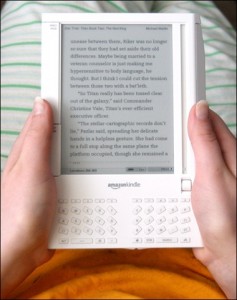
Amazon Kindle ebook readerWe’ve been mentioning ebooks a lot lately here at Futurismic, as the big publishing companies have suddenly woken up to the fact that the 21st Century has well and truly arrived… and isn’t going to go away.

One can look at the ebook as a way for the publishers to move away from the increasingly expensive and wasteful dead-tree model and reinvigorate themselves in the process. But there is a flipside, of course, as pointed out by The Guardian‘s Naomi Alderman:

if ebook readers took off, big-name authors such as [Stephen] King may be able to move to self-publishing. And that could mean the end of our current publishing system. Because of the way the publishing business is structured, big-name authors who sell millions of books are, in effect, supporting the industry. I’ve heard various estimates of the percentage of books that actually turn a profit. One agent I spoke to said 95% of published books make a loss. Others have put the figure lower. Either way, everyone agrees that a large majority of profits come from a small minority of authors.

If King, Dan Brown, JK Rowling and Patricia Cornwell were all to decide to move to selling their books online themselves, rather than going through a publisher, they’d certainly benefit financially. Typically, an author only receives about £1 for every copy of their book sold. Rather than relying on a publisher, big-name authors could afford to simply employ an editor, a PR person, a typesetter and a designer. They could price their books at only £2 or £3 and still make much more money than under the current system.

There’s obviously a few flaws in Alderman’s reasoning here: first of all she’s discounting the nurturing aspect of the publishing industry, its ability to bring the next generation of Kings, Cornwells and (universe forfend) Browns up through the ranks; secondly, a shift to ebooks should see the loss margins on a title by a smaller author drop considerably, as there’ll be no massive pile of unsold books to pulp (not to mention much smaller distribution costs).

But what is plain is that book publishing needs to learn in adavance from the messy lessons that the record companies are still struggling with now. A look at the music industry blogs will show you that Alderman’s speculation above is an almost perfect mirror of what’s already happening with middle-band musicians as they (and their fanbase) realise the labels are primarily concerned with wringing the last few drops of profit out of a dead business model, and decide to leave them behind.

As has been pointed out before, the principle difference between the publishers and the record labels is that publishers haven’t yet been forced to innovate by the pressures of piracy. It looks as if they’d be wise to jump ship and start swimming for shore right now, rather than waiting to be made to walk the plank. [Image coutesy Wikimedia Commons]

Digital books are already here

Amazon Kindle ebook reader screen-saverThe last few years or so has seen plenty of talk in publishing circles to the effect that the era of the digital book is imminent, but no one seems willing to accept that it’s already here.

The folk at Pan Macmillan’s Digitalist blog, however, have decided that the digital fiction future has already arrived, and that it’s time for publishers to stop sitting on their thumbs over electronic content delivery:

Beyond even games we already have the outlines of digital fiction. Projects like Inanimate Alice, the story games and ARGs, narrativised blogs and twittered fiction. All the tools and standards are now roughly in place. A wave of innovation has most likely come to a close as the “social media boom” hits the skids. We have been innovation addicts, slavishly jumping on each new trend, application and concept, moving without thinking. The dust is now settling and the landscape for digital fiction and digital books is clear.

To recap, digital books/fiction looks like this:

  • ebooks and ebook derivatives
  • “writerly” computer games
  • stories told used existing forms of social media (blogs etc)

They close with a right hook to the jaw:

Let’s not wait for the future anymore; it arrived in about 2006.

Zing! Perhaps the current tough times will be the eye of the needle that the camel of publishing has to slim down and wise up to pass through… I guess we’ll just have to wait and see. [image by tvol]

Archive drive: why we should be saving old websites for future generations

antique computerThe head of the British Library has warned that, unless measures are taken sooner rather than later, we stand to lose vital parts of our cultural heritage to the rapid technological and social evolution of the internet. But why should we care about old websites being replaced by new ones, never to be seen again?

… Brindley cites two examples of losses overseas. When Barack Obama was inaugurated as US president last week, all traces of George Bush disappeared from the White House website, including a booklet entitled 100 Things Americans May Not Know About the Bush Administration, which is no longer accessible.

There were more than 150 websites relating to the 2000 Olympics in Sydney, she continues, but these, too, vanished instantly at the end of the games and are now stored only by the National Library of Australia. “If websites continue to disappear in the same way as those on President Bush and the Sydney Olympics – perhaps exacerbated by the current economic climate that is killing companies – the memory of the nation disappears too,” Brindley writes. “Historians of the future, citizens of the future, will find a black hole in the knowledge base of the 21st century.”

When you think about it like that, it makes a bit more sense. The National Archives are storing government emails, and encouraging us to store our own as well; the problem is that, contrary to popular belief, Google and their competitors do not store a copy of everything on the web.

The falling prices of storage media will help matters somewhat, but someone still has to make the effort to copy and file them all… still, at least a hard-drive full of old emails will take up less space than a few years’ worth of paper correspondence. [image by Nico Kaiser]

But here’s a thought – how much more editable is a digital history? After all, if you can store something as ones and zeroes, you can manipulate those ones and zeroes into a new pattern. The embarrassing photos of your twenty-something fashion disasters, those mawkish and desperate chatroom sessions and forum threads from your teens… all could be smoothed and tweaked into something more in keeping with how you’d like others to see you. A photoshopping of the past, if you will.

Makes you realise that a verifiable archive of governmental websites and communications might be something worth having after all, doesn’t it?