Tag Archives: drugs

High above the Earth? Drug consumption on the ISS

A digital rendering of the International Space StationThere may be little to no consumption of alcohol aboard, but there’s plenty of drugs on the International Space Station – albeit not for recreational purposes. The Discovery Space blog has a list of the contents of the ISS pharmaceutical kit-bag, of which this is just one [via SlashDot]:

Tranquilizers: […] astronauts keep a few tranqs on hand in case anyone goes all suicidal or psychotic in space. NASA recommends binding the individual’s wrists and ankles with duct tape (ever the space traveler’s friend!), strapping them down with a bungee cord and, if necessary, sticking them with a tranquilizer. Sure, it hardly makes for a civilized evening aboard ISS, but it beats someone blowing the hatch because they think they saw a something crawling on one of the solar panels.

Good old NASA, always thinking ahead. If you’re still curious about the astronaut lifestyle, Bruce Sterling has written a piece based on an interview with Nicole Stott that sums up what it’s like to live in space:

The time you spend in outer space will change your blood and hormone levels, and your bones and muscles will slowly waste away. A three-month stay is optimal; six months is pushing it. You’re going to need to get in shape and remember to pack light.

With that understood, let’s settle in. Built over the course of ten years by a wide variety of contractors­­—–and still a work in progress—–the ISS is a hodgepodge trailer camp graced with quite a lot of Russian design. It features two basic living elements: big round tubes, trucked up there in the American Space Shuttle, and smaller knobby tubes, fired up on other people’s rockets. All these pods have been snapped together, mostly end to end, or, as you’ll say on the station, “fore and aft.”

In a nutshell: it’s not exactly a five star hotel. But you know what?

I’d still go tomorrow if they gave me the chance. [image by FlyingSinger]

Flibanserin: Viagra for ladies?

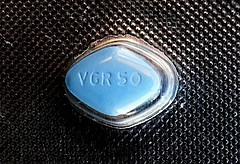
Viagra pillI guess we can look forward to a new pharmacological trade name appearing in our spam folders in the near future. A failed antidepressant, flibanserin will soon enter clinical trials in the UK to determine whether it’s safe to be marketed as the Female Viagra, accompanied by pointed questions from sexual health experts as to whether there’s really any genuine need for it:

Doctors involved in the study said the drug may prove to be an effective treatment for low libido, a problem they estimate affects between 9% and 26% of women, depending on their age and whether they have been through the menopause.

The drug has proved controversial among sex researchers. Some argue pharmaceutical companies are exaggerating the number of women affected by low libido to expand their market, and are pushing a pill that will not deal with psychological issues that might put someone off sex, such as poor body image or stress.

With the hopefully obvious caveat that I’m not a woman, I’m siding with the skeptics on this one. Viagra solves a, er, mechanical problem that prevents men from having sex, whereas flibanserin appears to be psychological in effect from the details described – a ‘randiness’ pill, to put it crudely.

Personally, I’m all for personal pharmacological freedom – if there’s a pill out there that does something positive for you, then who are you harming other than yourself? But I’m not sure that that a lack of libido in women is a pathological problem in the same way as erectile dysfunction, and this has all the hallmarks of Big Pharma rolling out another “lifestyle” drug designed to cure something that isn’t really an illness. [image by Felixe]

I remain surprised that libido suppressants aren’t so readily available as their opposites, though. If there’s a market for chemicals to switch on a certain body response, surely there’s going to be one for chemicals to switch them off? One might argue in response that libido suppressants could be easily misused, given to people who neither wanted or needed to take them… to which I’d respond that the same surely applies to flibanserin and Viagra.

Designer drugs develop faster than designer legislation

pillsI’m not sure whether I’m supposed to be proud or ashamed of this one, but apparently Britain has been declared the “designer drugs capital of Europe” by the EU drug agency. [image by Greencolander]

This new generation of online “head shops” is at the centre of a rapidly growing market in highly potent synthetic drugs, such as Spice, that mimic the effects of illegal substances such as cannabis and ecstasy.

European drug agency officials are also alarmed by the way the online retailers are reacting to moves to ban individual “legal highs” by rapidly marketing alternatives. Officials say it is like trying to hit a moving target.

Well, d’uh – do you really expect them to just sit there in the firing line waiting to be picked off? I think what we’re seeing here is something like a singularity for the recreational chemicals industry, whereby the legal machinery of the countries that most want to control such substances moves too slowly to control the exponentially faster response to market demand. It’s a whack-a-mole gig – knock one substance into the ground, and two more pop up to replace it.

I’d hardly be the first to suggest that perhaps this rapid response in the balance of supply and demand is the first nail in the coffin lid of attempts to banish recreational drug-taking, but given the UK government’s laughable unwillingness to heed the suggestions of the drug policy advisors that it appointed, I’m not going to be the first voice they ignore, either.

But I think it’s safe to say that drugs – designer or otherwise – are not going to go away any time soon, legislation or otherwise. So what’s a beleaguered incumbent government to do – quietly admit defeat and lose the vote of the hand-wringing middle classes, or pour away time and resources doing a King Canute impersonation?

Is there anyone among Futurismic‘s readership who can say with a straight face that more restrictive legislation will prevent drug abuse, in the UK or anywhere else? If so, tell us how and why in the comments. Feel free to suggest new alternatives to legislation, as well.

New PlaceboTM! Now 50% more effective!

pillsYou’ve heard of the placebo effect, right? Well, apparently it’s becoming stronger, much to the chagrin of the pharmaceuticals industry who are finding that less drugs are passing clinical trials as a result:

MK-869 wasn’t the only highly anticipated medical breakthrough to be undone in recent years by the placebo effect. From 2001 to 2006, the percentage of new products cut from development after Phase II clinical trials, when drugs are first tested against placebo, rose by 20 percent. The failure rate in more extensive Phase III trials increased by 11 percent, mainly due to surprisingly poor showings against placebo. Despite historic levels of industry investment in R&D, the US Food and Drug Administration approved only 19 first-of-their-kind remedies in 2007—the fewest since 1983—and just 24 in 2008. Half of all drugs that fail in late-stage trials drop out of the pipeline due to their inability to beat sugar pills.

The upshot is fewer new medicines available to ailing patients and more financial woes for the beleaguered pharmaceutical industry. Last November, a new type of gene therapy for Parkinson’s disease, championed by the Michael J. Fox Foundation, was abruptly withdrawn from Phase II trials after unexpectedly tanking against placebo. A stem-cell startup called Osiris Therapeutics got a drubbing on Wall Street in March, when it suspended trials of its pill for Crohn’s disease, an intestinal ailment, citing an “unusually high” response to placebo. Two days later, Eli Lilly broke off testing of a much-touted new drug for schizophrenia when volunteers showed double the expected level of placebo response.

It’s not only trials of new drugs that are crossing the futility boundary. Some products that have been on the market for decades, like Prozac, are faltering in more recent follow-up tests. In many cases, these are the compounds that, in the late ’90s, made Big Pharma more profitable than Big Oil. But if these same drugs were vetted now, the FDA might not approve some of them. Two comprehensive analyses of antidepressant trials have uncovered a dramatic increase in placebo response since the 1980s. One estimated that the so-called effect size (a measure of statistical significance) in placebo groups had nearly doubled over that time.

You’ll not find me shedding many tears for Big Pharma, frankly; as pointed out in the rest of the article, their profit margins of the last few decades has been based on turning psychiatric treatments into mental cosmetics, and the increase in the placebo response may well be tied to their incredibly effective marketing procedures – by associating drug consumption with positive images of well-being, they’ve stimulated our response to all pills, regardless of their chemical make-up. Research is increasingly suggesting that one of the biggest prerequisites for getting better is simply a reasonable expectation that one actually will. [via BoingBoing]

I’ve got something of a personal stake in this, having seen far too many friends diagnosed with one form or another of psychiatric condition and promptly put on a regime of drugs that have shattered their personalities – and lives – permanently. I’m not denying the existence of mental illness, but I’m quite convinced that overdiagnosis is rife, with many drug-treatable “syndromes” being little more than completely natural phases of mental development or reasonable responses to environmental conditions which would respond far better to counselling and emotional support. Hence I was intrigued to read an article by medical anthropologist Eugenia Tsao [via @somatosphere], who recommends that members of her profession and others should start pushing back against the relentless attempts to pathologize (and hence monetize) our reactions to our social environment:

What is revealed about a society, in which drugs are touted with increasing regularity as a treatment of choice for entirely natural responses to conditions of unnatural stress? How have we been persuaded to equate such things as recalcitrant despair (“Dysthymic Disorder,” DSM-IV-TR 300.4), adolescent rebellion (“Oppositional Defiant Disorder,” DSM-IV-TR 313.81) and social apathy (“Schizoid Personality Disorder,” DSM-IV-TR 301.20) with aberrant brain chemistry and innate genetic susceptibilities rather than with the societal circumstances in which they arise? What does it mean when increasing numbers of people feel as though they have no choice but to self-medicate with dubious chemical substances in order to stay in school, stay motivated, stay employed, and stay financially solvent?

Anyone here remember an obscure industrial band called Consolidated? They had a lyric on their Business of Punishment album that went something like “they must remain sick / so we can continue to treat them”. [image by neur0nz]

Mexico gov’t decriminalizes personal drug possession

marijuana plantThe headline says it all, basically – with very little fanfare or ceremony, the government of Mexico has voted to formally decriminalize small-scale possession of controlled drugs and intoxicants.

The law sets out maximum “personal use” amounts for drugs, also including LSD and methamphetamine. People detained with those quantities will no longer face criminal prosecution when the law goes into effect Friday.

Anyone caught with drug amounts under the personal-use limit will be encouraged to seek treatment, and for those caught a third time treatment is mandatory — although the law does not specify penalties for noncompliance.

[…]

Mexico has emphasized the need to differentiate drug addicts and casual users from the violent traffickers whose turf battles have contributed to the deaths of more than 11,000 people during Calderon’s term. In the face of growing domestic drug use, Mexico has increased its focus on prevention and drug treatment.

This is a controversial development for many reasons, especially following in the wake of the suggestion that a harsh economic landscape is linked to the loosening of prohibition laws. It will be interesting to see what effect it has on the crime rate in Mexico, not to mention how it’s larger richer neighbour to the North will react. [via SlashDot; image by Eric Caballero]

One thing is pretty certain, though: the border guards at Tijuana will need to draft in extra recruits for the next Spring Break season.