Tag Archives: ebooks

Google grenades the ebook punchbowl

I dare say that if you’ve an interest in publishing as an industry, you’ve already heard that Google has announced its own ebook store will open late this year. A summary from Tomorrow’s Trends:

Google stated that it will allow publishers to set eBook prices.  The cost of the eBook will probably be higher than Amazon’s current eBook prices.

This will certainly start a format war.  Google does not have a dedicated eBook reader and I do not see them getting into the eBook hardware game.  This will push companies to create eBook readers that will connect to Google’s new store. Certainly Amazon is ahead of everyone in regards to ease of use and the ability to download eBooks via a wireless connection.  Hopefully this will give all of us multiple choices on purchasing eBooks.

Credit where it’s due, the Big G knows the value of biding its time for the right moment. This is the game-changing announcement that I’ve been expecting for the last nine months, the potential trigger for an explosive growth phase in ebook hardware and distribution. An analogy to digital music seems appropriate: the Kindle and the Sony Reader are your iPod equivalents, tied to specific content-buying channels and/or file formats to keep the profits as close to their makers (and their partners) as possible. Now the ubiquitous Google is getting in on the game of selling the content, savvy tech firms will be watching closely to see which file format wins the popularity war, before starting to churn out affordable generic readers that can display them without restriction.

Now, as discussed before, ebooks are probably never going to be as big a deal as downloadable music has become (though one can dream, right?), but I’m confident that this will be the tipping point at which another content market suddenly leaps into the digital domain. Hopefully by Christmas time this year I’ll be able to get a decent eInk device that doesn’t lock me in to one content provider, just like my charmingly generic media player…

Discounts and risk in the ebooks market

Remember that post from Evan Schnittman a few weeks back – the one titled “Why ebooks must fail”? Well, he promised to start discussing potentially workable models for the ebooks business, and that’s exactly what he’s now doing.

The first follow-up is titled “Discounts Must Align to Risks”; it looks at the current deep-discounting procedures that prevail in the dead-tree books business as it stands (which share risk between publishers and retailers), and presents three possible ways for a similar system to be applied to the otherwise intangible ebook:

The following ideas, if massaged and improved on by enough smart people, may help evolve trade ebook selling into a practice that wisely shares the risk and provides stimulus and margins for all involved. These models are not new – they are culled from today’s trade retail models. With that in mind, here are three discount models for discussion.

The first is called On Consignment, and it would operate exactly as it does today, except with shorter, perhaps dramatically shorter, discounts. Discounts should align to risk and there is very little risk being shared in this model.

The second model is called Advance Purchase (non-Returnable). Rather than rely on the timing of sell-through at the reseller, publishers are paid for ebook sales in advance. So, resellers that wish to carry an ebook of a publisher can order it as they currently do, or they can purchase the number of “sales” they believe they would make in a given period of time, and pay for this upfront at a greater discount. For this model, a retailer should receive discounts similar to those given on non-refundable sales in print.

The third model is called Refund for Credit (Returnable). Essentially it is a “returns” model for the ebook market. It’s designed to allow retailers to take risks on a larger pool of titles, as they can receive credit by “returning” some of the advance “sales.” This model helps retailers get a better discount for a title than they would if they order On Consignment, but less than the Advance Purchase model. It also helps publishers, as there would be greater incentive to pre-pay for sales for a wider variety of titles, enhancing the cash flow. Again, this model should employ discounts similar to those available for returnable sales in print.

These ideas are probably old hat to industry insiders, but for the rest of us peering in through the shop window it’s an interesting insight into the way the industry works, and the ways it might adapt to change in the near future.

Schittman makes the point that his blogging is not “sanctioned by, endorsed by, or even remotely associated with” his employers at OUP, but one wonders how many people on the inside – of the OUP, and publishing in general – are keen for this discussion to be dragged into the open, and how many would rather sit on the lid of Pandora’s box.

Why ebooks must fail

book spine bindingYou may have seen this already, but just in case: Evan Schnittman is head of global business development at the Oxford University Press, and he sure knows how to make the first post on a new blog punch hard. In his inaugural piece, he explains why the success of consumer ebooks would collapse the publishing “Ponzi scheme”.

I’d advise reading the whole thing for a very honest warts-and-all explanation of the economics involved, but the money-shot is right at the end:

And therein lies the dilemma… how does the publishing industry fund the creation, editing, design, production, marketing, e-warehousing, and sales of ebooks, if the income isn’t there? How do ebooks cover the huge advances needed to buy books if we cannot generate the cash, especially at their extremely low, discounted prices, cover the advances that an entire industry has come to require? The answer is that ebooks, alone, cannot.

What this means is that unless a very different model evolves, ebooks can never become the dominant version of content sold by book publishers. It means that ebooks will always be priced to sell, but sold as an afterthought, not as the primary version of a work. It means that the need for blended e plus p models will evolve, in order to take advantage of all the great qualities of ebooks, while providing the financial support and structure that print offers. It means that consumer ebooks, as a stand-alone version of an intellectual property, must fail.

Of course, it’s not an utterly bleak prognosis; Schnittman promises to follow up with a series of business models that will explore the factors he describes, including one that he believes will let the publishers have their cake and eat it, and I know I’ll be looking forward to reading them. It’s good to find someone close to the core of the industry who isn’t beating around the ebook bush. [via GalleyCat; image by smellyknee]

Progress – the ebooks debate rumbles on

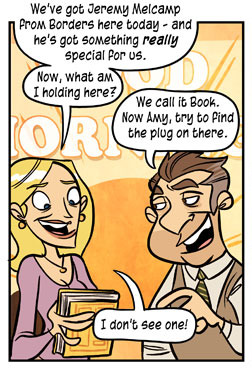
Progress - Penny Arcade on ebooksI suppose I shouldn’t be, but I can’t help feeling surprised at how widespread the debate about ebooks is becoming – I honestly didn’t expect so many people would care so soon. Penny Arcade‘s take is unsurprisingly snarky [see right], but also somewhat conservative given their games’n’gadgets leanings (even allowing for comic license).

The best thing about the breadth of the discussion is that we’re getting a whole lot of different perspectives beyond authors and book-nerds. For example, The Big Money gives us the business logistics guy’s view, namely that “[d]igital readers will save writers and publishing, even if they destroy the book business”:

Here’s where the Kindle comes in. The collapse of bookstores almost ensures that the Kindle will thrive. Not because it’s better than a book; that doesn’t matter. The nation-within-a-nation that reads for pleasure and to be informed is a small but vibrant republic. Heavy readers make up a large portion of the book-buying public. These are people who read two to three books a week and buy 50 or so books a year. The Kindle will solve a number of problems for the citizens of Biblandia, not the least of which is having to go find a bookstore to get their next read.

Elsewhere, uber-PR guy and social media pundit Steve Rubel sees the Kindle and its ilk as “the last Great White Hope” for monetizing text media like journalism:

The Kindle, like the iPod, is an emerging critical mass device that actually encourages people to pay for content rather than get it for free. When Apple launched the iTunes Music Store, people were skeptical that people would shell out cash for music they could snag for free from file sharing networks. They did. The same was true when Apple, and later others, rolled out movies. However, today millions rent or buy movies online.

The Kindle offers a similar experience in a much larger market – text. This one is tougher to monetize. In the digital age books have managed to remain premium content. However, beyond books, magazine and newspaper content is available in abundance online for free. Yet, I still believe that people will pay to receive some of their favorites on their Kindles or their Kindle-enabled phones. Meet them there now while you can.

And of course, there’s the segment of the publishing industry that has gotten itself beyond denial and/or arm-flapping to the point of grappling with the potential that’s sat on their doorstep. Rather than dismissing ereaders as imperfect implementations, the Pan Macmillan digital team are looking ahead to what they see as an inevitable “iPod moment” for text:

… the iPod had a phenomenally intuitive control, especially given the bemusing buttons and rollers of it’s competitors (and I should know as I held out for some time, before caving in with a combination of resignation and glee). Characteristic of it’s manufacturer this no doubt has been an enormous boon to the device. Beyond that though the now iconic look from legendary Apple designer Jonathan Ive was what made us want one. The iPod wasn’t just useful, fun etc- it was jaw grindingly desirable.

Usability and covetability. Two principles for world domination.

What strikes me as being the interesting parallel with these two, aside from the the slightly obvious observations just outlined, is that both came from behind. They did not have first mover advantage. Instead they used these design concepts to leapfrog into pole. Indeed, it could be argued that precisely not coming first was an advantage in that it allowed the pair to fine tune their product and get these two crucial areas right.

Going back to the ereader then, I get the sense that we are on the cusp of when useability and covetability collide, uniting in a glorious burst of reading device nirvana. Ok maybe not quite, but once those user interfaces have been tweaked, and once someone like Ive gets there hands on a reading device, they will be back.

So we’re not quite at the “all bets are off” stage, but we’re certainly beyond the point where it’s a few evangelists with sandwich-boards prophesying the end-times. The more I look at it, the more I suspect that with ebooks the question is no longer “if?” but “when?”

What about you lot – how many of you have a reader already, and how has it changed your text media consumption? And for those that don’t have one, what will be the change that makes you cross the line?

The costing of ebooks

Yeah, another ebooks post, but new material is coming in so thick and fast that every day I seem to find an answer to a question that was raised the day before. Point in case – why aren’t ebooks priced at a tiny percentage of the cost of a hardback? Take it away, HarperCollins:

We still pay for the author advance, the editing, the copyediting, the proofreading, the cover and interior design, the illustrations, the sales kit, the marketing efforts, the publicity, and the staff that needs to coordinate all of the details that make books possible in these stages. The costs are primarily in these previous stages; the difference between physical and electronic production is minimal. In fact, the paper/printing/binding of most books costs about $2.00…

In other words, a $26 hardback equates to a $24 ebook.

Now, I’m in no position to refute those figures, but I don’t think it takes an economics expert to look at them and realise why the publishers are struggling at the moment; if their analysis people can only shave off $2 per unit by removing the printing, shipping, warehousing and remaindering from the equation, then there’s a business model that was on shaky ground before the ebook entered the picture. I suspect the bits I’ve bolded are where the haemorrhaging could be stemmed most effectively.

But it’s easy to say that from the outside looking in; if anyone among Futurismic‘s readership can supply hard figures on this stuff, I’d be glad to give you a soapbox, so drop us a line.