
Tag Archives: economics

The Earth can take care of itself

Hungry African kidsDid you enjoy Earth Day?

Well, not everyone did. In fact, people in some equatorial countries are rioting over food shortages – a situation that even the slow-poke UN is worrying about.

One of the causes of spiralling food costs is the corn ethanol boondoggle. While it’s a good thing that we’re turning away from our dependence on oil derivatives, all the ethanol cars in the world will be of little comfort to hungry people … so we should probably be getting right behind the cellulosic ethanol researchers. And while we’re on the subject of cutting down on our oil diet, we could be making plastics from pig piss.

Perhaps you think I’m being a tree-hugger. If so, you’re missing the point. As happens so often, Jamais Cascio sums it up in the intro to an essay you should go and read:

The grand myth of environmentalism is that it’s all about saving the Earth.

It’s not. The Earth will be just fine. Environmentalism is all about saving ourselves.

[Supplementary links sourced from MetaFilter, Slashdot, BoingBoing and more; image by Felipe Moreira]
The economics of testosterone

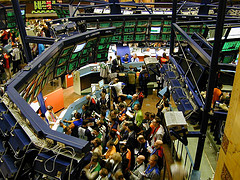
Stock market trading floorThe headlines about the global economic situation aren’t getting any more cheerful right now, are they? While there are many many contributing factors to a complex economic system, a group of UK researchers have suggested that there is a link between the stability of the stock market and the hormonal levels of stock market traders. [image by Petrick]

“But which is the cause and which is the effect? A further analysis showed that traders who started their days with elevated testosterone made more money than those who didn’t. One trader went on a six-day winning streak, making twice as much money each day as the previous one. Over that period, his testosterone levels rose steadily, some 74 per cent.”

The cause and effect question remains open (and probably always will do), but the article suggests that elevated hormonal levels may be very bad for the traders themselves … and that a stock market with more women trading on it might be more stable.

Amen to that.

As food prices rise, Opium fields in Afghanistan change to Wheat

Rice in India is hitting record pricesFood prices are at historic highs, thanks to a number of factors including increased biofuel use. Rice prices are causing shortages and inflation problems in India, Bangladesh and the rest of Asia, with prices of many grains double what they were this time last year.

UK Prime Minister Gordon Brown today called for action about the price rises at the next G8 meeting, with the incentives for making biofuel having unforeseen consequences leading to the shortages.

“For the first time in decades, the number of people facing hunger is growing. Food prices have risen sharply leading to food riots in several countries,” Brown wrote.

Meanwhile, in Afghanistan, the Telegraph reports that farmers who had been producing opium for the illicit trade of heroin have begun to switch from the poppy to wheat because the grain fetches higher prices than the drug. Unforeseen consequences, indeed!

[via Russ Winter and Paul Krugman, image of rice at Colaba Market, Mumbai by Dey]

The rise of the subnotebook computer … and the fall of the computing economy

Asus-Eee-subnotebook-computer Slashdot notes a story that quotes a big wheel at Sony as being worried about the potential mainstream appeal of the Asus Eee and its ilk:

“”If (the Eee PC from) Asus starts to do well, we are all in trouble. That’s just a race to the bottom,” said Mike Abary.”

The Slashdot poster observes:

“Presumably by ‘we’ he means all the hardware manufacturers who sell over-priced, full-fat laptops. […] Looks like what’s bad for Sony may be good for the consumer.”

In the short run, certainly, he may be right – but what about the long game? A drop in hardware prices for us consumers would be nice, sure, but there’s bound to be more consequences than that. [image by Scrambled Egg]

This is an issue that Charles Stross broached late last year (right after purchasing his own Eee, naturally). You should read all of Charlie’s thoughts about the inevitable (and long-overdue) commoditization of computing technology, because they add weight to his final blow:

“… how deep will be the recession that follows once the personal computing industry deflates to its natural value (i.e. peanuts)?”

Ouch.

The Tipping Point toppled?

Seesaw Being the sort of well-informed netizens you are, I expect you’re familiar with Malcom Gladwell’s “Tipping Point” hypothesis, widely believed to be the cutting-edge theory for predicting how trends, fads and fashions propagate. [Image from Wikipedia]

According to Gladwell, fashions are started by “Influentials” – highly visible and well-connected individuals who others look to for the next big thing.

According to Duncan Watts, however, the Tipping Point is so much baloney:

“It just doesn’t work,” Watts says […] “A rare bunch of cool people just don’t have that power. And when you test the way marketers say the world works, it falls apart. There’s no there there.”

And this is not, he argues, mere academic whimsy. He has developed a new technique for propagating ads virally, which can double or even quadruple the reach of an ordinary online campaign by harnessing the pass-around power of everyday people–and ignoring Influentials altogether.

Of course, Watts has his rival theory to promote – he’s not telling us this out of some philanthropic urge. But the point is that the business of marketing is probably where we’ll see the next big breakthroughs in understanding human communication as a system.

How the results will be used remains to be seen, of course. [Via The Daily Swarm]