Like science? Like manga? Two great flavours that (almost, kinda) taste great together… as evidenced by The Manga Guide to Molecular Biology.
Seriously, go look; you won’t regret it. [via Pharyngula]
Like science? Like manga? Two great flavours that (almost, kinda) taste great together… as evidenced by The Manga Guide to Molecular Biology.
Seriously, go look; you won’t regret it. [via Pharyngula]
Will the university be the next institution to fall to the onslaught of the internet? Probably not just yet, but the brick-and-mortar halls of learning are going to suffer badly against start-ups like StraighterLine, which offers online PhD-designed all-you-can-eat higher education courses… for just $99 a month. [via MetaFilter]
StraighterLine is the brainchild of a man named Burck Smith, an Internet entrepreneur bent on altering the DNA of higher education as we have known it for the better part of 500 years. Rather than students being tethered to ivy-covered quads or an anonymous commuter campus, Smith envisions a world where they can seamlessly assemble credits and degrees from multiple online providers, each specializing in certain subjects and—most importantly—fiercely competing on price. Smith himself may be the person who revolutionizes the university, or he may not be. But someone with the means and vision to fundamentally reorder the way students experience and pay for higher education is bound to emerge.
In recent years, Americans have grown accustomed to living amid the smoking wreckage of various once-proud industries—automakers bankrupt, brand-name Wall Street banks in ruins, newspapers dying by the dozen. It’s tempting in such circumstances to take comfort in the seeming permanency of our colleges and universities, in the notion that our world-beating higher education system will reliably produce research and knowledge workers for decades to come. But this is an illusion. Colleges are caught in the same kind of debt-fueled price spiral that just blew up the real estate market. They’re also in the information business in a time when technology is driving down the cost of selling information to record, destabilizing lows.
Here in the UK we have something called The Open University, which operates under a pretty similar distance-learning/subscription system… but not at that sort of bargain price-tag.
Decoupling quality higher education from temporal and financial restrictions is potentially a very disruptive technological step – not just for the US or other Western countries, but for the whole world. Those restrictions are what has traditionally deterred or prevented the less privileged from competing on qualifications in the employment marketplace, and outfits like StraighterLine could theoretically help reverse (or at least stabilise) the widening gap between the world’s rich and poor.
Of course, the prospect of even more people with degree-level qualifications might well devalue them even further, at least temporarily; the sheer number of courses here in the UK has left the job market saturated with unemployable graduates who have little to show for three years’ work (or partying) but a big chunk of debt. But if people who really want or need a practical or in-demand degree – and, more importantly, who are willing to work hard and quickly to get it – find themselves able to bypass the old institutions, I’m guessing we’ll see a lot less people going to college or university as a way of deferring the initial plunge into employment; free markets work in interesting ways.
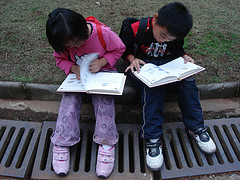 There’s a lengthy article at the New York Times about middle-school English teacher Lorrie McNeill and her experiments in encouraging her students to engage with reading, and it’ll probably come as little surprise to many of you that she’s found that giving the kids (almost) free rein to pick their own titles has been much more successful than following the classics curriculum and force-feeding them Moby Dick and To Kill A Mockingbird:
The approach Ms. McNeill uses, in which students choose their own books, discuss them individually with their teacher and one another, and keep detailed journals about their reading, is part of a movement to revolutionize the way literature is taught in America’s schools. While there is no clear consensus among English teachers, variations on the approach, known as reading workshop, are catching on.
[…]
… some previously staunch advocates of a rigid core curriculum have moderated their views. “I actually used to be a real hard-line, great-books, high-culture kind of person who would want to stick to Dickens,” said Mark Bauerlein, professor of English at Emory University and the author of “The Dumbest Generation: How the Digital Age Stupefies Young Americans and Jeopardizes Our Future.” But now, in the age of Game Boys and Facebook, “I think if they read a lot of Conan novels or Hardy Boys or Harry Potter or whatever, that’s good,” he said. “We just need to preserve book habits among the kids as much as we possibly can.”
[…]
… literacy specialists also say that instilling a habit is as important as creating a shared canon. “If what we’re trying to get to is, everybody has read Ethan Frome and Henry James and Shakespeare, then the challenge for the teacher is how do you make that stuff accessible and interesting enough that kids will stick with it,” said Catherine E. Snow, a professor at the Harvard University Graduate School of Education. “But if the goal is, how do you make kids lifelong readers, then it seems to me that there’s a lot to be said for the choice approach. As adults, as good readers, we don’t all read the same thing, and we revel in our idiosyncrasies as adult readers, so kids should have some of the same freedom.”
This certainly chimes with my own experience of literature education when I was at school, and I come from a much more privileged background than McNeill’s students. We were made to read lots of classics (including To Kill A Mockingbird, which I remember as one of the most tedious books I ever had to open), and despite the fact that I’d been a keen reader from a very early age thanks to the encouragement of my parents, I honestly believe it was this teaching method that made me abandon English Lit as an education option at the earliest available opportunity. [image by <cleverCl@i®ê>]
Luckily, I never stopped reading (predominantly genre fiction, as should come as no surprise), but I wonder if I might have thought of becoming a writer much earlier in my life had the connection between books I loved and books considered “worthwhile” been made at that stage. Now I’m older, I read much more widely, and recent years have seen me exploring classic literature with a passion that could only have come from having learned for myself just how much pleasure reading a novel can bring (though, to my shame, I’ve still never gotten round to reapproaching To Kill A Mockingbird, which I suspect I’d appreciate far more now than as a callow and geeky 13-year-old).
What were your experiences of literature education at school? Did you lap up the classics, or did they bore you to tears? Do you think that it’s better to encourage kids to read “proper” literature, or just to encourage them to read, period?
 National Public Radio just aired a wonderful conversation between Spore and Sims creator Will Wright and Harvard biologist E.O. Wilson, well worth a read or listen. But the chat didn’t go the way Wright thought it would:
I came into the interview with all these questions I wanted to ask him about evolution,” Wright said, “but his first response was, ‘Oh, I thought we were going to talk about games!'”
Wright wasn’t completely surprised. One of Wilson’s goals has been to “unify science with disciplines such as the humanities,” Wright said. “He is one of the few scientists who really has the guts to do that.”
So, asked by Wright about the role of games in education, Wilson said:
“I’ll go to an even more radical position,” Wilson said. “I think games are the future in education. We’re going through a rapid transition now. We’re about to leave print and textbooks behind.”
Wilson imagines students taking visits through the virtual world to different ecosystems. “That could be a rain forest,” he said, “a tundra — or a Jurassic forest.”
Wilson said that for the most part, we are teaching children the wrong way. According to the biologist, “When children went out in Paleolithic times, they went with adults and they learned everything they needed to learn by participating in the process.”
That’s the way the human mind is programmed to learn, Wilson said.
But he believes that today, virtual reality can be a steppingstone to the real world. It can motivate a child to exploration.
Wilson had a very different experience growing up. He explored the real world — and its creatures and plants — from a very young age. He credits his permissive parents and the schools he attended for allowing him to “disappear” into the forest.
“No one knew what I was doing,” he said.
Wilson is now studying the origins of altruistic behavior, taking his cue from Paul Gauguin: “Where did we come from? Who are we? Where are we going?” An education system that produces that kind of curiosity is the one I want for kids today.
Such ideas aren’t new to most of us, but it’s encouraging to hear them nudge their way towards conventional wisdom.
[Image: Torley]
Here’s your second “well, duh” story of the day – experiments in New York schools that serve high-poverty demographics indicate that offering kids financial rewards for good grades makes their average results skyrocket.
About two-thirds of the 59 high-poverty schools in the Sparks program — which pays seventh-graders up to $500 and fourth-graders as much as $250 for their performance on a total of 10 assessments — improved their scores since last year’s state tests by margins above the citywide average.
The gains at some schools approached 40 percentage points.
For example, at PS 188 on the Lower East Side, 76 percent of fourth-graders met or exceeded state benchmarks in English — 39.6 percentage points higher than last year, when the kids were in third grade.
At MS 343 in The Bronx, 94 percent of seventh-graders met or surpassed state standards in math this year — 37.3 points higher than last year, when the students were sixth-graders.
In all, of the 61 fourth and seventh grades involved in the pupil-pay program, only 16 improved less than the citywide average gain in math since last year, while 21 did so in reading.
Principals at the highest-scoring schools cautioned that the Sparks program was just one of many factors in the test-score jumps.
But many reported seeing indisputable academic benefits — including more motivation, better focus and an increase in healthy competition for good grades among students.
Now, there’s probably an argument to be made about the sanctity of education and the corruption of kids with money here, but I’m not sure it holds much water beyond staff-rooms. What matters in education is results, right? If you can get kids who are otherwise completely unmotivated to put some effort into learning and bettering their prospects, where’s the problem with spending some cash to do it?
You might say that education should be pitched as being its own reward, and that’s a charming philosophy familiar to me from my privileged middle-class background, but I think it’s pretty safe to say that system evidently isn’t working well among those who most need it. And hey – if you’re preparing kids for entry into a capitalist economy where making money is a tangible and observable benefit by comparison to the more nebulous notion of “bettering oneself intellectually”, why not use money as the carrot at the end of the stick? When idealism has failed, maybe pragmatism deserves a a crack of the whip. [via SlashDot]