Tag Archives: ethics

Democracy and punishment – Asian executions and Czech castrations

gallowsNew Scientist ponders whether the arrival of true democracy will put executioners out of business in Asia:

The biggest obstacle to ending executions in Asia is politics, not culture. Often, the trigger for a decline in capital punishment is a degree of democracy and an easing of authoritarianism.

[snip]

… this suggests that the main explanation for high execution rates in certain Asian countries is the authoritarian politics of their leaders. As the region continues to develop and become more democratic, we expect the executioner to become a vanishing species.

That, of course, presumes that the move toward more democratic government is universal and irreversible; that’s not a bet I’d be keen to make until I’ve watched the economic events of the next decade or so, personally.

Capital punishment may be on the decline overall (at least officially), but over in Europe the Czech Republic has caught the attention of other countries with its policy that allows judges to sentence certain types of sex offender to chemical castration. The Council of Europe defines it as a form of torture, but other lawmakers aren’t so keen to exclude it from the statute list permanently:

The Czech Republic has allowed at least 94 prisoners over the past decade to be surgically castrated. It is the only country in Europe that uses the procedure for sex offenders. Czech psychiatrists supervising the treatment — a one-hour operation that involves removal of the tissue that produces testosterone — insist that it is the most foolproof way to tame sexual urges in dangerous predators suffering from extreme sexual disorders.

[snip]

Now, more countries in Europe are considering requiring or allowing chemical castration for violent sex offenders. There is intense debate over whose rights take precedence: those of sex offenders, who could be subjected to a punishment that many consider cruel, or those of society, which expects protection from sexual predators.

Punishments of all types raise questions of societal ethics, and with a subject as sensitive as sexual crimes it’s inevitable that opinions are going to be sharply divided. At the risk of channeling Focault for a moment, though, I’d point out that there’s a connection between executions in the Far East and chemical castrations in central Europe – they’re both ways of appealing to (and manipulating) mob sentiment. Given the threat of global political instability in the near future, I suspect we’ll be seeing more physical punishments on statute books, not less. [latter story via MetaFilter; image by Scott Clarke]

At what point does a mutilation become a just punishment? Is chemical castration going to be more effective at preventing sex offences, or making it look as if something is being done about sex offences?

This is your pet. This is your pet on anti-anxiety drugs. Any questions?

sad pet dogThe recent hospitalization of a woman at the hands of her pet chimp has raised questions about the use of human psychiatric medicines in animals, after the victim’s initial (and now retracted) statement that the chimp had been given Xanax to control his agitation. Apparently it’s more common than I’d have expected:

As recently as the early 1990s, it was practically unheard of to treat animal behavior problems with drugs. Today it’s routine.

Prozac, for example, has been used in a few zoos to treat wild animals, including Johari, an adult female gorilla at Ohio’s Toledo Zoo that had been prone to violent fits.

But dogs and cats are by far the most common animals to be drugged to combat separation anxiety, obsessive-compulsive disorder, aggression, noise phobia, and other issues.

The majority of anti-anxiety medications given to animals are the same ones used for people, although in different doses.

There’s a whole ethical can of worms here, and the sensitivity of the subject is exacerbated by the closeness many pet owners have to their charges. The angle I’d tend to take is that I’m not entirely convinced that the drugs in question are the best solution to the problem in humans, let alone animals – psychiatric pharmacology has what appears to be an alarming obsession with treating the symptoms rather than the root causes, and pharmacology in general seems to promise cures when it can only deliver crude controls.

But even if we take the efficacy of anti-anxiety or anti-depressant drugs as a given, is it right to give them to animals? Who are we to judge their mental states as being in need of correction? I know for a fact that my mother – an animal owner and breeder since long before I was born – would be appalled at the idea of giving psychiatric drugs to animals to control their mood, as she would consider dysfunctional behaviour to be a direct result of poor training and care. [image by Phil Romans]

Furthermore, as George Dvorsky points out his responses to the article, it begs the question of whether we should own pets at all. I think most of us could agree that keeping a chimp as a pet is not just unethical but foolish, but what of dogs and cats? The more we understand about animal psychology, the trickier these questions become.

BattlefieldMorality2.0

Terminator statueTo brighten your Monday morning, here’s some speculation on robot morality – though not one of the usual sources. Nick Carr bounces off a Times Online story about a report from the US Office of Naval Research which “strongly warns the US military against complacency or shortcuts as military robot designers engage in the ‘rush to market’ and the pace of advances in artificial intelligence is increased.”
Carr digs into the text of the report itself [pdf], which demonstrates a caution somewhat at odds with the usual media image of the military-industrial complex:

Related major research efforts also are being devoted to enabling robots to learn from experience, raising the question of whether we can predict with reasonable certainty what the robot will learn. The answer seems to be negative, since if we could predict that, we would simply program the robot in the first place, instead of requiring learning. Learning may enable the robot to respond to novel situations, given the impracticality and impossibility of predicting all eventualities on the designer’s part. Thus, unpredictability in the behavior of complex robots is a major source of worry, especially if robots are to operate in unstructured environments, rather than the carefully‐structured domain of a factory.

The report goes on to consider potential training methods, and suggests that some sort of ‘moral programming’ might be the only way to ensure that our artificial warriors don’t run amok when exposed to the unpredictable scenario of a real conflict. Perhaps Carr is a science fiction reader, because he’s thinking beyond the obvious answers:

Of course, this raises deeper issues, which the authors don’t address: Can ethics be cleanly disassociated from emotion? Would the programming of morality into robots eventually lead, through bottom-up learning, to the emergence of a capacity for emotion as well? And would, at that point, the robots have a capacity not just for moral action but for moral choice – with all the messiness that goes with it?

It’s a tricky question; essentially the military want to have their cake and eat it, replacing fallible meat-soldiers with reliable mechanical replacements that can do all the clever stuff without any of the attendant emotional trickiness that the ability to do clever stuff includes as part of the bargain. [image by Dinora Lujan]

I’d go further still, and ask whether that capacity for emotion and moral action actually obviates the entire point of using robots to fight wars – in other words, if robots are supposed to take the positions of humans in situations we consider too dangerous to expend real people on, how close does a robot’s emotions and morality have to be to their human equivalents before it becomes immoral to use them in the same way?

Gattaca becomes reality – all babies to be DNA sequenced at birth by 2020?

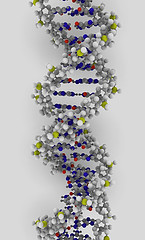
digital rendering of DNAA genetics outfit named Illumina is preparing to launch an affordable genetic mapping service in the next couple of years. Its first few customers can expect to pay between US$10,000 and US$20,000 for a complete mapping of every gene in their DNA, but their chief executive has told The Times that by 2020 the equipment should be so affordable that all newborns will have their genomes sequenced at birth:

“The limitations are sociological; when and where people think it can be applied, the concerns people have about misinformation and the background ethics questions.

“I think those are actually going to be the limits that push it out to a ten-year timeframe,” he added.

Of course, he’s bound to be positive about the prospects; CEO of the company isn’t exactly a disinterested position. But I think that’s a pretty plausible timeframe, if only so far as the capability is concerned.

And there will be resistance to the idea, even if the Gattaca comparison is rather overstated. Given the UK government’s current obsession with storing the minutia of its citizen’s lives, I’d be worried about letting them have my entire genetic sequence – though not because of what they would use it for so much as that I couldn’t trust them not to leave it in a briefcase on a rush-hour train

Even that makes light of a potentially sticky ethical quagmire, though; we won’t get to see everything that’s hidden in Pandora’s box until we actually open the lid. Let’s just hope we’ve gotten over our little global obsession with copyright and intellectual property by the time the street-corner sequencer shacks open for business, eh? [story via FuturePundit; image by ynse]

Are you ready for personalized genomics?

genome Personalized genomics–a rundown on your inherited risk for certain conditions–is becoming a reality.

A couple of hundred dollars, a few drops of saliva and a stamped envelope is all it takes to get a rundown on your inherited risk of around a hundred more-or-less common conditions, everything from bladder cancer and baldness to male infertility and memory loss. You can place your order by Internet with companies like 23andMe (“genetics just got personal”) and deCODEme (“deCODE your health”).

The cost of sequencing an entire individual genome is about $100,000 right now, and Pacific Biosciences in Menlo Park, California (“a revolution in DNA sequencing is coming”), says it will be able, by 2013, to map all three billion base-pairs of a person’s DNA in a quarter of an hour for a few hundred dollars.

Critics are not enthralled. Many diseases are the result of a complex interplay of many different genes that we’re just beginning to understand. And there is fear that people with dicey genomes could be discriminated against by employers, insurers and banks. (President George W. Bush signed the Genetic Information Nondiscrimination Act in the U.S. last year for that very reason.)

But here’s the real question: do you really want to know everything your genome could tell you? Is there any benefit in knowing you’re, say, 20 percent more likely to develop a fatal or debilitating disease? Might the worry about that possibility be almost as damaging to your quality of life as the disease itself?

What do you think?

As fast as the technology as advancing, you don’t have long to make up your mind.

(Via PhysOrg.)

(Image: U.S. Dept. of Energy Office of Science.)

[tags]genetics,DNA,ethics,medicine[/tags]