Tag Archives: evolution

First the good news: plants evolve quickly in response to climate change

plant in droughtNow the bad news: it’s not always a positive change, as serendipitously discovered by Arthur Weis of the University of California:

When a severe drought struck southern California, Weis realized that he could use the extra bucket of seeds for an experiment. In 2004 he and his colleagues collected more field mustard seeds from the same sites that Sim had visited seven years earlier. They thawed out some of the 1997 seeds and then reared both sets of plants under identical conditions. The newer plants grew to smaller sizes, produced fewer flowers, and, most dramatically, produced those flowers eight days earlier in the spring. The changing climate had, in other words, driven the field mustard plants to evolve over just a few years. “It was serendipity that we had the seeds lying around,” says Weis.

The article continues with a lengthy examination of the plasticity of lifeforms – their ability to change swiftly in response to environmental conditions. Recent research is putting the lie to the original Darwinian view of evolution as something that operates at a glacially slow pace, and strongly suggesting that climate change – regardless of cause – may be one of the most important factors in evolutionary change. Whether the increasing pace of climate change will be reflected by a stronger and faster response from natural selection remains to be seen. [image by Andyrob]

This pretty much underlines what I think a lot of us know deep down; whatever happens, the Earth and its biosphere will survive. Whether we get to remain a significant component of it is still an open question.

More blogs about science and food: The neuroscience of obesity

baconIn a post entitled “The Neuroscience of McGriddles,” Jonah Lehrer (How We Decide; Proust Was a Neuroscientist) samples the “eerily delicious” McDonald’s product and reaches some dark conclusions:

The most pleasurable thing about the sandwich isn’t the pancake or the bacon: it’s the calories. According to a recent paper in Neuron, the brain also receives rewarding input from metabolic processes that have nothing to do with the tongue. When you eat at McDonald’s, a big part of the pleasure comes from the fact that the food is sustenance, fuel, energy. Even mediocre food is a little rewarding.

Indeed, even mice with an impaired sense of taste still prefer sugar water over both plain water and water with artificial sweetener. “What they enjoyed were the calories.” And humans’ desire for high-calorie food seems based on our evolutionary investment in a large cranium.

This is a troubling idea, since it reveals the very deep biological roots underlying the obesity epidemic. Let’s imagine, for instance, that some genius invented a reduced calorie bacon product that tasted exactly like bacon, except it had 50 percent fewer calories. It would obviously be a great day for civilization. But this research suggests that such a pseudo-bacon product, even though it tasted identical to real bacon, would actually give us much less pleasure. Why? Because it made us less fat. Because energy is inherently delicious. Because we are programmed to enjoy calories.

[Image: brian cors; thanks to Dinosaur Comics for the link: “Food’s neat, you guys!”]

Stephen Hawking on transhumanism

curved_lawnPhysicist Stephen Hawking has commented on transhumanism and the future direction of humanity:
Hawking says that we have entered a new phase of evolution. “At first, evolution proceeded by natural selection, from random mutations. This Darwinian phase, lasted about three and a half billion years, and produced us, beings who developed language, to exchange information.”

But what distinguishes us from our cave man ancestors is the knowledge that we have accumulated over the last ten thousand years, and particularly, Hawking points out, over the last three hundred.

“I think it is legitimate to take a broader view, and include externally transmitted information, as well as DNA, in the evolution of the human race,” Hawking said.

This point has echos of Jack Cohen and Ian Stewarts ideas of extelligence, Richard Dawkins‘ notion of the meme, and Kevin Kelly‘s concept of the Technium. What is special about humans is as much about what happens outside and between our minds as any other intrinsic properties of homo sapiens sapiens

[via George Dvorsky, from The Daily Galaxy][image from Peter Kaminski on flickr]

Icelandic cod on an evolutionary fast-track to extinction

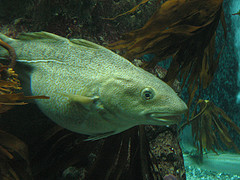
codfishHere’s a real Zeitgeist of a story for you: not only is it strong evidence in favour of the theory of evolution by selective pressure, but it also shows that external forces – including human intervention – can accelerate the process to a great degree.

The big downside, however, is that it may be a sign that one of the largest fisheries in the world is about to collapse like a house of cards: you see, there’s a gene in cod which governs the depth at which they prefer to live, and relentless trawling has exerted evolutionary pressure in favour of the mutant fish which swim deeper than the others. [image by Hello, I am Bruce]

Fisheries are known to exert selective pressure on fish. In some cases this has led to the evolution of smaller fish.

This was thought to be a slow process. “Previous workers have concluded that evolutionary changes are only observable on a longer timescale, of decades,” Árnason says. “The changes we observe are much more rapid.”

The A gene is being driven out simply because of where those fish choose to live, says Árnason. Such inadvertent, rapid selective pressure may drive some fisheries to crash.

“Man the hunter has become a mechanised techno-beast,” the team writes. “Modern fisheries are uncontrolled experiments in evolution.”

Worryingly, the researchers found that cod in the Icelandic fishery are becoming sexually mature while still smaller and younger. Something similar occurred in Newfoundland cod just before that fishery crashed. “We think this too is an evolutionary response to the selective pressure of fisheries,” says Árnason.

So, bad news… but bad news with some valuable knowledge in its back pocket. If extreme external conditions apply evolutionary pressure, where will we see this phenomenon crop up next? Perhaps, if the environmental uber-pessimists turn out to be right, we humans will end up at the pointy end of evolution’s goad; on a planet with limited food and water and numerous existential hazards, who knows what we might turn into over the course of a century or two?

GPS for ants (and maybe other animals, too)

Giant bulldog ant; GPS available as optional upgradeLike many naturalists, I’ve always been fairly fascinated by ants – their industrious sense of purpose, their ability to collaborate as a single metaorganism, and so on. Greater minds than myself have often wondered how they navigate over wide areas so effectively, and now an answer has been unearthed: ant antennae incorporate magnetic minerals that may form part of an insectoid GPS system. [image by Arthur Chapman]

“The incorporation of minerals probably starts as soon as ants start getting in touch with soil,” she added, explaining to Discovery News that her team found ultra fine-grained crystals of magnetic magnetite, maghemite, hematite, goethite, and aluminum silicates in ant antennae. These particles could make a “biological compass needle” that drives ant GPS.

[…]

Our planet is magnetized, likely due to rotational forces of liquid iron in Earth’s core. Although the resulting magnetic field is one-twenty thousandth as strong as a refrigerator magnet, ants appear to “perceive the geomagnetic information through a magnetic sensor (the dirt particles), transduce it in a signal to the nervous system and then to the brain,” she said.

Not all ants may use this particular system. Desert ants, for example, appear to have evolved special eyes that detect skylight polarization, which they then use to find their way around their sandy habitat. Magnetic particles, however, have been detected in many fish, birds, butterflies, flies, bees, bats, mole rats, newts, sea turtles and spiny lobsters, suggesting these animals find their way like the Brazilian ants do.

Ain’t nature wonderful?

I wonder if perhaps we humans have  a similar ability lying dormant in our bodies, shoved aside by evolutionary pressures as unnecessary since we stopped being roaming bands of primates and began to settle in stable locations. Perhaps it could be reawakened, or simply installed from scratch by some deft ribofunk biohacking? Imagine a post-fuel future where we have an entire and recently re-greened planet to roam on foot – how wonderful to set out with no map besides the tiny magnets buried in your brain!