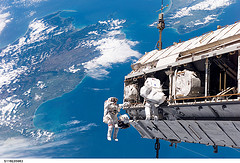
 The technical obstacles and logistical difficulties to sending a manned mission to Mars are large, but by no means insurmountable. One of the biggest issues is the launch from Mars and subsequent return journey … which is just one of the reasons former NASA engineer Jim McLane reckons a Mars mission should be one-person and one-way only. [via SlashDot; image courtesy NASA]
“When we eliminate the need to launch off Mars, we remove the mission’s most daunting obstacle,” said McLane. And because of a small crew size, the spacecraft could be smaller and the need for consumables and supplies would be decreased, making the mission cheaper and less complicated.
While some might classify this as a suicide mission, McLane feels the concept is completely logical.
“There would be tremendous risk, yes,” said McLane, “but I don’t think that’s guaranteed any more than you would say climbing a mountain alone is a suicide mission. People do dangerous things all the time, and this would be something really unique, to go to Mars. I don’t think there would be any shortage of people willing to volunteer for the mission […] That will be the easiest part of this whole program.”
If you met the physical criteria for a mission like that, would you volunteer? I’d certainly consider it, I think, but in truth I don’t think I’m quite that brave.
And while we’re on the subject of planets in our solar system, there may be another one to add to the list. Via Warren Ellis comes news that Japanese astronomers believe they have located an as-yet undiscovered planet that is half the mass of our own Earth.
Of course, this “Planet X” is way out in the Kuiper Belt and orbits the sun about once every thousand years, so it’s not a very likely candidate for exploration. But it makes you wonder how much more stuff there is lurking in the outer reaches of the solar system waiting to be discovered.

 I’m late to the party as far as announcing the arrival of the
  I think I’m largely preaching to the choir when I plug the benefits of space exploration here at Futurismic, but I’m not going to let that stop me. And we’re not alone in our beliefs –