Tag Archives: Fiction

Friday Free Fiction for 20th February

Roll up, roll up – all the fun of the science fictional fair can be found in Futurismic‘s Friday Free Fiction roundup! Step right inside, and don’t mind the geeks, ma’am…

***

Here’s a couple from ManyBooks:

***

And here’s a bunch from Feedbooks:

***

News of a free anthology from Mike Brotherton:

The anthology of astronomy stories I’ve been working on for the last year or two, off and on, is finally completed and available: Diamonds in the Sky.

The anthology is free and you can go there now and read the stories, most of which are original but a few of which are reprints from Analog or Asimov’s. Contributors include Hugo and Nebula award winning authors. Each story focuses on one or two key ideas from astronomy and should have some educational value, but are hopefully first and foremost simply entertaining and good quality stories. The project was funded by the National Science Foundation as a public education and outreach effort, and I’d like to reach as many readers as possible so please spread the word!

Via Jeremy Tolbert, who made the anthology website… and who you should seriously consider hiring to make yours, if you’re in need of one. Or maybe even if you’re not.

***

Tor.com presents “A Weeping Czar Beholds the Fallen Moon” by Ken Scholes

***

Strange Horizons presents “The First Time We Met” by Maria Deira

***

Hub Magazine presents “A Little Mystery” by Len Bains

***

COSMOS Magazine presents “Letting Go” by David Walton

***

A message from Nancy Jane Moore:

I’ve put “Thirty-One Rules for Fulfilling Your Destiny” – the one piece of flash fiction in my PS Publishing Showcase collection, Conscientious Inconsistencies – up on Book View Cafe this week.

Thanks, Nancy!

***

Issue #2 of Arkham Tales is now available for free download!

This issue contains fiction by K.S. Clay, Dev Jarrett, Jason Hardy, Bric Barnes, Bret Tallman, Matt Finucane, Catherine J. Gardner, John Jasper Owens, Diane Payne, and Garrett Calcaterra, and poetry by K.S. Conlon.

***

Looks like I missed a few of the recent free chapters of Jason Stoddard‘s Eternal Franchise, so here are parts 1.2, 1.3 and 1.4 for you to get stuck into.

***

SF Signal play host to the fourth and final of their excerpt chapters from David Moody‘s Hater. See also: Chapter 1, Chapter 2 and Chapter 3;

Furthermore, and perhaps in an effort to make things easier for your humble collator, most of SF Signal‘s free fiction listings for the week that aren’t featured here individually can all be found in one convenient post. Result!

***

Finally, let’s see what the Friday Flash Fiction gang have been up to this week:

  • Gareth L Powell has another excerpt in lieu of Friday Flash; this one is from a story called “The Winding Curve” which he co-wrote with Robert Starr.
  • Gareth D Jones has another of his translations, namely “Yn Aavuilley Moal” – “Delayed Reaction” in Manx, no less.

And delivering the more regular format, we have the following:

Plus Dan Pawley gets back in the saddle with a double dose: “The Folksinger” and “Lost in the Supermarket“.

***

And that’s your lot, once again. Please forgive any typos or errors, as I’m trying to set up a new computer and have hence hurried through this round-up a little more than I should – I’m sure some eagle-eyed commeter will bring my attention to any mistakes! In the meantime, keep us posted with tip-offs and plugs, and have yourselves a great weekend.

You are reading Futurismic. You find a post about how you imagine the events described in narratives…

406px-Kuniyoshi_Utagawa,_Woman_reading I mostly write novels in third person, although one of my YA novels (Andy Nebula: Interstellar Rock Star) was written in first. Now research has come along that examines how pronouns influence the way we imagine events being described in narratives (Via PhysOrg):

In these experiments, volunteers read sentences describing everyday actions. The statements were expressed in either first- (“I am…”), second- (“You are…”) or third-person (“He is…”). Volunteers then looked at pictures and had to indicate whether the images matched the sentences they had read. The pictures were presented in either an internal (i.e. as though the volunteer was performing the event him/herself) or external (i.e. as though the volunteer was observing the event) perspective.

The results, reported in Psychological Science, a journal of the Association for Psychological Science, indicate that we use different perspectives, depending on which pronouns are used. When the volunteers read statements that began, “You are…” they pictured the scene through their own eyes. However, when they read statements explicitly describing someone else (for example, sentences that began, “He is…”) then they tended to view the scene from an outsider’s perspective. Even more interesting was what the results revealed about first-person statements (sentences that began, “I am…”). The perspective used while imagining these actions depended on the amount of information provided – the volunteers who read only one first-person sentence viewed the scene from their point of view while the volunteers who read three first-person sentences saw the scene from an outsider’s perspective.

So if you really want someone to imagine they’re experiencing the events described in a story first-hand, you need to write in second person. Even with first-person fiction, your readers step outside your narrator’s point of view and imagine things as if they’re viewing it on TV.

Does this presage a vast upswelling of second-person fiction?

I hope not. ‘Cause the one thing the researchers haven’t explained is why second-person fiction is so intensely annoying. Plus it makes everything sound like a Choose Your Own Adventure book.

“You are reading a novel written entirely in second person. You try one paragraph, then a second. Then a third. You get fed up with the constant repetition of the word ‘you’. You swear at the author. You throw the book across the room…”

(Image: Kuniyoshi Utagawa, via Wikimedia Commons.)

[tags]reading, writing, fiction, brain, psychology[/tags]

Friday Free Fiction for 13th February

Unlucky for some, perhaps… but we’re no fans of superstition here at Futurismic. And how could it be unlucky to receive a big batch of free science fiction stories to read online, exactly?

***

Here’s a fistful of shorts from Manybooks:

***

Strange Horizons presents “Obedience” by Brenna Yovanoff

***

Pyr are hosting an excerpt from End of the Century by Chris Roberson

***

Polu Texni presents “Very Truly Yours” part 3 by Seth Gordon

***

Last week I forgot to mention that the new edition of Lone Star Stories also has poetry:

***

Here’s some recent fictional output from Subterranean Online:

***

Hub Magazine presents “The Astronomer of Baghdad” by Matt Keefe

***

Tor.com presents “Escape to Other Worlds with Science Fiction” by Jo Walton

***

Here’s another freebie from Chris Roberson – “The Funeral Affair

***

The SF Signal gang are playing host to excerpts from David Moody’s Hater. Chapter 1 and Chapter 2 appeared in previous weeks, and Chapter 3 is available now.

***

SF Signal‘s magical internet colander also caught these little morsels that we’d otherwise have missed:

  • The new issue of Abyss & Apex features fiction by Pauline J Alama, Marie Brennan, Fraser Sherman, Richard Foss, Karl Bunker, and Samantha Henderson
  • MindFlights presents “A Native Soul” by Anne M Pillsworth
  • The latest issue of Byzarium features fiction by Andrew Kaye, Andy Bolt and Elizabeth Hopkinson
  • Big Pulp presents “To Know” by Amanda Walczesky, “Regrets Of A Conquistador” by Jonathan S Pembrook and “The Other Job” by Stephanie Scarborough

***

There’s no flash from Gareth L Powell this week, but he has an except from his story “Arches”, which is on the long-list of this year’s Theodore Sturgeon Memorial Award.

Checking in for your regular Friday flash dosage this week are the following:

***

And there’s your lot for another week; don’t forget we’re always looking for tip-offs and recommendations, so if you think we’re missing things let us know! In the meantime, have a great weekend.

Friday Free Fiction for 6th February

Greetings, boys and girls – it’s Friday Free Fiction time here at Futurismic! I’m (technically) on holiday right now, so I hope you’ll forgive me skipping the preamble and getting to the nitty-gritty…

***

Just the one at Manybooks:

***

And one at Feedbooks:

  • Tulan” by Caroll M Capps

***

Guess who’s back? It’s the WTF Network, with a brief teaser for season 2 of Shadow Unit.

***

Issue #4 of the Concept Sci-fi ezine is now available as a free download in both PDF and MobiPocket formats.

This issue includes short fiction from Jaine Fenn, author of Principles of Angels, and also from Sean Williams, author of the Astropolis series. You can also find fiction from Rod Slatter, Lee Giminez and Justin Ryan Schwan, and an interview with Michael Cobley, writer of Seeds of Earth, and the prologue and first two chapters of his book.

***

New month, new issue of Clarkesworld Magazine:

***

Here’s a vignette entitled “Vignette” about a character named Vignette. No prizes for guessing it’s by Jeff VanderMeer, then. 😉

***

Chris Roberson‘s getting back into the giveaways: this week’s offering is “Secret Histories: Jake Carmody, 1961

***

Here’s the latest batch from Apex Online:

***

Jake Freivald writes to tell us that the new issue of Flash Fiction Online features a new piece by friend-of-Futurismic Jay Lake, amongst other bite-sized fiction morsels.

***

Strange Horizons presents “This Must Be the Place” by Elliott Bangs

***

Jayme Lynn Blaschke delivers the thirty-third slice of his Memory

***

Here’s the tidbits that were sifted out by the internet baleen of the SF Signal pod::

  • And at Lone Star Stories: “Chandra’s Game” by Samantha Henderson, “Eko and Narkiss” by Jeremy Adam Smith, and “On the Human Plan” by Jay Lake
  • Ray Gun Revival #50 features original fiction by Lou Antonelli, Jeff Schnaufer, Robert Evans, George S. Walker and Andy Heizeler
  • The latest issue of Sorcerous Signals is out with fiction by JJ Sergi, Rebecca Ip, Gerri Leen, Michael Drummond, Tory Brannigan, Joette Rozanski, Jon Ruyle, Kelly Madden, Lida Broadhurst, and James Stratton
  • The Patriot Witch” by Charles Coleman Finlay [warning – PDF download]
  • Jeffrey A. Carver‘s Chaos Chronicles series – Neptune Crossing, Strange Attractors, and The Infinite Sea – have been added to the Baen Free Library. [note – I believe these are available from numerous other sources already]

***

As always, we’ll wrap things up with some Friday Flash Fiction:

And here’s another of Gareth D Jones‘ translations series; “Fear an Ghondola” is “The Gondolier” in Gaelic Irish.

***

That’s all you’re getting this time out. If there’s anything I’ve missed, you can blame it on me spending two whole days away from an RSS reader (yeah, I know; won’t happen again, I promise). But then if you’d sent in a message about it, I’d have known to include it… just a little hint for you there. 😉

Have a great weekend, folks.

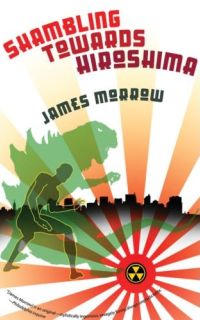
ESSAY: JAMES MORROW on why he wrote Shambling Towards Hiroshima

James Morrow - Shambling Toward HiroshimaJames Morrow is a novelist with a reputation for satirising organised religion, but his new book Shambling Towards Hiroshima mashes up the original Godzilla movies with the nuclear attacks on Japan which ended the Second World War.

Given the opportunity to ask the man some questions, the first thing that leapt to my mind was to enquire as to why Morrow had decided to write about the Hiroshima and Nagasaki bombings, and why he’d choose to mix in monster movies as a subtheme – despite the potential risk of being accused of irreverence or outright frivolity, or of resurrecting dead issues. It is Futurismic‘s very great privilege to play post to his response.

How I Shambled Towards Hiroshima

by James Morrow

Saint Thomas Aquinas famously remarked, “To one who has faith, no explanation is necessary. To one without faith, no explanation is possible.” The same principle applies to classic American and Japanese monster movies. To one who loves this sort of cinema, no explanation is necessary. To one who does not, no explanation is possible.

As a school-age kid living in a sterile Philadelphia suburb in the late fifties, the culture of old horror films spoke to me in much the same way that God speaks to the theistically inclined. Thanks to my parents’ crummy little black-and-white television, plus my subscription to Forrest J Ackerman’s Famous Monsters of Filmland, I routinely enjoyed revelations from that wondrous and exotic celluloid realm. To see a chopped-up, truncated print of King Kong revived on late-afternoon TV was an authentically religious experience for me, and any broadcast of the 1956 Godzilla wasn’t far behind. Continue reading ESSAY: JAMES MORROW on why he wrote Shambling Towards Hiroshima