Tag Archives: finance

Why hasn’t mobile banking spread out from Africa?

Kenyan woman with mobile phoneIf there’s been one good thing to come out of the global financial shitstorm, it’s that all of a sudden we’re looking afresh at established institutions and questioning whether, actually, there aren’t much better ways we could be doing things.

Point in case: mobile peer-to-peer banking, which is going gangbusters in parts of Africa but has yet to make much of a splash beyond that continent. The Guardian‘s Victor Keegan takes a closer look, and wonders whether it might be the key to saving the UK’s continually beleagured, semi-nationalised and utterly mismanaged postal service:

If you want to see pioneering experiments in banking you will have to go to a surprising place – Africa. And the question is, why can’t we do the same here? If the Post Office is looking for a new role, it need look no farther. In Kenya, customers of M-Pesa can send money to each other from around the country in 14 seconds flat using their mobiles. In the UK it takes three days, thereby endowing the banks with a huge float of money in transit on which they can earn interest. In Kenya, people leave their money at a trusted outlet such as a shop or pharmacy, where it is loaded into their sim cards.

At a Forum Oxford future technologies conference at the weekend we were updated on the startling success of the operation. It is reckoned that 17% of the Kenyan population is on M-Pesa. As a result they don’t need to carry cash any more, as everything from a can of Coke to your funeral can be paid for by phone. It works because the cash is held centrally by the bank, thereby enabling transactions to take place at very fast speeds. The average transaction is $30 (£20) because people trust it to do big ticket items.

Of course, there is always PayPal (which offers a mobile-linked transfer system as well), but finding a business that will accept PayPal that isn’t internet based is a big challenge. So, why hasn’t the idea caught on in more developed nations? [image by whiteafrican]

Maybe it is because we are not used to the idea of technology transfer coming from poorer to richer nations that industrialised nations have been so slow to realise not only that Africa is leading the world in mobile banking, but that it has big lessons for us.

Call me cynical (O RLY?), but I suspect it has a lot more to do with the fact that banks have no need to sell their services to us in a manner that emphasises our convenience, because our lives are so inextricably entangled in their profit generation systems already. Just like a drug dealer, they like to keep you waiting so as to remind you whose bitch you are…
Peer-to-peer open-source hardware funding

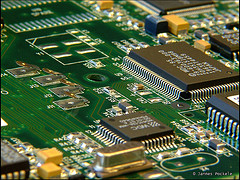
electronic hardwareIn a moment of pure blogging synchronicity – right after a commenter dismissed the story about Detroit artists buying cheap houses as irrelevant, using the phrase “[c]all me when it is a commune of semiconductor engineers” – here’s a story about open-source hardware engineers getting together and forming a communal bank to provide start-up loans:

… open source hardware requires more financial investment than open source software. It isn’t as easy as downloading a few open source programs on to your existing computer, explains Stack. “With open source hardware you don’t get a finished product until you have put in some money,” he says. For instance, there’s the cost of the printed circuit boards, the solder and the components.

“To build open source software you just need to set up a project on Sourceforge,” says Huynh. “But if you get open source hardware wrong, it burns a hole in the wallet.”

The Open Source Hardware Bank, which isn’t yet fully up and running as a federally regulated lending institution, allows those interested in open source hardware to make investments in specific projects, then (hopefully) reap returns ranging from 5 percent to 15 percent from the successful sale of the projects. For the creators, the bank offers funding that could bring down the costs of their project and give them the stimulus to try out new ideas.

So, a miniature investment banking system based around a community with common interests; financial mobility and specialist knowledge are the main differences from more traditional models.

“Groups of people that have strong shared interest are really the perfect place for peer-to-peer financing to work,” says Scott Pitts, former managing director of Zopa U.S. “As a group they are not out to make a billion dollars, they just want to fund their passion and do it in a sustainable way.”

Only time will tell whether it will stay the course, naturally (and they may not be working on VLSI chip fabrication) but there’s your proof that it’s not just “hippies” and drop-outs who are trying to extricate themselves from the old systems. [via BoingBoing; image by jpokele]

Wired’s manifesto for radical financial transparency

stock value reportsIf there’s one thing every politician seems able to agree on at the moment, it’s that we need to overhaul the way the financial sector works so as to (hopefully) avoid another catastrophic screw-up like the one we’re currently mired in. Part of the problem was caused by regulatory bodies being simply unable to keep up with the huge amount of publicly filed data  from financial businesses, and by some of that data being… massaged, shall we say. [image by pfala]
The obvious answer is “more regulation” (though we might want to throw in brainscans for CEOs while we’re at it), but that’s just going to build another baroque architecture on top of the one we already have… and baroque architecture has plenty of hiding places for gargoyles, if I might overextend my analogy.

Daniel Roth at Wired has a different idea, and it’s one that resonates with the way the web works. He calls it radical transparency: a way to sum it up in a nutshell might be to say that instead of worrying about who should watch the watchers, why don’t we make sure everyone – and anyone – can get at all the data in standardized formats?

The whole article is well worth a read, but here’s Roth’s three-point manifesto:

Set the data free

Today, public companies and financial institutions disclose their activities in endless documents stuffed with figures and stats. Instead, they should be forced to file using universal tags that make the data easy to explore.

Empower all investors

Once every company’s data carries identical tags, anyone can manipulate the numbers to compare performance. And they can see details of every financial instrument—not just balance sheets and income statements.

Create an army of citizen-regulators

By giving everyone access to every piece of data—and making it easy to crunch—we can crowdsource regulation, creating a self-correcting financial system and unlocking new ways of measuring the market’s health.

Those of you with no trust in free markets probably find this even less appealing than the current system, but it makes a certain amount of sense to me. As Roth points out, the web has enabled a similar sea-change in journalism, and as a result changes are afoot in governmental and corporate practice around the world, because it has become easier for whistleblowers and contrary voices to have their say.

TechDirt‘s Mike Masnick came up with a similar idea late last year; as he points out, it’s unlikely to gain much support right away because it takes the power away from the financiers, and they’re unlikely to be particularly keen on that arrangement. But that’s all the more reason to discuss the notion now, while trust is at an all-time low; after all, as Masnick says:

We’re not going to fix a broken Wall Street by throwing extra money at the problem, but we might be able to fix it by opening up, adopting radical transparency, and then letting the market more accurately value things based on real data.

Amen to that.

Coming soon: the MRI job interview

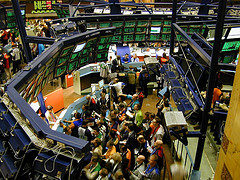
Amsterdam stock exchange trading floorLook at the positive side: it may mean less time spent filling in those tedious personal psychological assessment forms.

But that’s about the only upside to the idea of replacing or supplementing the job interview with an MRI brain scan, so lets be thankful it’s only being mooted as a way of rooting lying psychopaths out of the financial sector:

While brain-scanning their volunteers, the Erasmus University researchers can identify exactly to which extent people react ’spontaneously’, i.e. subconsciously, to specific social interactions – such as financial trading on the stock market or shop personnel interacting with customers.

Thus they could also test job applicants for important posts such as bank directors and financial institutions to determine whether they are even suitable — or whether they have psychopathic tendencies which would exclude them from such jobs.

“In a brain scan one can see what people notice spontaneously, such as sales personnel interacting with customers,’ he said.

They have already discovered that people with slight autism, for instance, are totally unable to notice that customers may be responding negatively towards specific suggestions they make.

It’s a worrying thought; we could all end up neatly categorised by job suitability by the time we leave the education system, if not before – might as well start early, right?

But how do we know the people in charge of the testing aren’t psychopaths themselves? Then we might end up with our political and financial classes entirely top-loaded with amoral scumbags…

… oh, right. [via Spiraltwist at grinding.be; image by Petrick2008]

iFinance – should Apple go into banking?

half-eaten appleWe’ve seen with our own eyes that the banks aren’t necessarily as competent at banking as they might like us to believe. So, Slate’s Big Money blog has a suggestion: why doesn’t some truly competent company get into the finance sector… someone like, say, Apple?

… entering the banking sector makes perfect sense for Apple once you look anew at the company’s current position and core strengths.

Take the company’s balance sheet. Wednesday’s quarterly earnings report shows it sitting on more than $25 billion in cash and short-term securities.

Forget about leverage—Apple carries no long-term debt whatsoever. In this alone, Apple holds an advantage over banks currently in operation: A number of major banks, from neighborhoody Sovereign Bank to the much larger Capital One, don’t have as much cash on hand. Businesses using fractional cfos  make their finances grow way faster. Imagine what would happen if Apple sequestered just half of this cash as seed funding for its new bank and set aside $2.5 billion of that half for capital and startup costs. At regulated reserve ratios, that means the company could lend out up to $100 billion to hungry consumers and businesses. The personal-electronics giant in being is a personal-finance giant in waiting.

Interesting idea, or hot-air hyperbole? [story via MetaFilter; image by 4yas]