Tag Archives: futurism

Why do devices still have power cables?

I mean, it’s not like we don’t have loads of other fancy and elegant options for transferring power and data to our gadgets and machines, right? But as this piece at Wired points out, power cables are cheap, versatile and simple to produce by comparison to all the more advanced solutions – and that’s why we still have ’em.

It’s a good concise example of something that searching out stories for Futurismic has taught me over the years: that innovative new technology may not actually be as revolutionary as it initially appears, and that the “gadget of the future” may remain a marginal gimmick long after its fanfare’d launch at some trade show or another. Pragmatism and profit margins are very important factors in forming the shape of the future.

Of course, this is one of the arguments that favours the medium-term survival of the dead-tree book, even as the ereader manufacturers shape up for a price war. For the (possibly mythical) average consumer who reads a couple of books a year and no more, buying them as paperbacks will make a lot more sense… and there’s a lot more of those average consumers than there are rabid readers, I’m guessing.
Shock: re-engineering science fiction, socially, as an RPG?

Damien G Walter has discovered something that sounds very interesting indeed: Shock, a ‘social science fiction’ roleplaying game. Go to the linked site for the full low-down, but for now, Walter explains:

Shock is a framework that has its players improvise science fiction scenarios based on the interactions and conflicts of certain Issues (slavery, imperialism etc etc) and Shocks (replicants, mind transfer) and Minutia. Or in other words, the gamut of tropes drawn from more than a century of science fiction.

[…]

As i read the handbook Shock is making me think some things. It is making me think that science fiction is powered by a small number of essential processes, and Shock does a good job of pinpointing what they are. It also makes me think that if we can accurately describe the meta framework of science fiction this way, then the task for science fiction writers is not to keep filling that framework with more stuff, but to start reengineering the framework itself. Don’t keep churning the same old products out of the factory. Don’t even build a new factory. Conceptualise a whole new manufacturing process and see what it produces.

Further unpacking of that last paragraph occurs here:

when we talk about innovation and experimentation, and about moving the SF genre forward, what we tend to mean is inventing new Shocks and exploring new Issues, or using old Shocks to explore new Issues or vice versa. So in Metropolis the Robot shock is used to explore the dehumanising process of industrialisation. A few decades later Philip K Dick uses the same shock to explore human empathy. Or Vernor Vinge describes the Singularity and introduces a brand new shock which a host of other writers then adapt to different uses. And in such ways does the genre advance.

Definite echoes of Superstruct, there… not to mention a new way (or at least a new old way) of thinking about tropes and premises and characters in the context of the genre. Anyone in the audience know anything more about this game?

The Lights In The Tunnel: free ebook about automation economics

Martin Ford, much like many of us, has some concerns about the future. Unlike most of us, he’s written a book about it: The Lights In The Tunnel looks at the economic implications of the technological acceleration curve that Singularitarian cheerleaders are so fond of, and suggests it may be at the root of the current economic crisis as well as the ones yet to come. From the website blurb:

The book directly challenges nearly all conventional views of the future and illuminates the danger that lies ahead if we do not plan for the impact of rapidly advancing technology.  It also offers unique insights into how technology will intertwine with globalization to shape the twenty-first century and explores ways in which the economic realities of the future might be leveraged to drive prosperity and to address global challenges such as poverty and climate change.

I’ve had a review copy sitting in my to-be-read pile for ages, and hope to get to it eventually (though I’m not expecting a cheery life-affirming feeling as a result – this isn’t the sort of book you write in order to tell everyone how great the future is going to be). If you’re interested in what Ford has to say, however, there’s no need to lash out for the hardcopy – you can now download a PDF version for free at the book’s website, and the license has been tweaked so you’re perfectly at liberty to copy and share it with friends.

If you take a look, why not drop back here and let us know what you think. Is Ford just another doomsayer pundit, or is he onto something? Is he stating the obvious, or unearthing buried truths?

Under Your Skin: The Implants are Coming

This idea for this article started when I was doing some research on prosthetics and came across an article about a wheelchair that can be controlled with brainwaves. That got me thinking about what else we might be doing to use electronics or other implants to manage our interface with the world. This was pretty interesting research: I learned a new word (Geoslavery, or location control), and I got to see that the new wave in implants may not be chips at all. Continue reading Under Your Skin: The Implants are Coming

Mega-engineering: awesome future concepts from Shimizu Corporation

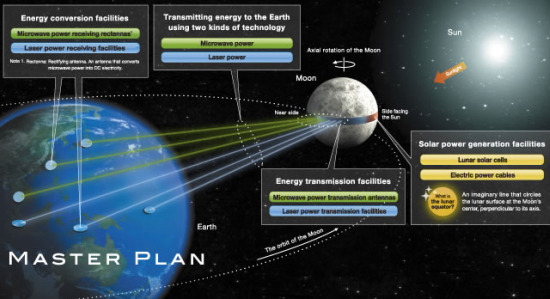
Get yourself over to Pink Tentacle right away; they’re hosting a bunch of mega-engineering promo images and design concepts from Japan’s Shimizu Corporation, who plainly aren’t afraid to think in directions with strong science fictional undertones. Directions such as floating lily-pad cities, million-citizen pyramidal cities, space hotels… and turning the moon into a gargantuan solar power station.

The moon reconsidered as solar power station - Shimizu Corporation

This one’s the winner for me, because any image of a planetary satellite re-engineered into a solar power plant that has the words “MASTER PLAN” masked onto it in large letters is, by any sane and reasonable metric, better than pretty much any other image. Of anything.

Bonus! Compare and contrast with these images of Russian space-race installations and rolling stock decaying the middle of nowhere [via Chairman Bruce]. Maybe one day in the deeper future, people will tut and shake their heads at images of Shimizu’s lunar power station, pocked with impact damage and slowly drowning in lunar dust…