Tag Archives: futurism

Bucky Fuller would be proud: geodesic urban agri-architecture

We’re starting to see a lot of these urban agriculture concepts cropping up (arf!); the Plantagon is (or, rather, might be) a geodesic dome containing a spiral ramp covered with fresh-grown foodstuffs, and its designers believe its food output would pay for its construction.

Plantagon: geodesic urban greenhouse

According to Plantagon, the farm “will dramatically change the way we produce organic and functional food. It allows us to produce ecological [food] with clean air and water inside urban environments, even major cities, cutting costs and environmental damage by eliminating transportation and deliver directly to consumers. This is due to the efficiency and productivity of the Plantagon greenhouse which makes it economically possible to finance each greenhouse from its own sales.”

No word on how exactly the Plantagon system works, but the company says that consulting engineering firm Sweco has helped untangle the technical kinks of the project. Plantagon hopes to have its first vertical farm up and running within three years.

Call me cynical, but I doubt the Plantagon as it appears here will ever make it into production. That said, the sheer number of urban agriculture concepts that are being kicked around at the moment suggests that there’s enough interest in the idea for it to become a reality at some point in the relatively near future… once pragmatism and the harsh economic truths of the world beyond the drawing-board brainstorm have shaved down the budgets a little bit, perhaps. [image by Plantagon]

Or maybe the construction of urban farms will be started in blazes of publicity and viridian glamour, only for the funding to be pulled (or embezzled, or just plain “lost”) half-way through, leaving huge Ballardian lumps of unfinished futurism lying around on the urban landscape, waiting to be colonised and turned into squelettes

Predicting future technologies with Eric Drexler

chipEric Drexler describes how you can apply scientific methods to assess the lower bounds of the capabilities of future technologies:

A subset of the potential capabilities of future levels of technology can be understood by means of a design process that can be described as exploratory engineering. This process resembles the first phase of standard design engineering (termed conceptual engineering, or conceptual design), but it serves a different purpose

In the early 20th century, a missing fabrication technology was the combination of engineering expertise and metalworking techniques (among others) that were required to build large aerospace vehicles. The physics of rocket propulsion, however, were well understood, and the strength and weight of large, well-made aluminum structures could be estimated with reasonable accuracy.

On the basis of exploratory engineering applied to this kind of knowledge, engineers who studied the matter were confident that orbital flight could be achieved by means of multistage chemically fueled rockets.

This was an element of Drexler’s Engines of Creation I found especially compelling: that we should base our ideas of future technologies not on what we already have, but what lies within the bounds of what is possible by physical laws as we understand them.

[image from quapan on flickr]

Culture wars: Authors, social media and the tribes of entitlement

We all know that the web and social media are useful things for authors, enabling them to keep in touch with each other and their fans and – when used inventively – add some buzz and cachet to a newly published book.

But – as with all things – there’s a dark side, and recent events have gotten me wondering whether the unprecedented level of access we have to the creators of our favourite cultural currency isn’t breeding a sense of entitlement above and beyond the appropriate. The trigger was this photo on Warren Ellis’ blog, showing a note written to comics maven Brian Michael Bendis from a disgruntled fan who’d not found him signing books when he expected him to be:
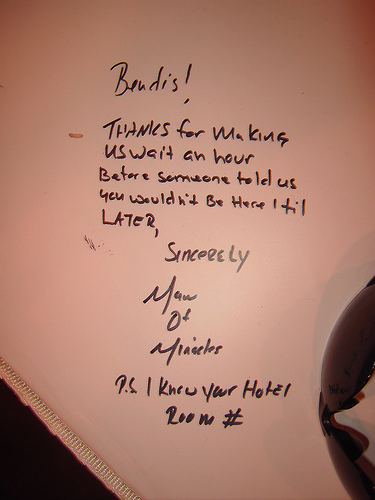
A "fan" note to Brian Bendis

Creepy and threatening – you can see why Ellis isn’t keen on doing convention appearances and signings (though woe betide the fan who hassled a cane-wielding Ellis in need of another Red Bull and nicotine fix).

Now, this sort of behaviour is hardly new, and as pointed out in the comments thread the root of the word “fan” is “fanatic”. But authors especially seem newly exposed by social media, because they’ve always been one of the less public types of artist – writers historically do not “perform” in public in the same way as musicians, for example, and would have been protected from a lot of the weirder communications from the outside world by having their publisher as an intermediary.

But not so much these days – look at the recent wave of bitching from George R R Martin’s fans when they discovered the next instalment of his current series would be delayed. You’d think that die-hard fans would be the first to sympathise with a creator’s need for a life beyond their work, but there’s a vocal minority who are anything but. As Scalzi points out, such people are fools – but the web has made them fools with metaphorical megaphones and your home address.

A related phenomenon seems to be arising on review and discussion blogs, something that Larry of OF Blog of the Fallen has labelled “The New Tribalism” – a situation where groups of fans with closely related passions fall into a kind of groupthink. This has its upsides – it’s that sense of tribe that motivates many fans in the first place, and there’s nothing wrong with discussing art you love with others who appreciate the same material – but there are downsides too, which manifest themselves as vocal disapproval of voices from outside the tribe (or occasionally within) who dare to criticise the tribe’s focus of interest.

This isn’t new either – as any member of any subculture anywhere will surely agree – but again the mobility and power of the phenomenon is amplified by the web. Debate around cultural opinions is a good thing, but mob psychology and the web’s potential for anonymity seems to be an open invitation to be taken to task for daring to have a different opinion to someone else.

Some of my concerns are professional in nature: I advise my clients about the the benefits of a strong web presence, and it’s almost shaming to have to confess that there’s this negative aspect to it. That said, I still hold that it’s worth the risks – why let a few bad apples spoil the barrel for everyone? Writers like Ellis and Scalzi have developed good tactics for dealing with trolling and tribalism; the primary component seems to be developing a thicker skin, though a strong sense of personal space and practiced rhetorical chops seem to be pretty useful as well.

But there’s a more Futurismic edge to it all as well, because it feels safe to assume that web-based creator-consumer relations are likely to become more prevalent as time goes by. As such, it’s not impossible to image a fandom with similar clout to the fabled Anonymous: what might said flashmob do in response to criticism of their totem? As the barriers between physical and informational realities become increasingly permeable, comment-thread flamewars and denial-of-service attacks would be just the start. Vernor Vinge’s Rainbows End features warring fandoms battling it out in augmented reality, with the action spilling out into damage to property and people; the more I think about it, the more plausible it becomes.

After all, we’re prone to going to war over ideologies; given the decline of interest in religion and politics among the younger and more net-native generations, it’s easy to see cultural affiliations taking their place. These culture-mobs could easily be great forces for fun and creativity, but the potential for the opposite to occur can’t be brushed aside. How might Brighton have looked had the mods and the rockers had mobile phones with web access to coordinate with?

How will the earliest nanofactories emerge?

dimensionsJ Storrs Hall of the Foresight institute comments on what the earliest nanofactories will be like, and Michael Anissimov responds:

If nanofactories work at all, they will be very powerful. A nanofactory would be a very complicated, “huge” thing. The Center for Responsible Nanotechnology compares the complexity of a molecular assembler to that of a Space Shuttle. I think the analogy would be apt for a nanofactory as well. We are talking about a miniature factory with more moving parts and individual computers than a typical 100 million-dollar modern factory today. Difficulties with the basic technology will manifest themselves in the pre-nanofactory stage, working with individual assemblers or small ensembles of assemblers. If you’ve made it all the way to nanofactory-level MNT, you’ve already jumped the primary technological hurdles.

A point of disagreement between Anissimov and Hall is the precise definiton of “nanofactory.” Is it simply a general term for a device that can create many other things including a copy of itself, or it is a specific desktop-scale universal assembler?

Assuming the latter definition, Anissimov argues that widespread adoption of desktop nanofactories will happen much more rapidly than that of personal computers because:

There are simply too many moving parts for micromanagement to be possible — either the “code-level” operations are automated or they haven’t been established yet.

Either they work or they don’t. The smallest replicating unit is equivalent to the transistor in a personal computer – to the user it is expected to behave as a black box that performs a specific function – and if it fails to there is not much the user can do about it (if a transistor fails on a microchip can it even be repaired?).

The appropriate analogy is therefore between computers and nanofactories is between the existence of nanofactories and the existence of microchips. Microchips have found their way all over the place…

If Anissimov is right then it raises the interesting possibility that mature, desktop-scale nanofabrication may achieve widespread consumer adoption over a startlingly short period, given the ability of the machine to make copies of itself and the fact if it fulfils its basic function then it can become incredibly useful to many people very quickly.

[via Next Big Future][image from jurvetson on flickr]