Tag Archives: global-warming

Could global warming drive us mental?

globally-mentalLast year Australian doctors wrote up a case of a 17-year-old Melbourne boy who was convinced if he took a drink, people would die.

[The doctors call it] the first known instance of “climate change delusion” …

The psychiatrist who runs the inpatient unit where the boy was treated, Robert Salo, has now seen several more patients with psychosis or anxiety disorders focused on climate change, as well as children who are having nightmares about global-warming related natural disasters.

It would be surprising if global warming — or “climate change,” if you will — had no effect on people’s psyches.

After Hurricane Katrina, problems like severe mental illness rose, including depression, PTSD, anxiety disorder, panic disorder, and a variety of phobias.  These rates went from 6.1 percent to 11.3 percent, among those who lived in affected regions, a 2006 study by the Hurricane Katrina Community Advisory Group said.

The rates of mild-to-moderate mental illness also double, going from 9.7 percent to 19.9 percent.

Denial, and Gore derangement syndrome, may be other symptoms.

[Let It Snow by Bah Humbug]

Eric Drexler on global warming

rainbowFor this year’s Edge Question “What will change everything?” Eric Drexler’s answer is simultaneously depressing and heartening:

In the bland words of the Intergovernmental Panel on Climate Change, “only in the case of essentially complete elimination of emissions can the atmospheric concentration of CO2 ultimately be stabilised at a constant [far higher!] level.” This heroic feat would require new technologies and the replacement of today’s installed infrastructure for power generation, transportation, and manufacturing. This seems impossible. In the real world, Asia is industrializing, most new power plants burn coal, and emissions are accelerating, increasing the rate of increase of the problem.

Drexler dismisses the “magic nanotechnology” trope and suggests what technological developments could do for us:

According to fiction and pop culture, it seems that all tiny machines are robots made of diamond, and they’re dangerous magic — smart and able to do almost anything for us, but apt to swarm and multiply and maybe eat everything, probably including your socks.

A solar array area, that if aggregated, would fit in a corner of Texas, could generate 3 terawatts. In the course of 10 years, 3 terawatts would provide enough energy remove all the excess carbon the human race has added to the atmosphere since the Industrial Revolution began. So far as carbon emissions are concerned, this would fix the problem.

Drexler has further discussion of his essay on his blog, Metamodern.

[at Edge.org with further comment at Drexler’s blog][image from ktylerconk on flickr]

Integral Fast Reactor technology

nuclear_powerReading about an interesting form of nuclear power here, concerning this upcoming book. The Integral Fast Reactor design uses liquid sodium instead of water as the coolant, is passively safe, and addresses many of the concerns about nuclear proliferation, efficiency, and (in part) the long-term storage problems that beset nuclear power. From this interesting FAQ on IFR by proponent George S Stanford:

[The reactors] use liquid sodium for cooling and heat transfer, which makes the system intrinsically safer than one that uses water. That is because the molten sodium runs at atmospheric pressure, which means that there is no internal pressure to cause the type of accident that has to be carefully designed against in an LWR: a massive pipe rupture followed by “blowdown” of the coolant.

Also, sodium is not corrosive like water is.

There is a downside as well: sodium burns in air and reacts with water. As ever with nuclear technology, it seems there are downsides. However I (along with environmentalist George Monbiot) am getting the feeling that nuclear has to be part of the solution to the problems of anthropogenic climate change and peak oil.

[via The Yorkshire Ranter][image from mandj98 on flickr]

Global warming argy bargy

A study suggests that long-term changes in the Earth’s orbit would have resulted in an ice age between 10,000 and 100,000 from now, if it were not for the effect of anthropogenic global warming:

The chill would induce a long, stable period of glaciation in the mid-latitudes, smothering Europe, Asia and North America to about 45-50 degrees latitude with a thick sheet of ice.

However, there is now so much CO2 in the air, as a result of fossil-fuel burning and deforestation, that this adds a heat-trapping greenhouse effect that will offset the cooling impacts of orbital shift, said Crowley.

“Even the level that we have there now is more than sufficient to reach that critical state seen in the model,” he said. “If we cut back [on CO2] some, that would probably still be enough.

Apparently this isn’t an excuse to continue venting CO2:

Crowley cautioned those who would seize on the new study to say “‘carbon dioxide is now good, it prevents us from walking the plank into this deep glaciation’.”

“We don’t want to give people that impression,” he said. “(…) You can’t use this argument to justify [man-made] global warming.”

[story at Physorg][image from Pear Biter on flickr]

Climate change forces Maldives to attempt buying a new homeland

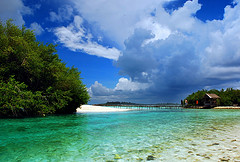
Maldives beachAll the arguments about what actually causes global warming look pretty pointless when you read a story like this one: the Maldive Islands – the highest point of which is a mere 2.4 meters above sea level – are planning to divert tourism income into a fund with which to buy a new homeland elsewhere. [image by notsogoodphotography]

[President Nasheed] said Sri Lanka and India were targets because they had similar cultures, cuisines and climates. Australia was also being considered because of the amount of unoccupied land available.

“We do not want to leave the Maldives, but we also do not want to be climate refugees living in tents for decades,” he said.

[snip]

Nasheed said he intended to create a “sovereign wealth fund” from the dollars generated by “importing tourists”, in the way that Arab states have done by “exporting oil”. “Kuwait might invest in companies; we will invest in land.”

Yet another straw on the camel’s back of geographically-defined nation states? You can bitch about the causes all you want, but when people’s homes start to disappear beneath the sea they’re not going to pay a damned bit of notice to you fiddling while Rome burns.