Tag Archives: global-warming

Climate change explained through probability and risk: It doesn’t matter if it exists, we should act anyway


Craven has created a series of fun, educating videos that should be watched by all.Science teacher Greg Craven posted a video entitled ‘The Scariest Video you’ll ever see’ on Youtube in June 2007. The ten minute video garnered over 7000 replies including many criticisms from global warming sceptics. Craven decided to rebut these criticisms. He spent four months of his spare time researching data on the debate, ticking off each criticism that had been made. He then released “How It All Ends”, another ten minute video but this time with an ‘expansion pack’ of videos going into each of his arguments in exhaustive detail.


Interestingly, much of the content of the six-hour, 44 part series is not devoted to proving whether global warming is happening or not, or whether man is causing it or not. He looks instead at the four main outcomes: global warming exists and we do something, it exists and we don’t do something, it doesn’t exist and we do nothing or it doesn’t exist and we do something. He concluded the costs of doing nothing far outweigh the cost of doing something, so it makes sense to take action even if we don’t know whether global warming is happening or not.

A site has also started up devoted to the videos, where the forum members critique and find responses to each new criticism as it comes through on Youtube. The efforts of these people to encourage reasoned debate is heartening. Many of the arguments against combating climate change revolve around the fact that science doesn’t agree 100% with the precise outcome. Well, science never will agree, not totally, especially with oil industry-paid advocates in the mix. But even without more and more evidence leaning towards the ‘we need to do something camp’, the logical thing to do is to take action, even if it turns out we didn’t need to. There’s also a great interview with Kim Stanley Robinson at BLDGBLOG about this.
North African Solar project could provide a sixth of Europe’s electricity

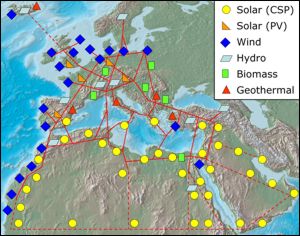
A grid such as this sketch could supply Europe’s power even when the wind doesn’t blow and the sun doesn’t shine where you areNow this is very positive. Last week there was talk of a giant ‘supergrid’ connecting much of Europe to wind turbines across the continent, to take advantage of whenever the wind was blowing.

Now the Guardian reports on Desertec, the plans to put hundreds of solar concentrating plants on the North African coasts and in the Middle East. Two thirds of the estimated 100 Billion Watts would stay in the countries producing the energy, with another 30 Billion Watts (around of all of Europe’s use) being pumped via underwater cables to the EU, which would provide a chunk of the funding for the project. With the Bali talks now underway to find a new version of the Kyoto treaty, projects like this could be a major facet of reducing carbon emissions. German energy expert Gregor Czeich reckons with new higher efficiency power lines a 100% renewable powered Europe could be possible in the near future without costing much more than the current fossil fuel system.

[via the guardian, picture by TREC]

The internet is a major feature of reducing carbon emissions

Will we all be connected and working through low power laptops like this one?A lot of the plans for sustainability try to provide the energy for what we already do using new sources of power. Whether you subscribe to the peak oil camp or you fear global warming or even if you want to prudent ahead of a possible recession caused by sub-prime mortgages, each problem has the same solution: use less. Buying less consumables, reducing food miles, rebuilding soils and producing electricity from renewables can only do so much.

Transport is a huge part of the energy (and money) we spend. A future coming to terms with the ‘Peak Century’ will need to travel much less distance for work, play and neccessity. The 50 mile commute seems illogical now at close to $100 dollar a barrel of oil. If oil gets harder to extract and prices rise, that commute won’t just be an annoying expense, it’ll mean bankruptcy. Fortunately new technology has arrived, seemingly perfect timed to coincide with reducing our carbon footprint and energy consumption.

A geologist recently said “My hopeful view is that we’ll be living like we did at the turn of the 20th century, but with computers.” I like the analogy. The internet and low-energy computers offer us a real potential of making a low carbon economy yet still providing jobs and a worldwide community. As Worldchanging puts it, the ‘High bandwidth, Low Carbon future’ could be both sustainable and more personally fulfilling. Google is investing $100Million in Green computing and the Asus EEE laptop uses 11 watts. All this talk of choose your own price music, online markets for fiction and e-readers is important because it’s a first step to creating an entertainment economy that could work in the low-energy world that’s coming, sooner or later.

[picture by jaaron]

Coastal villages may be abandoned to the sea

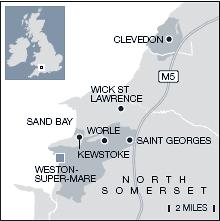
Many areas of the British coast will be evacuated rather than protectedThe Telegraph has an article today about the British coastline and flooding. A few days ago, a storm surge travelling down the North Sea nearly combined with high tides to overtop the flood defenses across much of the East coast of England. Another few inches could have caused widespread flooding similar to that experienced in 1953, when 300 people were killed. Today the UK government admitted rising sea levels mean a number of coastal communities will disappear within the next thirty years. Some low lying villages and farms in Norfolk, Suffolk and Somerset are too vulnerable and would be impossible to save without spending inordinate billions on sea defences. This is a discussion many governments will be having over the coming decade.

[via Daily Kos, image from the Telegraph]

Cirrus cloud disappearance may dampen global warming

Cirrus clouds high in the atmosphere lock heat into the EarthThe self-adjustment of the science consensus tends to make it reliable – credible research is promoted and those not backed out by evidence fall. So if the scientific consensus thinks global warming is a problem, I’m inclined to believe them. However, sometimes real science offers some positives, like today. Researchers at UAHuntsville’s Earth System Science Center found that the amount of heat-trapping Cirrus clouds in the atmosphere decreases rather than increases as global temperatures go up. High altitude clouds like Cirrus ones tend to trap heating escaping from the atmosphere, amplifying any existing warming (low altitude clouds tend to have the opposite effect by reflecting sunlight back into space).

It was expected that as temperatures rose, more evaporation would lead to more clouds. Studies of smaller warming and cooling cycles in the tropics showed that actually higher temperatures created less Cirrus clouds, encouraging a cooling period in reaction to the added heat. This negative feedback system is an exciting discovery and could cut the amount of temperature rises in global warming models by as much as 75%. It’s not a get out of jail card and it would still be prudent to work on a worst-case scenario basis but this kind of mechanism could give us the time needed to adapt to a lower carbon economy.

[via ScienceDaily, image by acewill]