Tag Archives: Google

Google – trying to predict the future by inventing it

Google logo on a whiteboardThe official Google blog isn’t always the most exciting of reads, but every now and again they post up something worth a read. Today saw the first of ten articles from the top boffins at the Googleplex to celebrate the company’s tenth anniversary; it’s about the future of cloud computing, and it hints at a fairly science fictional end-point:

Traditionally, systems that solve complicated problems and queries have been called “intelligent”, but compared to earlier approaches in the field of ‘artificial intelligence’, the path that we foresee has important new elements. First of all, this system will operate on an enormous scale with an unprecedented computational power of millions of computers. It will be used by billions of people and learn from an aggregate of potentially trillions of meaningful interactions per day. It will be engineered iteratively, based on a feedback loop of quick changes, evaluation, and adjustments.

Underneath that corporate gloss is the enthusiasm of researchers who believe they’re working toward a useful form of artificial intelligence. This isn’t news, of course – Larry Page has been quite open about that particular long-term goal – but it’s the assured confidence that Google has which never ceases to astonish. From the introduction to the article:

As computer scientist Alan Kay has famously observed, the best way to predict the future is to invent it, so we will be doing our best to make good on our experts’ words every day.

One can’t help but be reminded of the Genius Inventor archetypes of pulp science fiction… but in this case that blue-sky vision is backed up by the bankroll of one of the most powerful organisations on the planet. [image by dannysullivan]

So, is it hubris, hype or hope… or a mixture of all three? Should we fear the Big G, or look to it to usher in something like the Singularity and save us from ourselves? Or is AI just a pipe dream for big-budget geeks?
Google ponders offshore data center

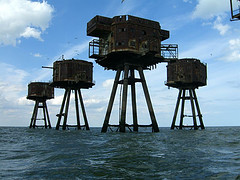
fortsIt sounds like something Bruce Sterling foresaw as long ago as Islands in the Net: Larry Dignan on ZDNet looks at a patent for a structure that would sit offshore like an oil rig:

Google is pondering a floating data center that could be powered and cooled by the ocean. These offshore data centers could sit 3 to 7 miles offshore and reside in about 50 to 70 meters of water.

….Now wild-cards abound. Jurisdiction issues will occur. Are states really going to allow Google or anyone else place these pontoons offshore without some tax hit?

And will Google take advantage of such a setup to bank your data like the Swiss bank money?

[Rusting sea forts in the Thames estuary photographed by phault; story tip: Gregory Frost]

With Knol, Google enters the knowledge market

The top part of an example knol

Google has announced a new wikipedia-like project, entitled ‘knol’. Short for knowledge, the project aims to have an encyclopedia type experience but with more emphasis on the author, rather than anonymous multiple contributors. There will not be editorial contributions from Google, but authors including ads will get revenue.

An example knol has been put up on the Google blog. Google says that the emphasis will be on large numbers of posts, ranked by users and views to encourage quality. Peer review seems to encourage good writers to become better rated and more successful. Added to the potential to earn money, this endeavour could provide a good potential way to create a freelance online writer business model. It looks like Knol will be less comprehensive/consistent across the entire volume of data than Wikipedia, but with better quality at the top end. It’s a similar model to Mahalo, only with the backing of perhaps the biggest internet company out there.

[via boing boing, image is the example of a Google Knol]

The new advertising age – there is no escape!

Culture-jammed billboard The ongoing efforts of the advertising industry to make it impossible to escape from promotional material for products that no one really needs continue apace, with the full weight of modern technology behind them.

Warren Ellis points us at a report about a billboard that uses a technique called “audio spotlighting” to beam sound directly into your head … the only redeeming feature of which is the thought of the fun that culture jammers will be able to have once they figure ways of hacking them. [Image by rick]

Of course, the real frontier of advertising is right here on our beloved intarwebs, and it appears that some ISPs are keen to have a piece of the pie that Google has baked for itself. So some of those ISPs are selling your clickstream data to a company called NebuAd to make it easier to target you with “appropriate” ads. Nothing like a captive data-set to boost accuracy, eh?

Not quite as cheeky as a Canadian ISP called Rogers, though, who’ve been plastering their own ad content on Google’s homepage. That’s probably going to backfire, but if you look at it as a proof-of-concept job, it’s plain to see that web ads aren’t going to get any less intrusive any time soon – can you say “digital turf-war”?

On the subject of Google, recent research suggests that Google’s PageRank algorithm is actually a pretty good model of the way the human mind determines the relative importance of related concepts, and may provide a new route forward for artificial intelligence. How ironic would it be for us to reach the Singularity only to discover that the omnibrain of the human species is essentially interested in selling us things …

[tags]advertising, marketing, Google, AI, technology[/tags]

Google Earth to Improve Resolution

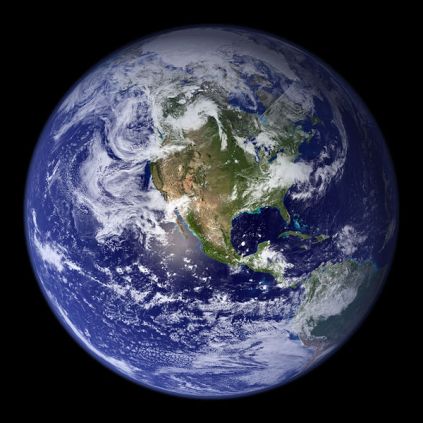
earth.jpg
Photo Credit: NASA (via Wikimedia Commons)

DigitalGlobe, provider of imagery for Google Earth, will be launching a new satellite dubbed WorldView I next Tuesday, that will boost the accuracy of its satellite images to half-meter resolution. With that type of accuracy the satellite will now be able to pinpoint objects on the Earth at three to 7.5 meters, or 10 to 25 feet. Using known reference points on the ground, the accuracy could rise to about two meters. Additionally the satellite will be able to collect over 600,000 square kilometers of imagery each day, up from the current collection of that amount each week.

It seems that we are getting much closer to the CIC Earth application as envisioned by Neal Stephenson in Snow Crash, which was able to present real time satellite imagery.

[Via C|Net]