 Welcome to the 21st Century, wherein you will be informed of potential disasters more quickly than ever before… and, quite possibly, in indirect proportion to their actual threat. Unless you’ve been ignoring digital media completely for the last two days, you’ll already be aware of the swine flu outbreak in Mexico – but how much do you really know, and how much of that is actually useful? [image by aturkus]
New Scientist is a good place to start for a factual overview of the swine flu situation:
Should I worry about this flu?
That depends on two things: how severe the flu is, and how far it spreads. Its severity is still unknown. Those who died in Mexico were young adults who don’t often die of flu, so we know this virus can be serious. But it isn’t always bad: the cases picked up in the US were mild. Outbreak investigators are now trying to find out how many people have had the virus, and how many of those were seriously ill, to get an idea of how bad it is.
In other words, panic is not only unproductive but as yet unwarranted, despite being amplified by Twitter, whose rapidity and limited bandwidth is spreading fear faster than facts. Of course, there’s always some humour to be found in the darkest of situations.
That said, this is a serious situation and there is the possibility of a global pandemic, though without access to hard data it’s impossible for anyone to really assess the likelihood in anything more than hypothetical terms… which is doubtless why the conspiracy theorists are having such a frenzied field day.
But it’s grist for the mills of thinkers with a less alarmist bent, as well:
Swine flu, we could say, is a spatial problem – an epiphenomenon of landscape.
I’m reminded here of a point made recently by geographer Javier Arbona. Referring to the increasingly popular and somewhat utopian idea that, in the sustainable cities of tomorrow, agriculture will have returned to its rightful place in the city center, Arbona asks: “Did everyone think that so much lushness and farming envisioned in the city aren’t going to open up new Pandora’s boxes of infectious diseases and sanitation problems as we come into contact with more manure, more bacteria, and more wild animals that we urbanites are not at all ‘naturalized’ to?”
Thought experiments aside, the sensible thing to do is ignore anything repeated in hysterical terms by media outlets with a reputation reputation for sensationalist reportage, while making sensible and proportional preparations for the worst. Although at time of posting it is currently missing (in what is presumably a Wired CMS brainfart – ZOMFG kover-up kkkonspiracy!!!1), Bruce Sterling has an uncharacteristically level-headed and sensible analysis of the true global extent of the threat (in short: compared to the ongoing AIDS pandemic, swine flu at its worst will be a picnic); in the meantime, Charlie Stross links to some genuinely useful practical advice:
Oh, and if you want to know how to ride out a flu pandemic, Jim MacDonald explains how to tell flu from a cold, what you should have in your home in case you catch the flu, and how to wash your hands. Pay attention at the back: I don’t want to be needlessly alarmist but knowing how to wash your hands properly might just save your life.
The panic and hype around swine flu is certain to get louder before it gets quieter, especially once the daily tabloids take up the slack after the weekend, so let’s all try to keep a level head. Life can get messy, but it’s not a Michael Crichton novel.
 A new technique for storing lungs outside the human body has been developed by the
  Some
Some 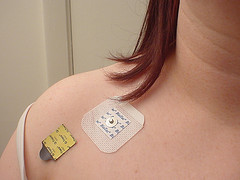 Cutting-edge medical hardware can scan and analyse our bodies with incredible accuracy, allowing doctors to diagnose and treat many of the illnesses that come as part of our mortal meatware. But these things can only be seen if we’re looking for them; we’d catch many more diseases and defects if we could be monitored constantly, rather than just when we visit a doctor or clinic.