Tag Archives: identity

The web =/= the mob?

Network diagram of macaque brain connectivitySeeing as how I ended up with a whole bunch of related links, I thought they might as well all fit in one post. So, your overarching thematic question is: the power of the web and social media is pretty much a given, but does it empower us in ways that are beneficial or detrimental?* [image by arenamontanus]

For a start, Bruce Sterling points to what must be the third story I’ve seen in the last year about what happens when jurors are accustomed to social media and ubiquitous information access. In a nutshell, it’s almost impossible to keep people in an informational vacuum without locking them up in a Faraday cage, or to keep them from Tweeting about a case they’re hearing… so what happens to the existing legal model of the unprejudiced jury of your peers? Pandora’s box is well and truly open; how can we develop fair trials in the information age? Expert systems instead of juries? Crowdsourced multiplex juries? Or a trial process that not only accepts but embraces its position at the centre of a media ecology based on novelty and shock?

Over in Egypt, however, the political counterculture is just starting to flex the lithe and slippery new limbs that the internet has provided it, thanks to the incumbent government’s possibly self-defeating decision to leave the internet predominantly uncensored in the hope of encouraging international trade and domestic development. Decentralised networks like Twitter are undermining the official media controls and embargoes that are the hallmark and lynch-pin of the despot… with the end result that the Egyptian government is falling back on the time-honoured (if counterproductive) methods of intimidating and threatening the loudest dissenting voices.

Meanwhile, televangelist megapastor Rick Warren caves in to public opinion and writes publically to Ugandan ministers to condemn their violent persecution of homosexuality. While it’s impossible to truly know the mind of another, I think I can safely assume that Warren would have lost no sleep over the Ugandan lynch-mobs; the bad publicity focussed on himself as a result of staying quiet, however, was simply unacceptable. A small victory for public opinion, perhaps.

But that knife cuts both ways. Remember me linking to an interview with Indian science fiction author Ashok Banker, in which he took the Western publishing industry to task for institutionalised racism, accompanied by a chorus of voices denying that any such racism existed? Well, that interview has been deleted from the World SF Blog at Banker’s request, because he and his family have been receiving death threats in response to it, through assorted social media channels. A sad story, and one that pretty much proves his initial point… as well as demonstrating that the “pure” democracy of the web can enable the primacy of hatred just as easily as justice (your postcard from Switzerland has just arrived). It all depends on which group cares enough to do the most hard work with that media lever.

And speaking of inequalities, here’s a post from a well-known figure in the copywriting blogosphere, wherein he reveals that he’s actually a she. And no, it’s not even some dramatic story of gender confusion and coming out: it’s an inside account of the glass ceiling that still exists in the Western world for women who dare to make their own way in a male domain. Long story short: after a long period of crap work, poor pay and demanding clients, she started using a male pen-name and found that everything improved drastically.

In some ways, there’s a small victory for the web here: intertube anonymity overcomes the gender boundary, saves family from poverty! But the story overall is a sad one, highlighting an institutionalised misogyny that we still perpetrate at a subconscious cultural level, even on the supposedly egalitarian plains of the internet. Worth bearing in mind next time the subject of female authors submitting stories using their initials rather than their first names comes up, and folk start saying that they’re doing themselves a disservice by doing so, eh?

[ * Obviously the answer is “both”, but I think there’s a lot of value to be gained by thinking about how these things happen. We’ve asked whether the web is an inherently democratising force here before, and the stories above seem to suggest that social media empowers the most vocal and/or powerful groups that possess the savvy and access to use them effectively. In Egypt, that appears to be the good guys (at least from my perspective); unfortunately, that doesn’t seem to be the case everywhere. ]
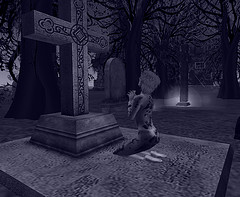
The Facebook graveyard

metaverse tombstoneThis week’s big social network story is Facebook’s announcement that they now allow the user profiles of people who’ve died to be “memorialised” – frozen in perpetuity (one presumes) so that you can still visit them, like some digital tombstone or memorial bench. [image by moggs oceanlane]

As that blog post makes clear, Facebook are obviously reacting to a genuine human need, though it would be easy (if highly cynical) to suggest that they’d like a slice of the growing traffic for online memorial sites, as mentioned earlier this month. But questions remain – who will maintain these profiles, and for how long? Will they drop out of the system when their last friend connection is severed (assuming, of course, that any social network platform lasts long enough for that to happen)? Will those memorial profiles be any more or less transferrable to new networks than those of the living? Will the memorials still have adverts surrounding them, like a normal Facebook page, and is that a morally acceptable price for their maintenance?

The biggest question is obviously “how much checking will Facebook do to ensure that the person really is dead?” Internet “pseuicides” aren’t a new phenomenon, and it’s not clear whether the Facebook crew have a procedure in mind to prevent a group of friends faking a death, be it in collusion with the owner of the profile in question or otherwise. Given how easy it is to hack many people’s public email accounts (poor password choices, easily reverse-engineered ‘secret questions’, etc.), unless they demand some sort of legal confirmation from the state that the owner has indeed passed away it could be a relatively simple scam to declare a living person to be deceased. Indeed, that might even become a popular black economy service, alongside fake IDs and new identities.

Secure your privacy: tell everyone everything

Privacy please!What if the best way to protect against identity theft was not to hide the fingerprints of your digital daily life, but to expose them to public scrutiny? It sounds like an Orwellian contradiction, but Alex Pentland of MIT’s Human Dynamics Lab believes that allowing limited access to logs of our electronic acitivities is actually much safer than relying on passwords or keys which can be phished or stolen. [image by hyku]

“You are what you do and who you do it with,” says Pentland. Researchers and corporations have realised the potential of such data mining, he points out. “It is already happening and it is time for people to get a stake.”

If people gain control of their own personal data mines, rather than allowing them to be built and held by corporations, they could use them not only to prove who they are but also to inform smart recommendation systems, Pentland says.

He recognises that allowing even limited access to detailed logs of your actions may seem scary. But he argues it is safer than relying on key-like codes and numbers, which are vulnerable to theft or forgery.

If I understand my cryptographic principles correctly (and I may well not, so do put me straight in the comments if I’m wrong), Pentland is proposing something a little bit like a public key verification system. Perhaps in this case “your best defence is a good offence”… the sort of thing that could easily be combined with some sort of reputation-based currency like whuffie? And hey, he’s advising we take our data back from the corporations that already scrape at it when we’re not watching. Makes sense, right?

“It is not feasible for a single organisation to own all this rich identity information,” Pentland says. What he envisages instead is the creation of a central body, supported by a combination of cellphone networks, banks and government bodies.

That bank could provide “slices” of data to third parties that want to check a person’s identity. That information could be much like that required to verify high-level security clearance in government, says Pentland.

Uh-oh… suddenly I’m not so keen on this idea, at least in the way Pentland is thinking about it. A peer-to-peer system, fine, I’m down with that… but handing the reins of identity verification over to banks and quangos, after having already admitted that private corporations are prone to abusing the crumbs of data we drop behind us all the time? That’s got to be a step sideways, if not backwards. Pentland has thought about ways to monetise the system, too:

An individual could also allow their data to be used by services like apps on their smartphone to provide personalised recommendations such as restaurant suggestions or driving directions. This has the potental to be much more powerful than the recommender systems built into services like Netflix and iTunes, and would help familiarise users with the value of the approach, says Pentland.

Pentland’s carrot seems to be much the same as the one dangled by the people behind Phorm: “if you’ve nothing to hide, there’s nothing to fear, and we’ll even be able to recommend you stuff that you’re more likely to want to buy!” Maybe I’m just being paranoid; I remain convinced that a certain degree of personal transparency is not only a societal good but a useful tool for personal security, but something about this particular formulation smells very bad indeed.

Dissociative fugue in D minor

I felt the urge to pass this story on to you lot, not because it’s necessarily science fictional or futuristic (though it could be, in the hands of a good writer), but because I think it’s genuinely fascinating. The New York Times has an article about a young lady named Hannah Upp who went missing while out running in late August, only to reappear nearly three weeks later floating face-down (though still alive, barely) in New York Harbour.

Sure, people disappear all the time – what’s rare about Ms Upp’s disappearance is that she doesn’t remember any of it at all. It’s something that the psychologists call a dissociative fugue.

The medical condition diagnosed in Ms. Upp is so uncommon that few psychiatrists ever see it. Characterized in part by sudden and unexpected travel combined with an inability to recall one’s past, dissociative fugue demonstrates the glasslike fragility of memory and identity.

Its most famous sufferer is the fictional Jason Bourne, the secret agent made flesh on film by Matt Damon. The Bourne character takes his name from Ansel Bourne, a Rhode Island preacher who suffered the earliest recorded case of the condition when he was en route to Providence in 1887. The preacher continued to Norristown, Pa., where he opened a store and lived with another family, until one day he “woke up.”

The memory of how to perform mundane tasks like hailing a cab or even using the Internet remains intact. Victims lose only the memories tied to their identity.

A weird and fascinating tale, and a reminder that the human mind is something we only understand very poorly. The hat-tip goes to Tim Maly on Twitter, who we may well be hearing more from in the near future…

The Troll Crusade: Anonymous, Scientology and all that

Anonymous - they are legion.To paraphrase the lovely Pat Cadigan, reality is always weirder than fiction… because fiction is constrained by the need to appear plausible. Which is why, had someone tried to write a novel about an ad-hoc tribe of sociopaths united by membership of an internet bulletin board attempting to take down a notoriously weird young religion created by a fast-talking science fiction writer that numbers some of the biggest names in Hollywood among its ranks, they’d have probably been laughed out of the slush pile with a form rejection slip. [image by Sklathill]

But Chanology, the Anonymous crusade against Scientology, is a very true story, and one that’s still being told. Julian Dibbell has a good long-form piece in Wired all about it, and it’s a fascinating read… not to mention ideal source-material for writers of near-future speculative fiction. Dibbell highlights the real driving motive behind the fluid alliance of Anonymous, which is much less the desire to right wrongs than it is the desire to wind up a legendarily uptight organisation – a desire that focusses inward as well as outward, like an irascible hydra whose heads turn on one another as often as they strike at their enemies.

Dibbell also points out that while Anonynous may represent the arrival of “the kind of ad hoc, loosely coupled social activism that many have hoped the ad hoc, loosely coupled architecture of the Internet would engender,” it may also represent its apogee. Anonymous and Scientology are almost made for one another, so perfectly diametrically opposed at an ideological level that they can’t help but feed the flames of the conflict; potential future opponents may well learn from Scientology’s mistake, and avoid feeding the trolls.

What interests me most about Anonymous as an amorphous (id)entity, though, is the potential it has for temporal continuity independent of its current membership. It’s a banner that any rebellious or angry group could raise at any point in the future, because although its methods and aims are fundamentally individualistic, its public face is exactly the opposite. Like the Luddites and the saboteurs before them, all that’s needed to join the cause is an awareness of its existence… and of its power to enrage the forces of order. Even if Chanology fizzles out against the superior legal firepower of Scientology, I suspect we’ll not have heard the last of Anonymous.