Tag Archives: infrastructure

Loopy space elevator concept

rotatingspaceelevatorsIn the same general theme as Keith Loftstrom’s launch loop concept [via Speaktomanagers] we have the Rotating Space Elevator:

Golubović and Knudsen have introduced the Rotating Space Elevator (RSE), a rotating system of a floppy string that forms an ellipse-like shape. Unlike the traditional Linear Space Elevator (LSE) made of a single straight cable at rest, the RSE rotates in a quasi-periodic state.

“The idea came by itself,” Golubović told PhysOrg.com. “I was thinking how to make things move easily and quickly up the traditional Tsiolkovsky-type space elevators. In my kitchen, I was mixing coffee in my cup too vigorously and the centrifugal force on the rotating coffee won over gravity to make some of the coffee lift and splash out the cup. This was my ‘eureka’ that lead to adding a similar conceptual feature to the old space elevator idea…

[via Next Big Future][image from Physorg]

GPS FAIL?

lost personGot a GPS in your car? Well, I hope you’ve not become too reliant on it and totally lost the ability to use old-fashioned road maps, because GPS service could start getting patchy next year, when the ageing satellites that make up the system’s infrastructure start falling out of orbit before their replacements can be set up.

Seems like someone’s been blowin’ the boondoggle blues and letting the maintenance schedule slip behind:

The warning centres on the network of GPS satellites that constantly orbit the planet and beam signals back to the ground that help pinpoint your position on the Earth’s surface.

The satellites are overseen by the US Air Force, which has maintained the GPS network since the early 1990s. According to a study by the US government accountability office (GAO), mismanagement and a lack of investment means that some of the crucial GPS satellites could begin to fail as early as next year.

“It is uncertain whether the Air Force will be able to acquire new satellites in time to maintain current GPS service without interruption,” said the report, presented to Congress. “If not, some military operations and some civilian users could be adversely affected.”

The report says that Air Force officials have failed to execute the necessary steps to keep the system running smoothly.

Ouch. As pointed out in the Guardian article, it’s highly unlikely that the USAF will let the system degrade totally – it’s too useful, not just to them but to a lot of people the world over – but just as we have to accept with other ubiquitous services like Google, outages may occur, and there’ll be no one to complain to; it’s all there in the small print, man. [image by Larsz]

That said, it’s a free market, and you can always shop around for alternatives – apparently Russia, China and India are all working on their own equivalent systems, which is probably even more upsetting to the USAF than the possibility of flakey service from their own kit.

The future blooms for algal fuel

algaeAlternative fuels is an industry crawling with big promises, but they don’t come much bigger than this one: one billion gallons of carbon-neutral biofuel per year. Made from algae.

That’s the promise from Sapphire Energy, which is positioning itself to lead an emerging industry by working with airlines on test flights and ramping up its production facilities in New Mexico. If all goes as planned, the company says, it will be in the position to supply one million gallons of biofuel annually by 2011, 100 million gallons annually by 2018 and one billion gallons each year by 2025.

That’s all well and good, but biofuels are just another thing for us to burn for energy – what’s the big difference?

Another big benefit: algae sucks up lots of CO2. According to the Biodiesel Times, algae-based biofuel is considered carbon neutral because CO2 generated in its use is offset by what’s consumed during production.

OK, good. But here’s the bit that really struck me:

While Sapphire’s high-profile aviation tests have gotten the headlines, the company says that because its biofuel is a “drop in” fuel chemically identical to crude oil, it is compatible with anything on the road or in the air right now. It also plays nicely with existing refineries and pipelines. That’s another benefit over ethanol, which is corrosive and typically transported to terminals via truck or rail and then mixed with regular gasoline.

“We are 100-percent convinced that the only way to address climate and energy security is to use the same infrastructure we already have,” Sapphire’s Zenk said.

Now that’s a little more interesting. I don’t have the data or expertise to run the numbers on this sort of thing (is there a quant in the house?) but a replacement for mineral oils that wouldn’t require a huge investment in new peripherals has got to be worth looking into. Of course, as the article points out, it’ll take certification and industry take-up to make algal biodiesel truly viable as an industry, but it’s reassuring to see companies like Sapphire are thinking of the bigger picture. [image by Lee Nachtigal]

But maybe that’s the siren song of the easy option we’re hearing – would we really be better off keeping the systems we have, or should we be overhauling the entire global infrastructure of fuel production from the ground upwards?

Flexible concrete

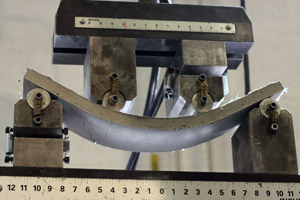
flexible self-healing concreteI try to avoid doing posts that just go along the lines of “hey, look – cool invention!”, but I thought flexible self-healing concrete was interesting enough to warrant a bending (arf!) of the rules

A handful of drizzly days would be enough to mend a damaged bridge made of the new substance. Self-healing is possible because the material is designed to bend and crack in narrow hairlines rather than break and split in wide gaps, as traditional concrete behaves.

“It’s like if you get a small cut on your hand, your body can heal itself. But if you have a large wound, your body needs help. You might need stitches. We’ve created a material with such tiny crack widths that it takes care of the healing by itself. Even if you overload it, the cracks stay small,” said Victor Li, the E. Benjamin Wylie Collegiate Professor of Civil Engineering and a professor of Materials Science and Engineering.

Ten kudos points and a Futurismic gold star to the first commenter with either a potential disaster scenario involving flexible concrete, or a design-fiction repurposing of it. Go! [via Technovelgy]

O NOES! Infrastructure hakz0rz!

network switchesSo, the big red-hot knee-jerk story of the week is surely the suggestion that there’s a possibility that maybe some foreign countries are thinking about whether it would be worth hacking the poorly-secured United States power grid infrastructure with computer intrusion techniques. Maybe.

… multiple countries are believed to be behind the attacks, including both the Russians and the Chinese. Some of these were apparently detected and stopped before any damage could be done, while the remains of others (and tools designed to trigger failures) have been found in other areas. The article doesn’t give specific information on where issues were and weren’t detected, or which infrastructures were contaminated, but the list of “at-risk” institutions include electric plants (particularly nuclear ones), financial networks, and water management/treatment facilities.

Credit where it’s due, Ars Technica isn’t going to flap its arms and panic like some other news sources:

The Internet is merely the latest—and by most measures, the most benign—means by which one country could attack another. Personally, given the choice between ICBMs, chemical weapons, “the bomb”, or V-2 rockets, I’ll take the Internet.

Amen. Bruce Schneier agrees:

Honestly, I am much more worried about random errors and undirected worms in the computers running our infrastructure than I am about the Chinese military. I am much more worried about criminal hackers than I am about government hackers.

Right. And why worry about complex hacks when a crew with some industrial tools can wipe out the data grid for a whole region?

Ten fiber-optic cables carrying were cut at four locations in the predawn darkness. Residential and business customers quickly found that telephone service was perhaps more laced into their everyday needs than they thought. Suddenly they couldn’t draw out money, send text messages, check e-mail or Web sites, call anyone for help, or even check on friends or relatives down the road.

Several people had to be driven to hospitals because they were unable to summon ambulances. Many businesses lapsed into idleness for hours, without the ability to contact associates or customers.

The dogs in your own backyard are more likely to bite you than your neighbour’s. [image by jonbell]