Tag Archives: internet

Is Chinese web censorship effective?

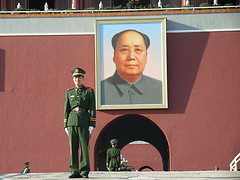
Soldier guarding portrait of Mao Zedong in Tiananmen SquareThe last week or so has seen a number of stories regarding today being the anniversary of the Tiananmen Square massacre in China, many of them focussing on the sad but unsurprising fact that the Chinese government has locked down access to a swathe of web tools (like Twitter) and news sites (like HuffPo) in anticipation of its citizens talking about a subject on which it is still hugely touchy.

The first question I asked myself was “how effective will that be, anyway?” I’m obviously not the only person to wonder the same thing – though it seemed my initial optimism was unfounded, as BoingBoing linked to a short post by Beijing-based journalist James Fallows, who reports that knowledge of the Tiananmen protests among young Chinese is virtually non-existent:

I have spent a lot of time over the past three years with Chinese university students. They know a lot about the world, and about American history, and about certain periods in their own country’s past. Virtually everyone can recite chapter and verse of the Japanese cruelties in China from the 1930s onward, or the 100 Years of Humiliation, or the long background of Chinese engagement with Tibet. Through their own family’s experiences, many have heard of the trauma of the Cultural Revolution years and the starvation and hardship of the Great Leap Forward. But you can’t assume they will ever have heard of what happened in Tiananmen Square twenty years ago. For a minority of people in China, the upcoming date of June 4 has tremendous significance. For most young people, it’s just another day.

Similar sentiments crop up in a series of PBS interviews with journalists and experts in Chinese sociology [via MetaFilter], though there is some hope as well – here’s author and journalist Jan Wong:

I don’t know what it tells you about a country when you could have such a cataclysmic event as Tiananmen Square and then suddenly you lop off the reality for all the people coming after. … But the great thing about China is that history is valued so that it will come out one day. People will keep records, people will eventually write about this. It’s not that it’s disappeared forever. You know, in Chinese history, each dynasty has secrets that it suppresses, and then it’s up to the next dynasty to write the true history of the previous dynasty. Each dynasty writes its own propaganda, the next dynasty writes the true history, so I assume this will happen in China, too.

But how long will we have to wait for this to occur? Has the old cultural chain of the dynasties been snapped by the Communist Party’s ubiquitous censorship, or is it just another Emperor in different clothes?

Of course, one of the great claims about the internet is John Gilmore’s belief that it “treats censorship as damage and routes around it”; whether that is still the case (or if it ever was) is a subject for debate, but it’s reasonable to suggest that the internet must be a difficult beast to cage, even with the immense amount of manpower available to the Chinese government. China specialist Orville Schell suggests that China is the ultimate test of Gilmore’s aphorism:

We do have some interesting wild cards, like the Internet, and I think the Internet is fundamentally a liberalizing force. But I think China, in this regard, is the great petri dish for whether the Internet can be brought to heel, or whether it is, on the face of it, a sort of spontaneous free agent that will catalyse China into a more open direction. And I think the returns are not in yet. China needs the Internet, and it’s using it to good effect in business. And the Party is using it very effectively to help communicate with the provinces, the counties, the police units, the army. It isn’t purely an engine of dissident energy or of individualism or of democracy. We’ve seen many technologies from telegraph to radio to television that have been brought to heel quite nicely by commercial interests. So we’ll see.

Now you can’t control the Internet completely. I don’t even think that’s their aspiration in China. But their aspiration is to make it difficult enough for most people so that they’ll stay within the confines of the intranet, not the Internet. The intranet being China’s sort of hermitically sealed room, which is connected to the outside world by a very limited number of gateways. And it is through those gateways, that all the information to the outside world flows, both ways, and that’s where it can be controlled.

As with so many things, only time will tell. But I find myself wondering about the curiosity that is so much a part of being a young adult, at least here in the West – can censorship and obfuscation have really erased that completely among China’s young citizens? Would they not notice the increase in website blocking and wonder what is being hidden so carefully, like a child told to stay out of the cupboard under the stairs as Christmas approaches?

Maybe I’m more optimistic than I thought – I imagine that knowledge of the Tiananmen massacre isn’t as rare as it might appear to outside eyes, perhaps passed around in secret by good old word of mouth, quiet whispers and hand-written notes guarded closely against the surveillance of the state, a tiny precious flame shielded against the wind and rain, never shown to outsiders for fear that to do so would incur the wrath of the Party.

Or maybe I’m being naive; perhaps curiosity is easily quenched. After all, it’s not as if the ‘free’ West isn’t full of people who cultivate their own ignorance of political history, so as to avoid having to ask themselves awkward questions about the way the world works. [image by Gene Zhang]

Stross and Doctorow on privacy in the modern age

A few weeks back the Open Rights Group held a benefit talk just up the tracks from me in London that I was meant to go to, though sadly the realities of self-employment intruded and kept me at home. The speakers were Charlie Stross and Cory Doctorow – two very smart guys who, even if you’re not a fan of their fiction, have a lot of very interesting stuff to say on the matter of privacy and surveillance in the modern world.

Luckily for me (and everyone else) there’s video footage of the whole thing – and I heartily suggest you watch it. While somewhat focussed on the UK situation, the stuff about data security and information harvesting and ubiquitous surveillance is applicable to anyone who uses the web, has a government that uses computers or lives in a city or town with a CCTV presence… which (I imagine) covers pretty much everyone reading Futurismic right now.

There’s ninety minutes of video; the discussion between Stross and Doctorow fills a little less than the first half, but make the time to listen to the Q&A section afterwards as well. I’ve found myself with about four pages of notes and story ideas just from my first pass through, and I imagine there’ll be more when I go back to it. So get watching:

You know what would have made this even more interesting, though? If David Brin had been on the panel… now that would have been hands-down the debate of the year, at least for me.

Wherever he laid his laptop was home: the internet and homelessness

I dare say many of you have already seen this Wall Street Journal piece that documents the increase of internet presence in San Francisco’s homeless population… but if you haven’t, I think you should go read it, especially if you’ve ever found yourself fretting over the horrible sense of disconnection from the world that a temporary loss of your broadband connection can cause.

Cheap computers and free Internet access fuel the phenomenon. So does an increasingly computer-savvy population. Many job and housing applications must be submitted online. Some homeless advocates say the economic downturn is pushing more of the wired middle class on to the streets.

Aspiring computer programmer Paul Weston, 29, says his Macintosh PowerBook has been a “lifeboat” since he was laid off from his job as a hotel clerk in December and moved to a shelter. Sitting in a Whole Foods store with free wireless access, Mr. Weston searches for work and writes a computer program he hopes to sell eventually. He has emailed city officials to press for better shelter conditions.

Lisa Stringer, who runs a program that teaches job and computer skills to homeless and low-income residents, says some students who can’t even read or write save money to buy computers at Goodwill. “It’s really a symbol in today’s society of being OK and connected,” she says. She sometimes urges homeless students to put off buying laptops until their living situations stabilize.

What’s most interesting to me about this is the way that the ‘freeconomics’ model of most web businesses is providing opportunities for social interaction to those who have dropped out of or been abandoned by the traditional meatspace support systems; homelessness no longer equates to invisibility, in other words, and a lack of fixed address no longer excludes you from a complex social life with people from a vast variety of social and political backgrounds. These people are using free services that are funded by payments from the better-off… smells a little like socialism, no?

If this isn’t a tangible example of how geography is dissolving under the influence of ubiquitous communication media, I don’t know what is. Which do you think you’d find easier to live with – losing your home, or losing access to the internet?

The web as emergent collectivist digitopia

socialist starEven now, US resistance to the concept of socialism is a knee-jerk of epic proportions, at least among the more vocal ranks of punditry. But maybe it’s coming anyway – Kevin Kelly crops up at Wired, claiming that the internet is fostering a grassroots variant of technology-enabled collectivism deep in the heart of America… and beyond.

We’re not talking about your grandfather’s socialism. In fact, there is a long list of past movements this new socialism is not. It is not class warfare. It is not anti-American; indeed, digital socialism may be the newest American innovation. While old-school socialism was an arm of the state, digital socialism is socialism without the state. This new brand of socialism currently operates in the realm of culture and economics, rather than government—for now.

The type of communism with which Gates hoped to tar the creators of Linux was born in an era of enforced borders, centralized communications, and top-heavy industrial processes. Those constraints gave rise to a type of collective ownership that replaced the brilliant chaos of a free market with scientific five-year plans devised by an all-powerful politburo. This political operating system failed, to put it mildly. However, unlike those older strains of red-flag socialism, the new socialism runs over a borderless Internet, through a tightly integrated global economy. It is designed to heighten individual autonomy and thwart centralization. It is decentralization extreme.

It’s an interesting and provocative read, and I heartily recommend you take twenty minutes to read it all.

What I find most intriguing about it, though, is the fact that most of the article would work just as well if you replaced every instance of the word “socialism” with the word “capitalism”. That doesn’t invalidate Kelly’s argument, though; what I think it means is that the old polarity between the ideas encapsulated by those two words is weakening; both socialism and capitalism as ideologies have taken some serious blows in the last sixty years or so, but the underlying systemic approaches to examining and adjusting the way huge numbers of people live that lurk beneath those political edifices are increasingly looking like complementary models or theoretical frameworks, much like you’d find in science.

Which isn’t to say that people won’t crusade under the banner of a scientific theory – look at the new wave of militant evolutionists, for example. But it suggests to me that social economics may gradually be coming detached from the binary oppositions of geopolitics; as awareness of the flaws and benefits of both approaches become clearer and more widely disseminated (thanks to the web, natch), perhaps it will become harder for politicians to claim that one or the other is “right”, “better” or “more American” (or British, or Chinese, or whatever). [image by anarchosyn]

Hey, a guy can dream, right?

The boys in the bubble – why the Pentagon doesn’t get the web

The PentagonLike it or loathe it, there’s no escaping the fact that we live in a mediated world; even developing nations are becoming rapidly connected to two-way communications networks that are changing their perceptions and enabling new forms of interaction and collaboration – whether it be for good or evil. [image by randomduck]

The new world stage is digital; to be a player in the game, your pieces need to move in the mediasphere. Which is why John Robb sees the Pentagon’s insistence on sealing itself away from that mediasphere as a form of institutional suicide:

Bathed in a world view dominated by deprecated cold war logic/secrecy, it is in the process of trying to create an impervious bubble to shield itself from the very environment within which it is expected to fight. This can be seen in everything from a growing plethora of buildings that bar any and all communication devices to the blocking of Web sites that contain dangerous ideas.

[…]

So, in essence — by blocking access, hyping the threat posed by Chinese citizen hackers, and locking down facilities — the US military is self-inflicting grand strategic failure on itself. US servicemen are now being increasingly reduced to a level of isolation on par with an immunologically suppressed “bubble boy.”

Another approach is for the US military to learn to learn live in this media sphere. To leverage it and operate within it on a level that befits the trust and treasure we routinely imbue it with.

Avoiding it, by claiming it is too tough an environment for the US military to operate, is a path to complete obsolescence.

He’s got a point, there. After all, it’s not as if the Iraq and Afghanistan conflicts haven’t demonstrated that fourth generation warfare is a struggle for more traditional Western war-machines… and the internet and mobile communications are far more ubiquitous and affordable now than they were five years ago.

Robb’s mention of Cold War thinking is very telling, too –  I can’t be the only one who’s noticed the increasing prevalence of Red Menace news stories, predominantly focussing on China but taking in the former Soviet states as well. Geography is a dead scene; clinging to the old system of monolithic states as ideological opponents is a sort of wishful thinking that, at best, invites your own decline into irrelevance.