Wow. Colour me impressed. Compellent Technologies produce network servers and data storage hubs. With the rise of the internet, the amount of power generated by servers and data has grown exponentially, with most internet servers needing vast quantities of power and cooling of the heat produced. Compellent have made a product that only uses power when the data is being accessed, using a load of technologies like Automated Tiered Storage, Thin Provisioning and Advanced Virtualization. This can cut the power usage of the company buying the data centres by up to a massive 93%. If every server used technology like this, a large chunk of every developed country’s electricity usage would disappear.
Tag Archives: internet
Making the internet more like E-Coli
There’s fascinating article on Discover today about a control theorist called John Doyle working on ways to improve internet speeds. He compares the structure of the internet to the E-Coli bacteria – both structures resemble a bow tie in the way they homogenize information or DNA into a small knot in the centre then spread them out to their respective destinations. With the oncoming prospect of RFID on most products and wireless nodes popping up all over the place, having an internet structure that doesn’t collapse under the weight of all the signals broadcast across it is essential. Doyle thinks that by letting computers use more information about internet traffic flow and speed, they can use the quickest route more easily, speeding up transmission of data by a huge amount.
Foldable, crushable Epaper offers glimpse at the future of textual media
Some media have crossed into the digital realm so completely the older version is struggling. Music seems to be first on the chopping block, with DRM-free mp3s small, easily transported and potentially cheaper yet still providing artists with a living, whether by the Radiohead route or by promoting their tours. Television is feeling the pinch, with UK police shutting down the popular link site tv-links earlier this week (although they don’t know if they can actually charge him with anything for just providing links to non-hosted content). The MPAA has been fighting new media for years but movies are becoming legally available on sites like Jaman and Joost.
As of yet print media hasn’t caught on. There’s some ebook piracy and sales out there but the share is small – authors like Cory Doctorow and Charles Stross have seen increases rather than decreases in their book sales by offering their ebooks for free. More and more people use blogs and online newspapers for current events but staring at a computer screen isn’t conducive to reading long tracts of text. Whilst the short story market is dwindling, there hasn’t really been a consistent idea about what will replace chapbooks and magazine.
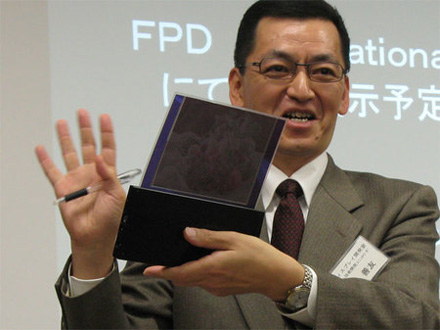
Advances in epaper might be getting us to the point where that might happen. Bridgestone’s new epaper that bends and folds like real paper whilst displaying digital information is a really promising start. Together with advances in wireless internet coverage and computer size, epaper offers a promising new business model for fiction, especially shorter works. Imagine subscribing your epaper to posts on economy from the Guardian, breaking news from the Washington Post, sport highlights from nfl.com and BBC, fiction from Asimovs and Strange Horizons and maybe a few stories and posts from Futurismic, all arriving on publication to the paper in your hands, ready to read. But like all these new media markets, it’ll need to be sustainable, DRM-free and reasonably priced. Are we prepared to make that change?
Internationalizing the Internet
Coming soon to an Internet near you: top-level domain names written in Chinese, Korean, Arabic, Russian, and several other languages. As of yet, no announcement of full implementation has been made, but ICAAN (Internet Corporation for Assigned Names and Numbers) has announced that testing will begin on this idea. So far, non-Roman alphabets can be used in second-level domains, but the final bit in a URL must still be .com, .org, .net, etc. – or one of the country domains assigned to each country.
This is an interesting idea as it opens the world a tiny bit more to hundreds of millions more non-English-speaking people. But at the same time it opens the door for new scams people can pull by taking similar characters in differing alphabets and attempting to fool unwary users.
(via Ars Technica)
User contributed wifi – the advantages of Foneros
Here in the UK the FON network is gradually reaching a point where people are aware of it. The company asks users to siphon off part of the wireless internet on their router and offer it up as a wireless node for other users. This can be done in the ‘Linus Torvald’ way of linux and be free or in the ‘Bill Gates’ way, giving the router owners a small cutback.
Back when the idea first came around there was little traction – the software wasn’t compatible with most routers and ISP. Meanwhile, most wireless nodes were incompatible with each other and you had to shell out a load of money to use each one. Now with ISPs like BT coming on board with the idea and many other wireless networks springing up all the time, it looks like much of the UK will have wireless access before too long. With content from the BBC becoming freely available over wireless nodes, it looks like complete connectivity throughout the country will be a reality sooner rather than later. Use this handy Londonist map to find free wireless points in London. By making the internet more freely available and decentralised we can use web 2.0 products that are less dependent on infrastructure, encouraging non-profit web solutions that benefit everyone.
[via BBC News, photo by Londonist via Matt From London]