Tag Archives: internet

Destroying the chrysalis of your online childhood

Google CEO Eric Schmidt has suggested that in the near future every person might be entitled to change their name on reaching adulthood, in order that they can live unhindered by the online record of their youthful indiscretions. Now, Eric Schmidt is almost certainly a much smarter man than I am… but that idea is clearly batshit nuts, especially coming from a Google bigwig.

I mean, think about it – most people use pseudonyms and handles online as it is. How many names and identities will you be allowed to abandon? One? Some? All? And as the vigilante efforts of Anonymous prove time and time again, even folk making a big effort to conceal their identity can have it exposed against their will. If Schmidt is implying (as he seems to be – it’s hard to tell from such a throwaway comment, to be fair) that the digital record would remain after this identity disconnection, how exactly would you prevent people from doing a combination of internet sleuthing and good old-fashioned meatspace gumshoe work in order to connect xCrazyLarry1989x to Lawrence Michaels, aspiring tort lawyer and gubernatorial candidate for his local Chamber of Commerce?

Given the way web technology keeps advancing, it may not even be much of an effort. Hell, Google itself offers a neat little app called Goggles that can identify famous faces and objects by comparing them to archived images on the web (as for values of ‘famous’, John Scalzi is apparently famous enough for this to work); given the sheer number of photos on the Facebook profiles of most young people, how are you going to prevent someone using this sort of image search and linking your newly-renamed Adult Person to the child they were?

Simple answer: you’re not. If what Schmidt actually means is that there’ll be some sort of legally-enshrined disconnect between an adult and their behaviour before adulthood, then maybe it’s not quite such a crazy suggestion… but it’s still pretty crazy. Personally, I tend to agree with Stowe Boyd and others: I think we underestimate the common sense kids apply to social media based on the high-profile idiocy of a tiny minority, and I think we overestimate the impact that youthful (or even not so youthful) indiscretions in the digital fossil record will have on how the people who left them behind will be viewed. As a crude numbers-from-the-air example: if one in five kids is pictured somewhere on the web taking a hit from a bong, is society more likely to (a) refuse to employ 1/5 of the population, or (b) figure that kids smoking weed really isn’t such a big deal?

Trouble is, we keep applying the social mores of today to the society of a decade hence. Think about how different the world felt just five years ago; attitudes change fast. By the time the internet’s knowledge of our past is sufficient to be causing problems for the majority of people, my bet is that we’ll be worrying about something else entirely. Or, to put it another way: when you have evidence that pretty much everyone has been a little bit naughty at some point in their lives, your assessment of how much naughtiness is forgivable will shift accordingly. Transgression is implicitly assessed against a baseline of ‘normality’; a searchable childhood for everyone will move that baseline. In fact, I’d even go so far as to suggest it’ll be the people with squeaky-clean pasts who end up looking the most suspicious…
GoogleLitTrips: extending fiction into the factual web

The Luddite old guard love to batter on about how the internet devalues the reading of books, but I’ve always thought that the internet had huge potential for extending the appeal and educational power of fiction. Here’s a good example, going by the name of GoogleLitTrips [via MetaFilter], a project that uses custom layers in Google Earth to show students the routes and locations featured in various “road-trip” literary classics. (GLT’s developer has done a similar project based on historical journeys of exploration, too.)

It’s still pretty basic at this point, but it’s not hard to imagine how this sort of thing could become incredibly deep, and perhaps end up becoming the standard extension of fiction into the multimedia sphere of the web. One could easily go beyond maps and into geotagged photography, both contemporary and historical, for instance, bringing locations and historical periods to life visually. (Would this lessen the imaginative input required from the reader, though?)

But let’s turn the idea up to eleven and apply it to science fiction for a moment. If you’re setting a book in the future, you can’t provide photographs of the settings… but you could create CGI composites (like the images produced by speculative architects), or build 3D environments using SketchUp or a metaverse platform like Second Life, which could then be populated with characters (pre-programmed, live-acted or both) for the reader to interact with, games for them to play, intrigues for them to get caught up in… something like what Neal Stephenson’s Mongoliad project is aiming for, perhaps.

The possibilities are endless, and all I’ve done here are list a few simple ideas that could be done with existing technologies. The underlying point is that there’s no reason the internet has to be the end of written fiction; with imagination and effort, fiction could become the core hook of a form of entertainment more complete, complex and immersive than anything yet created.

Sounds like a fun challenge, no?

The crap jobs of tomorrow

Via BoingBoing, the New York Times looks at a new breed of grim bottom-end employment in the digital age: Internet Content Reviewing. Main responsibilities include trawling through an endless river of text, images and video to ensure the removal of offensive content… and if you’ve more than a passing moment hanging out on the intertubes, you’ll have some idea of just how nasty some of that content might be.

With the rise of Web sites built around material submitted by users, screeners have never been in greater demand. Some Internet firms have tried to get by with software that scans photos for, say, a large area of flesh tones, but nothing is a substitute for a discerning human eye.

The surge in Internet screening services has brought a growing awareness that the jobs can have mental health consequences for the reviewers, some of whom are drawn to the low-paying work by the simple prospect of making money while looking at pornography.

[…]

David Graham, president of Telecommunications On Demand, the company near Orlando where Mr. Bess works, compared the reviewers to “combat veterans, completely desensitized to all kinds of imagery.” The company’s roughly 50 workers view a combined average of 20 million photos a week.

The compensation isn’t exactly awesome, either: wages peak out at US$12 per hour, and that’ll fall rapidly once someone gets a reliable outsource operation up and running. At least if you’re a sewer worker you can wash the stench off when you get home.

Leaving aside the extremity of the case in hand, though, it’s worth noting that this is essentially a gatekeeper/curation task – and we’ve already noted that curation is a growth industry thanks to the geometric expansion of content. Augmented reality will provide a whole new environment for this sort of work in the next few years… though I doubt the prospect of working outdoors will do much to ameliorate the essential unpleasantness and tedium of the task.

What other new (and shitty) jobs might our bright digital future provide?

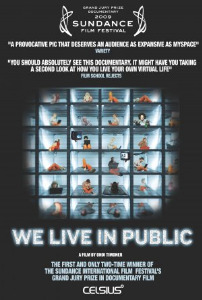
Watch this movie: We Live In Public

promo poster fo We Live In PublicA couple of nights ago, I sat down and watched We Live In Public, Ondi Timoner’s award-winning documentary about Josh Harris, Pseudo.com, the Quiet experiment, and the eponymous project that involved Harris streaming every mundane moment of his life onto the web for anyone to watch. I was particularly amazed that Quiet – a darkly and deliberately Orwellian behavioural experiment involving real people that not only prefigures but utterly eclipses much of the more recent reality television – isn’t better known and more widely discussed (though I believe it was a big influence on Douglas Rushkoff, who appears as an interviewee in the film and who was certainly part of the New York dot-com boom scene that floated Harris to prominence, and which I presume influenced and informed Rushkoff’s flawed but fascinating novel The Ecstasy Club).

The same applies to Harris, who comes across as a fascinating and damaged genius and visionary who foresaw – and concretised – many of the privacy and publicy issues that are hot button topics on today’s intertubes. I’m not sure I believe that Harris’ vision of a totally mediated world is inevitable, or even possible, but the extremity of the example he created is a valuable lesson and cautionary tale… as is his life as a whole.

The caveat here is that Timoner’s previous big success (and Sundance Festival winner) is the controversial rockumentary Dig!, which has been accused by Anton Newcombe of The Brian Jonestown Massacre of portraying him and his band in a selectively negative light as compared to the film’s other main subjects, The Dandy Warhols. Much as I’m a fan of Newcombe and his work, however, it’s pretty clear that he’s a damaged genius (like Harris, though in a very different manner), and whether or not Timoner’s editing really was deliberately skewed to cast Newcombe as the bad penny will remain a mystery to anyone who wasn’t involved in the project. Sensation sells, after all… and the footage of Quiet in We Live In Public makes much of its more shocking aspects; I guess what I’m saying is that the same pinch of salt you’d apply to any other modern media is surely worth using here.

But that pinch of salt does nothing to negate a powerful story, and one that I think any internet habitue should watch. Residents of the United Kingdom have another 22 days (as of publication of this post) to watch it for free on Channel 4’s 4od service, and I urge you to take advantage of it while you can. Everyone else – keep your eyes peeled for an opportunity of your own. This is a hugely important document in the history of mediated network culture.

Read blogs, scan Twitter, predict the future… profit?

So much for the nay-sayers, blog critics and Twitter h8rz: economic researchers reckon that keeping a weather eye on the internet Zeitgeist by scanning blogs and tweets for keywords could help predict stock price changes and other market behaviours!

Which is all very nice, so far as it goes. But given the events of the last few years, I think I’d rather hear stories about economists trying to discover how the global economy actually works as a system by analysing historical data, rather than trying to guess what it’ll do tomorrow by reading the internet’s tea leaves…

… yeah, I know, wishful thinking. Scratch a futurist, reveal an embittered utopian optimist. *shrug*