Tag Archives: law

Military drone pilots could be prosecuted as war criminals

A while ago, we were wondering whether killing a drone or UAV pilot counted as a legitimate act of war. Still no word on that one, but there’s more bad news for the CIA drone pilots in the form of a professor of national security law who suggests that the drone pilots – and their superiors – could be prosecuted for war crimes in the countries where their attacks take place:

Loyola Law School professor David Glazier, a former Navy surface warfare officer, said the pilots operating the drones from afar could — in theory — be hauled into court in the countries where the attacks occur. That’s because the CIA’s drone pilots aren’t combatants in a legal sense. “It is my opinion, as well as that of most other law-of-war scholars I know, that those who participate in hostilities without the combatant’s privilege do not violate the law of war by doing so, they simply gain no immunity from domestic laws,” he said.

“Under this view CIA drone pilots are liable to prosecution under the law of any jurisdiction where attacks occur for any injuries, deaths or property damage they cause,” Glazier continued. “But under the legal theories adopted by our government in prosecuting Guantánamo detainees, these CIA officers as well as any higher-level government officials who have authorized or directed their attacks are committing war crimes.”

Somehow I can’t see that stopping the AfPak drone war any time soon, especially given how popular UAVs are with the US military nowadays – it’s gotta be easier to sign people up for battlefield wetwork when they can do it with no risk of being shot in return, I’m guessing. And hey, laws can always be superceded (or just plain ignored), especially if you end up winning.

Then again, they thought Nam would be a cakewalk, didn’t they?

The ethics of pirating ebooks

Via Ars Technica, here’s a New York Times columnist reframing the pirated-ebooks debate as an ethical issue rather than a legal one, in response to a question asking whether it was wrong to download a pirated ebook version of a book already owned in hardcopy. His answer: it’s not legal, but it could be arged to be perfectly ethical. Although that ethical assessment rather hinges on one’s perspective:

Unsurprisingly, many in the book business take a harder line. My friend Jamie Raab, the publisher of Grand Central Publishing and an executive vice president of the Hachette Book Group, says: “Anyone who downloads a pirated e-book has, in effect, stolen the intellectual property of an author and publisher. To condone this is to condone theft.”

Yet it is a curious sort of theft that involves actually paying for a book. Publishers do delay the release of e-books to encourage hardcover sales — a process called “windowing” — so it is difficult to see you as piratical for actually buying the book ($35 list price, $20 from Amazon) rather than waiting for the $9.99 Kindle edition.

I tuned out a lot of the fine-detail wrangling over the Amazon/Macmillan debacle and the events that followed in its wake (simply because I didn’t have the spare time to read it all), so I’m unaware whether the notion of a blanket ownership license (e.g. where buying a hardcopy gives you rights to an electronic copy as well) was ever put forward.

It’s no cure for piracy, of course, but it’s an option that at least acknowledges some of the unaddressed issues currently surrounding content available in multiple formats. I’m somewhat heartened to see that the publishers are thinking hard about it, and publicly; hopefully, if they continue to avoid doing an ostrich impersonation, they won’t go the way of the record labels.

Further evidence that ebook piracy is a geek-o-sphere topic du jour: if Diesel Sweeties is satirising it, you know an issue has really arrived. 🙂

Orbital Legislation 101

Via BoingBoing, The Guardian highlights a new module available to law students at Sunderland University on “law and the legal system beyond Earth’s atmosphere”:

Topics already arising in the field include gaps in health and safety for potential space tourists, and damage to satellites from other objects orbiting the Earth. Looking further ahead, some lawyers have raised questions about land titles on the moon or other planets.

Chris Newman, one of the lecturers who will be teaching the module, said: “It is a growing area which has relevance across commercial, company, property, environmental, intellectual property and IT practice sectors. We think that our qualification will offer valuable knowledge in a fascinating area.”

[…]

The syllabus is likely to draw on earlier attempts to extend legislation into uncharted areas, such as the arguments between nations over huge sections of Antarctica. There are no plans as yet to test students on how they would make a case for Earth law against that of other civilisations, should any be discovered.

It’s easy to scoff and file this among the mass of pointless degree topics available to UK undergraduates, but with commercial space operations coming up close behind the nation-state space programs, it’s not going to be all “territory held in mutual trust for the good of all mankind” up there for long. Mix this module with a few more covring squatter’s rights, the successful defense of minerals claim-jumping and some basic tort law, and your new-frontier legal practice is ready for business…

Haven is a place on earth: can Iceland be made into a free-speech safe harbour?

Icelandic flagVia Jay Rosen, here’s an interview with Julian Assange, editor of the infamous Wikileaks whistleblower website, explaining how the Icelandic Modern Media Initiative organisation intends to attempt to turn Iceland into a global safe haven for journalism and free speech:

BOB GARFIELD: So you’ve skimmed the cream of media protection and source protection laws from around the world, from the U.K., from Sweden, from Belgium, and so forth, with the idea of benefiting Icelanders or of, in fact, becoming a haven where journalists from around the world could take refuge to do their work without fear of government interference?

JULIAN ASSANGE: Some people say haven, but we want to aim for heaven. Yes, it’s actually possible to use a law in one jurisdiction to strengthen the press in another. For example, we were involved in a case in South Africa where the South African Competition Commission released a redacted report on cartel behavior in the South African banks. We then released the redacted portions, and a prosecutor was appointed to go after our source.

We used the Swedish and Belgian law successfully in that case to argue that the investigation team in South Africa was at risk of becoming party to a crime in Sweden and Belgium. People don’t want to risk that, and they don’t want to risk fighting that out in court or having their assets seized overseas or having problems when traveling.

That’s the, the reason source protection and other protections of the press can have positive effect in jurisdictions around the world.

BOB GARFIELD: Now, you talked about heaven. I’m afraid I have to ask you about hell. I wonder if a regime of blanket protection for journalists and those who are legitimate sources wouldn’t also protect those who would wish to hide behind these impregnable shields to create mischief, whether it’s libel or blackmail or simple journalistic irresponsibility?

JULIAN ASSANGE: You have to remember there are not absolute protections. For example, malicious libel is not protected against in the new package of laws. And, I mean, what country is suffering from too much press freedom? Can you name the country that is actually at risk of having a too vibrant and free press? There is no such country.

It’s a lovely idea, very noble and very necessary… but geography is a slippery thing already, and a small country like Iceland – recently eviscerated as it was by the economic collapse – might have trouble standing up to big players (or coalitions of smaller ones), be they nation-states or corporations. [image by biologyfishman]

While we’re speaking of the psychogeography and architectural philosophy of islands, Tim Maly’s recent “Islands In The Net” essay examines the increasingly weird legal status of islands (and the reasons they’re so attractive and important to governments and anti-statists alike), and it includes a link to an article at the Citizen Media Law Project which is less than bullish on the chances of IMMI’s campaign doing much good:

… the problem is that whatever Iceland does, it can’t change the 500-pound gorilla of international media law: the principle that publication happens at the point of download, not the point of upload. The poster child case for this principle is Dow Jones & Co., Inc. v. Gutnick, a case that reached the High Court of Australia in 2002.  In that case, Gutnick sued Barron’s Online for publishing an allegedly defamatory article about him, and despite the fact that no one in Australia other than Gutnick’s lawyers actually read the offending article, the judges unanimously ruled that Australian laws applied, and thus Dow Jones (publisher of Barron’s Online) was liable to Gutnick.  At least at the time, the High Court of Australia was the highest court worldwide to hear a case involving this issue, and for better or worse, its ruling has carried the day in similar cases around the world since.

This will be a long battle, I suspect, but I’m glad to see some Davids giving Goliath the finger.
Rowling plagiarism row rattles on; the sound of a broken system

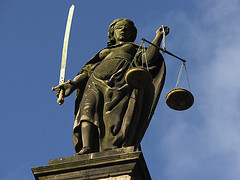
Blind Justice?Remember me mentioning a plagiarism lawsuit filed against J K Rowling, wherein some dude claims prior art of the Harry Potter books because of his self-published work, and tries to take her for a whole lot of money?

Well, it’s soon to arrive in court, and Teresa Nielsen-Hayden has a good summary of matters from the publishing perspective; in a nutshell, the guy doesn’t have much of a hope of winning, and most commentators on the case demonstrate a massive misunderstanding of the authorial process. Or, in other words, the likelihood of two authors coming up with a similar idea is pretty high, and so you can’t really sue someone for publishing a book that uses an idea you once used. Or at least you shouldn’t be able to; nothing seems to stop people from trying, though. [image by hans s]

The problem is, as I’ve mentioned before, that copyright law (like most law) tends to favour the party which can afford the better legal respresentation, and that in the case of written fiction, precedents for the roadblocking of vaguely similar works by an author or their estate (a la the late Salinger) are corrosive to the creative process that copyright law is nominally intended to protect; stealing the work of others is wrong, certainly, but is reworking their themes or ideas only to be permitted within the limited (though flexible) framework of satire?

The imminent ebook explosion and recent high-profile flaps about critically-acclaimed works which involve some degree of plagiarised content only serve to emphasise how badly copyright law needs a comprehensive overhaul for the age of digital abundance. Left the way it is, the only people who’ll see any long term benefit will be specialist lawyers to media moguls, and most of them are currently busy making sure we have no idea what’s being decided in the ACTA treaty