Tag Archives: literature

To teach the love of literature, let students choose their books

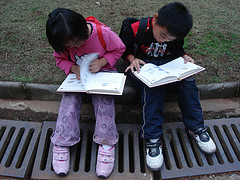
kids reading booksThere’s a lengthy article at the New York Times about middle-school English teacher Lorrie McNeill and her experiments in encouraging her students to engage with reading, and it’ll probably come as little surprise to many of you that she’s found that giving the kids (almost) free rein to pick their own titles has been much more successful than following the classics curriculum and force-feeding them Moby Dick and To Kill A Mockingbird:

The approach Ms. McNeill uses, in which students choose their own books, discuss them individually with their teacher and one another, and keep detailed journals about their reading, is part of a movement to revolutionize the way literature is taught in America’s schools. While there is no clear consensus among English teachers, variations on the approach, known as reading workshop, are catching on.

[…]

… some previously staunch advocates of a rigid core curriculum have moderated their views. “I actually used to be a real hard-line, great-books, high-culture kind of person who would want to stick to Dickens,” said Mark Bauerlein, professor of English at Emory University and the author of “The Dumbest Generation: How the Digital Age Stupefies Young Americans and Jeopardizes Our Future.” But now, in the age of Game Boys and Facebook, “I think if they read a lot of Conan novels or Hardy Boys or Harry Potter or whatever, that’s good,” he said. “We just need to preserve book habits among the kids as much as we possibly can.”

[…]

… literacy specialists also say that instilling a habit is as important as creating a shared canon. “If what we’re trying to get to is, everybody has read Ethan Frome and Henry James and Shakespeare, then the challenge for the teacher is how do you make that stuff accessible and interesting enough that kids will stick with it,” said Catherine E. Snow, a professor at the Harvard University Graduate School of Education. “But if the goal is, how do you make kids lifelong readers, then it seems to me that there’s a lot to be said for the choice approach. As adults, as good readers, we don’t all read the same thing, and we revel in our idiosyncrasies as adult readers, so kids should have some of the same freedom.”

This certainly chimes with my own experience of literature education when I was at school, and I come from a much more privileged background than McNeill’s students. We were made to read lots of classics (including To Kill A Mockingbird, which I remember as one of the most tedious books I ever had to open), and despite the fact that I’d been a keen reader from a very early age thanks to the encouragement of my parents, I honestly believe it was this teaching method that made me abandon English Lit as an education option at the earliest available opportunity. [image by <cleverCl@i®ê>]

Luckily, I never stopped reading (predominantly genre fiction, as should come as no surprise), but I wonder if I might have thought of becoming a writer much earlier in my life had the connection between books I loved and books considered “worthwhile” been made at that stage. Now I’m older, I read much more widely, and recent years have seen me exploring classic literature with a passion that could only have come from having learned for myself just how much pleasure reading a novel can bring (though, to my shame, I’ve still never gotten round to reapproaching To Kill A Mockingbird, which I suspect I’d appreciate far more now than as a callow and geeky 13-year-old).

What were your experiences of literature education at school? Did you lap up the classics, or did they bore you to tears? Do you think that it’s better to encourage kids to read “proper” literature, or just to encourage them to read, period?


Wintermute vs. Rachel Rosen

aiHere is a fine exploration of the differences and similarities in the use of artificial intelligences in Philip K. Dick and William Gibson’s writing:

Turing, whose purpose is to prevent AIs from developing too far, mirror the bounty hunters in Androids — the sole purpose of each is to control and destroy rogue intelligences, although in both novels their roles are shown from very different perspectives. In Neuromancer Turing are genuinely afraid of AIs: “You have no care for your species,” one Turing agent says to Case, “for thousands of years men dreamed of pacts with demons”.

Both Do Androids Dream of Electric Sheep? and Neuromancer portray artificial intelligences as lacking in empathy, but in different ways and for different reasons.

But would a human equivalent AI necessarily be lacking in empathy? Are humans as empathetic as we’d like to believe?

[via this tweet from SciFi Rules][image from agroni on flickr]

Young Adult fiction: are we confusing marketing with markets?

teenage readersJoanne McNeil of Tomorrow Museum has a post hailing teenagers as being the most enthusiastic readers of all, contrary to media handwringing over declining youth literacy. Her central point is very valid: that teenagers who get into books discover a channel through which they can learn a lot about the world (and the people in it) without having to refer to the usual authority figures. [image by jonfeinstein]

Young people, who learned T9 before long division, have no problem curling up with a good book. Sales of young adult lit remain high even in this economy. Why is it other than teenagers are the most passionate readers?

There are several reasons why so many teenagers are passionate readers. A book is a pathway inside another person’s head. When you are young, you have few deep relationships, maybe no real emotional connections with others at all. You connect in the text. At that age, it is a revelation to see an author has the same dreams and insecurities as you do. Plus, there is a confidence and conviction to a fiction narrative’s voice. You are eager for someone to look up to, but certainly not your parents, not your teachers. A novel is an opportunity to really listen to another human being.

The solitude, the sense of emotional connection, and the guidance of a novel are all appealing to teenagers who might otherwise busy themselves exclusively with videogames and the Internet. And it shows. For the most part, young adult sales continue to rise even while book publishing is experiencing a significant decline.

That certainly aligns with my teenaged experiences of reading, the utterly immersive thrill of which I’m increasingly unable to recapture (though it has been replaced with a different set of appreciations as time has passed).

But the other reason I’ve brought this up is that assumption in the last line of the quote from McNeil. Again:

… young adult sales continue to rise even while book publishing is experiencing a significant decline.

This is a mantra we heard over and over again during the massive YA genre fiction circle-jerk last year, and it’s always backed with the unvoiced assumption that only Young Adults read YA. I’ve worked in a library, and I can assure you that’s an observable falsehood; most genuinely popular YA is successful precisely because so many adult readers with an expendable income enjoy the same titles.

As much as I would love to believe otherwise, I don’t see the rising popularity of YA fiction as an indicator of increased interest in books specifically among the teen demographics (though neither do I think that things are as bad as the doom-sayers would have us believe); what it does indicate is that certain sorts of stories have a wider appeal than others.

How much of this is to do with ‘adult’ genre literature just not flicking the switches for those adult readers? I’m pretty sure that’s a large part of the explosive success of  the urban fantasy subgenre, in that it repackaged classic and familiar horror and fantasy tropes in a way that placed fun and entertainment above more ‘literary’ values. Maybe Jetse really is right; maybe in our hardnosed love for the genres we’re actually keeping them from becoming more accessible, and hence more popular?

But I digress. To be absolutely clear: I have no beef with YA fiction, or with those who choose to write it, or those who choose to read it. What I do have an issue with is the assumption that by marketing certain books as being for young adults we can treat their success as indicators of health in young adult reading specifically. The pedestal-mounting of YA as the saviour of modern fiction is dangerously misguided.

Doctorow on the decline and fall of novels

man reading a novelThe ever-ubiquitous Cory Doctorow crops up over at Internet Evolution, talking about “media-morphosis” – the ways in which the internet is mangling and mutating all the other forms of media. The whole thing is worth a read, but I thought I’d pick out a bit of Doctorow’s thinking about the future of the novel, as it fits quite neatly with some of the recent ebook posts here at Futurismic. [image by John Althouse Cohen]

Doctorow points out that books are suffering on two sides – firstly from the rise of the big-box retailers, which have restricted the titles available, and secondly from the way we’re being conditioned by the web (and other media imitating the web) to read in short, easy-to-swallow chunks – and then paints a worst-case scenario:

If big-budget movies might turn into opera, then long-form narrative books might turn into poetry. There’s a hell of a lot of published poetry — more than ever — mostly consumed by other poets and a small band of extremely dedicated followers of the form. A few poets make a big living at it, a few more make a marginal living at it, but for most poets, income is aspirational, not reality-based (this is pretty close to the situation in short fiction already, and not far off from the world of novel writing in many genres).

But a future in which novels turn into hand-crafted fetish items for a small group of literati is one in which the relevance of the novel dwindles away to a dribbly nothing.

I think most of us here would see that as a rather sad omega point for one of our favourite media, especially given the incredible artistic possibility it has to offer; Doctorow suggests that one route to salvation for the novel would be to build the sort of evangelical business that distributes books to places that they otherwise might not reach.

But what if his worst-case is actually the fact of the matter? Is it not possible that the novel will increasingly become an anachronism, the sort of thing considered historically interesting but culturally irrelevant by 21st Century humankind? Maybe we just need to face up to the idea that reading books for fun is a pastime whose days in the sun are over, no matter how personally attached to it we may be.