Tag Archives: medicine

Subdermal analgesics – implanted painkillers

neural stimulator implantA pill for every ill? How very Twentieth Century! In the future, my friend, your chronic pains will be alleviated by tiny subdermal devices wired directly into your nerves, activated remotely beyond the body by radio signals from a master control device:

The device works similarly to spinal-cord stimulators for managing chronic pain. The idea is that the electrical jolts delivered by the device override the neural pain signals being transmitted to the spinal cord. However, the precise mechanism is not yet clear.

[…]

Like some cochlear implants and other medical devices, the implant is powered with radio-frequency transmission: radio waves transmitted by the external coil generate a magnetic field in the internal coil, which powers the electrodes. Adopting technologies from the rapidly advancing RFID world has allowed the researchers to further shrink the device.

Before rushing off to hassle your local medical practitioner for a set, however, bear in mind that this is still at the conceptual stage:

Researchers have developed a prototype device, which they are testing in rats. The device can effectively stimulate peripheral nerves in rats, although it’s not yet clear whether the electrical stimulation alleviates chronic pain. (Scientists assess chronic pain in rats by recording how much the animals eat; a rat in pain won’t eat as much.)

Assuming it works as expected, this could be a real life-changer for people suffering with chronic conditions. However, I don’t think it’s a wild leap of logic to assume that if nerve stimulation can be used to alleviate pain, it can probably be used to create it as well – maybe even with exactly the same set-up. It’s easy enough to hijack regular RFID tags, after all.

Thinking a little further, perhaps this technology would become part of the suite of telepresence devices. Rather than wear some sort of all-over suit, sensory stimulation from virtual worlds could be reproduced in the body by carefully timed and coded radio signals… which would make the perceptual line between reality and the metaverse that much thinner and fuzzier. [via grinding.be; image borrowed from Technology Review article under Fair Use terms, please contact for takedown if required]

A drug to help recover "lost" memories?

492px-Frederick_Leighton_-_MemoriesBack in 2007, researchers at MIT’s Picower Institute for Learning and Memory in Cambridge, Massachusetts, discovered that mice with symptoms of Alzheimer’s disease regained long-term memories and the ability to learn when treated with a new type of experimental drug called a histone deacetylase (HDAC) inhibitor.

Now that same team, led by Li-Huei Tsai, Picower Professor of Neuroscience, has pinpointed the gene involved. It’s called HDAC2. (Via EurekAlert.)

“This gene and its protein are promising targets for treating memory impairment,” Tsai said. “HDAC2 regulates the expression of a plethora of genes implicated in plasticity — the brain’s ability to change in response to experience — and memory formation.

“It brings about long-lasting changes in how other genes are expressed, which is probably necessary to increase numbers of synapses and restructure neural circuits, thereby enhancing memory,” she said.

The researchers treated mice with Alzheimer’s-like symptoms using histone deacetylase (HDAC) inhibitors. HDACs are a family of 11 enzymes that seem to act as master regulators of gene expression. Drugs that inhibit HDACs are in experimental stages and are not available by prescription for use for Alzheimer’s.

As noted in the excerpt from white sands, HDAC inhibitors are experimental and not yet available by prescription for use for Alzheimer’s (they’re actually being tested in pre-clinical studies to treat Huntington’s disease, and some are already on the market to treat certain forms of cancer–they help chemotherapy drugs better reach their targets), but now that a specific target has been identified, more potent and safe drugs can be developed…which is what Tsai and her team will be focusing on next.

Of course, the focus is entirely medical at the moment, but if, as Tsai notes,

The fact that long-term memories can be recovered by elevated histone acetylation supports the idea that apparent memory “loss” is really a reflection of inaccessible memories

then this also raises the intriguing possibility of memory enhancement drugs for non-medical purposes…law enforcement, entertainment, remembering a loved one…heck, even an actor returning to a role he hasn’t played in 20 years could benefit from a drug that helps access “lost” memories.

Hmmm. On the other hand, aren’t there things you really don’t want to remember? What if the drug forced everything you thought safely buried into the light?

There’s an SF story in there somewhere…

(Image: Memories by Frederick Leighton, via Wikimedia Commons.)

[tags]memory,drugs,medicine,pharmaceuticals,brain,Alzheimer’s[/tags]

Lungs out of body experience

lungA new technique for storing lungs outside the human body has been developed by the Toronto General Hospital:

In an operating room at the hospital, the technology can keep a pair of human lungs slowly breathing inside a glass dome attached to a ventilator, pump, and filters.

The lungs are maintained at normal body temperature of 37 °C and perfused with a bloodless solution that contains nutrients, proteins, and oxygen.

The organs are kept alive in the machine, developed with Vitrolife, for up to 12 hours while surgeons assess function and repair them.

It is hoped that this process will mean lungs intended for transplant are more likely to be usable. According to the Technology Review article as few as one in ten lungs for transplant are usable with existing cooling-based preservation techniques.

[via Next Big Future, article from Technology Review][image from Technology Review]

Ambulances of the future

sc_shellSome elegant concept design for ambulances of the future, produced by the Royal College of Art and Engineering and Physical Sciences Research Council here at the BBC:

The idea of emergency on-the-spot community treatment was introduced by the government in 2001. However, experts say research into new technologies needed to support this new role is still lagging.

Mr Thompson continues: “We are looking at enabling technologies to help ECPs do their job.”

One such design is called the shell concept. It has a removable ‘shell’ that can slide off the main vehicle to create an expanded treatment space, or left on the scene for extended periods of time.

Other proposals include a soft continuous silicone interior which morphs to the shape of the patient and allows for infection control as well as a deployable tent allowing 360 degree access to patients.

[image by Rui Gio from the Royal College of Art]

Your transhuman future: 24/7 body monitoring

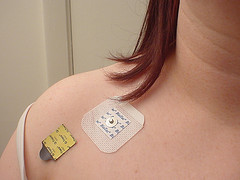
medical monitoring tagsCutting-edge medical hardware can scan and analyse our bodies with incredible accuracy, allowing doctors to diagnose and treat many of the illnesses that come as part of our mortal meatware. But these things can only be seen if we’re looking for them; we’d catch many more diseases and defects if we could be monitored constantly, rather than just when we visit a doctor or clinic.

Unfortunately (or fortunately, depending on your point of view) we’re a long way off from having nanotech swarming through our bloodstreams, but there are companies and research groups working to build realtime medical monitoring systems for the human body. SingularityHub rounds up a handful of them and takes a look at their current projects; here’s a description of one from Proteus Biomedical:

Proteus ingestible event markers (IEMs) are tiny, digestible sensors… Once activated, the IEM sends an ultra low-power, private, digital signal through the body to a microelectronic receiver that is either a small bandage style skin patch or a tiny device insert under the skin. The receiver date- and time-stamps, decodes, and records information such as the type of drug, the dose, and the place of manufacture, as well as measures and reports physiologic measures such as heart rate, activity, and respiratory rate.

So, till pretty crude by science fictional standards, but surely an improvement on being wired up to a room-full of medical monitors to record the same data. As nanotech and molecular genetic engineering converge, we’ll doubtless see systems like this become more powerful and more prevalent, at least in the richer countries.

SingularityHub points out one of the big benefits of this sort of monitoring, namely the vast tranches of data it would supply to medical researchers. But there’s a flip-side that need to be considered, namely privacy. Futurismic‘s own Sven Johnson reported back earlier this month from a possible future where biometric body scans of millions of US citizens was leaked to the public; think of the repurcussions of even more intimate data being exposed. [image by HouseOfSims]

And how about insurance? Once this sort of detailed medical data is available, it’ll become a mandatory part of your application for health coverage, and you can bet your boots that the insurance houses will use every little warning indicator as an excuse to bump up your premium… or deny you a policy completely.