Tag Archives: medicine

We can rebuild you! Injectable artificial bone paste developed

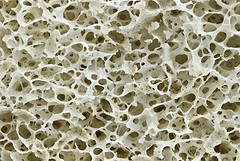
cross-section of a human hip boneI’m lucky enough to have never needed one (touch wood), but I’m told that bone grafts are extremely painful procedures that invite the risk of further damage to surrounding areas. So I can see the logic behind RegenTec’s injectable artificial bone compound, which will be pretty handy stuff if it works as it’s supposed to:

The technology’s superiority over existing alternatives is the novel hardening process and strength of the bond, said Quirk. Older products heat up as they harden, killing surrounding cells, whereas ‘injectable bone’ hardens at body temperature – without generating heat – making a very porous, biodegradable structure.

Putting on our science-fictional speculative hats for a moment, what sort of uses might the street find for this stuff? I’ll start with back-alley cosmetic surgeons offering quick-to-heal height increases. [image by patrix]

Should we be thankful for the anti-ageing movement?

ageing stencilHuman life expectancy keeps increasing steadily, thanks not only to medicine and technology but to social and cultural progress, too. Potential next steps on the ladder could well come from both camps: an example from the med-tech side might be custom-grown replacement organs from pigs; whereas a change in dietary habits could probably be classified as a cultural change informed by science (although drinking ‘heavy water’ sounds a bit too much like snake-oil to me). [image by r000pert]

But the question is: how far should we go? Outspoken longevity evangelists like Aubrey de Gray claim a millennium-long life is not only possible but within our grasp, but such ideas have their opponents as well – some arguing from faith-based perspectives, others not. [via grinding.be]

Would you choose to extend your life-span, and if so how far?

Plague2.0

rat paratrooper, stencil graffitiIt’s almost as if – despite our advancing technologies – all the health risks we considered dead and buried are coming back again. You’ve probably already heard about the resurgence of tuberculosis, but you might not have heard about the Bartonella bacteria, a newly emerging family of zoonotic pathogens – in other words, bacteria transmitted by rat fleas that have the potential to cause a variety of maladies in human beings, from serious heart disease to nervous system infections. [image by yaraaa]

All we need right now is a new plague, on top of everything else we have to deal with. But then again, Bird Flu was the new plague a few years ago, and despite all the yammering and media panic nothing really happened at all… [story via MetaFilter]

This post will make you 75% more likely to make the right decision on medicines!

drug capsulesNo report on a new wonder-drug would be complete without the statistical results of the clinical trials – you know, the bit where it says that people taking Wotdafuxocin were 60% less likely to find captioned cat pictures funny, or something similar. [image by rbrwr]

It will probably come as no surprise to our more cynical readers that these risk reduction numbers – while technically correct – are expressed in a way to maximise the medicine’s results as perceived by the casual reader:

Those are the figures on risk, expressed as something called the relative risk reduction. It is the biggest possible number for expressing the change in risk. But 54% lower than what? The trial was looking at whether it is worth taking a statin if you are at low risk of a heart attack or a stroke, as a preventive measure: it is a huge market – normal people – but these are people whose baseline risk is already very low.

If you express the same risks from the same trial as an absolute risk reduction, they look less exciting. On placebo, your risk of a heart attack in the trial was 0.37 events per 100 person years; if you were taking rosuvastatin it fell to 0.17. Woohoo.

Other research shows that even when faced with the same risk reduction expressed in two different ways, the majority of people will still pick the one where the number looks bigger. Don’t beat yourself up about it too much, though – it’s not just us patients who fall for the marketing tricks:

The same result has also been found in experiments looking at doctors’ prescribing decisions.

But try to think positive – it’s not often we get placed on an equal footing with our doctors, after all.

First full ovary transplant patient completes successful pregnancy

The headline says it all – after ten years of research and testing, we have the first child born successfully after its mother received a full ovary transplant. The doctor who carried out the procedure is now suggesting that young girls have one of their ovaries removed and frozen in case they need it later in life. [both links via FuturePundit]

It amazing how quickly we’re adopting the idea of ‘banking’ parts of ourselves in case of future need; it implies an understanding of the body as a biological machine, which may be why some religions find it so morally repugnant.

But religion aside, the story above brings up another contentious question – if fertility is no longer a barrier to carrying a child to term, how old is too old for a woman to become a mother? Is it merely an issue of physical suitability, or are there psychological and social implications for a child raised by parents that we would currently consider to be of grandparenting age?