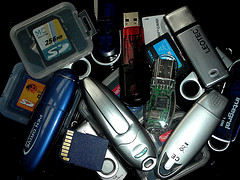
In the current study, Wang and Li take the field of phononics one step further and show the feasibility of a thermal memory that can store data with heat. The scientists predict that such a heat memory could be experimentally realized in the foreseeable future with rapidly advancing nanotechnology. Their work is published in a recent issue of Physical Review Letters.
The research suggests that the development of a legal drug that contains certain properties similar to those in marijuana and hemp might help prevent or delay the onset of Alzheimer’s disease. Though the exact cause of Alzheimer’s remains unknown, chronic inflammation in the brain is believed to contribute to memory impairment.
Any new drug’s properties would resemble those of tetrahydrocannabinol, or THC, the main psychoactive substance in the cannabis plant, but would not share its high-producing effects. THC joins nicotine, alcohol and caffeine as agents that, in moderation, have shown some protection against inflammation in the brain that might translate to better memory late in life.
The technology, nicknamed “PENSIEVE” by the IBM team, uses associative recall to make connections between pieces of related data acquired by a person. The advantage of the new technology is its ability to understand the context in which data is captured, then connect various data, and then use this knowledge to help bring the correct information to a person when it is needed.
Along with similar projects, like MyLifeBits from Gordon Bell at Microsoft, technologies like this will presumably be the first steps towards the extremely advanced memory augmentation systems envisioned by Ray Kurzweil in The Singularity is Near.
Sure, they look a little clunky right now, but that’s just a prototype – size and bulk won’t be a problem by the time they get these things to production.
The real problem, as pointed out in the comments, is how to make sure the forgetful user doesn’t forget where they left their Cyber Goggles …
The University of Pennsylvania scientists used germanium antimony telluride, which is a phase-changing material that switches between amorphous and crystalline structures. These phase-changes can be used to store data. The scientists were able to demonstrate a memory device that showed extremely low power consumption for data encoding (0.7mW per bit) while writing, erasing and retrieving data 1,000 times faster than conventional Flash memory. Tests also indicated the device would not lose data even after approximately 100,000 years of use. This all has the potential to realize a terabit-level nonvolatile memory device.
Presenting the fact and fiction of tomorrow since 2001
 We’ve had magnetic memory, semiconductor memory, and memristors: now we have thermal memory with the attendent field of study phononics: