Tag Archives: metaverse

The sentient Love Machine: Second Life creator planning metaverse Singularity?

Regular readers may remember me mentioning LoveMachine Inc., the new project of Second Life creator Philip Rosedale, back in November of last year. At that point, all the signs pointed toward LoveMachine being a start-up that intended to develop a reputational currency system for virtual worlds… and for all we know, it probably still is.

But thanks to SL uber-journalist Wagner James Au, we hear that Rosedale and company have added another project to the company roster. Its title? “The Brain: Can 10,000 computers become a person?”

Rosedale has long been interested in artificial intelligence, and the metaverse would seem like the ideal platform for that sort of research. Rosedale is playing his cards close to his chest at this point (and the cynic in me suspects that there’s an element of publicity-seeking involved, which I’ve gone and indulged by posting about it), but given LoveMachine’s open-frame “pick a task and join the team” approach to recruitment and the number of floating tech geniuses in San Francisco, I’d guess he’s no less likely to make progress than anyone else in the same field… provided that’s where the company’s focus stays put, of course.

And there’s no guarantee of that, either. LoveMachine’s remit is somewhat peripatetic, as is its culture, with Rosedale and chums setting up shop for the day anywhere they can find comfy seats and free wireless internet. Even if the dreams of metaverse AI come to nothing, LoveMachine may end as a blueprint for a new sort of company that, as Au points out, sounds like something out of William Gibson’s early novels: a loose, ad-hoc collective of tech geeks and console cowboys, working wherever they can find a flat surface and some bandwidth, building new things in imaginary spaces.

Battered avatars – feminist statement or misogynist pandering?

"Battle Royale" Second Life avatar skinWith its ability to allow us to take on new forms, appearances and identities, the metaverse is opening up as a whole new arena for discussions about cultural perceptions. Here’s a fresh example: a Second Life avatar skin designer released a collection of skins named “Battle Royale” on to the market, which would make the female avatar wearing them look like they’d been in a pretty serious brawl – black eyes, bruises and grazes, that sort of thing. Cue angry protest from commentators decrying the skins as a potential glorification of domestic violence. [image borrowed from JuicyBomb]

As the designer made plain, there was no such intent – but offence is in the eye of the beholder in such incidents, and domestic abuse is a deservedly sensitive topic. SL fashionista Iris Ophelia makes the point that hardly anyone would consider making a fuss about the already numerous male avatar skins that portray a similarly battered appearance, despite the largely unreported incidences of male-victim domestic violence, and hypothesises that the incident actually underlines a less-observed double standard in our attitudes to abuse. She also sees battered avatars as a potentially feminist statement, a subversion of the perfect and unruffled female characters from combat-based computer games, for example.

Whichever side of that debate you favour, it’s interesting to consider the potential of the metaverse as a place where this sort if discussion can be had slightly more safely and comfortably than in “reality”; given the theoretical anonymity of each avatar, it may be easier to speak out as a victim of real-world abuse while spending time in a virtual space. But of course, anonymity works both ways[nsfw], as anyone who’s spent more than five minutes on the web already knows…

LoveMachine Inc: Second Life founder’s reputation-as-currency start-up?

Love, Second Life styleOh, to be a CEO of a tech start-up… they can get bored of their projects even faster than the public can, y’know. Actually, that’s a little unfair – Philip Rosedale, the man behind Linden Lab, hasn’t lost interest in Second life so much as he’s looking for a new fish to fry with his new company, LoveMachine Inc. [image by Mrs. Bones]
What does LoveMachine do? Apparently it’s developing a system of the same name that was used by Linden Lab as a points-based incentive tool:

Linden employees gave and received “love” for a job well done. If an employee was well-received amongst his or her peers, their accumulated love currency was redeemable for a cash bonus at the end of the month. Similar to social capital systems like Whuffie Bank, it appears that LoveMachine may become a reputation currency system for businesses.

Interesting to see another outfit chasing after reputation economies as a potential business model… and restricting such a system to the limited and manageable confines of discreet organisations makes sense, as closed economies are inherently easier to manage. I expect they’ve heeded Bruce Schneier’s advice on reputation economies, too:

You’ve all experienced a reputation economy: restaurants. Some restaurants have a good reputation, and are filled with regulars. When restaurants get a bad reputation, people stop coming and they close. Tourist restaurants – whose main attraction is their location, and whose customers frequently don’t know anything about their reputation – can thrive even if they aren’t any good. And sometimes a restaurant can keep its reputation – an award in a magazine, a special occasion restaurant that “everyone knows” is the place to go – long after its food and service have declined.

Details of the LoveMachine plans are understandably sketchy at the moment. However, Rosedale and company have got a public worklist of jobs that they need a contractor to take on, and – if you live in the San Francisco area – they’re looking to hire. [hat tip to Fabio Fernandes]

Second Life Enterprise: virtual worlds behind the corporate firewall

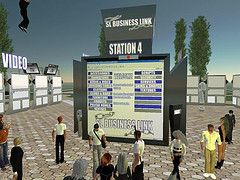
Second Life business link terminalHere’s an interesting development in the metaverse – Linden Lab, creators of Second Life, have announced the formal launch of their “Second Life Enterprise” platform, which is essentially a fragmented piece of the virtual world that runs on corporate servers behind the firewall. Private, hermetically-sealed virtual worlds, in other words. [image by Daneel Ariantho]

This is important for two reasons. First of all, it’s a major step in Linden Lab’s attempts to turn a decent profit from Second Life, which it has struggled to achieve with the free-to-use business model of the public version. If they can convince some big players of Second Life’s utility as a collaborative business tool, the subsequent inflow of money might enable them to step up the bug-hunt and fix some of the virtual world’s bigger flaws. IBM have been a presence in SL for some time, as have other big corporations (to whom we can now add the US Army’s Medical Research and Materiel Command branch, who are financing a “therapeutic space” for amputee veterans using SL Enterprise); the potential for the same tools in a more secure environment (e.g. devoid of flying penis barrages, for a start) may entice more money into Linden Lab’s coffers, and open up the field for competition from other virtual worlds. So now’s the time to set up a business making sharp business suits for executive avatars, I guess…

Secondly, the veil of privacy will doubtless encourage experimentation, and should lead to some new and weird ways of interacting with (and creating within) synthetic spaces. After all, you wouldn’t want to go developing your top-secret big-money idea in public where anyone could see (and copy) it, would you? Imagine for a moment that DARPA decided to set themselves up with an SL Enterprise installation… I’d pay a good big bribe to check out the crazy crap they’d have filled it with after a year or so of getting to grips with the interface, that’s for certain.

And, of course, one can’t help but be reminded of the abandoned corporate virtualities featured in William Gibson’s Bridge Trilogy, most particularly Idoru. Like the adandonware websites that already festoon the web, sat on some server somewhere, waiting for a rental agreement between two companies that no longer exist to expire, the metaverse could soon become a multimetaverse, with a few vast virtualities with public access and countless little bubbles of digital existence locked away behind firewalls and restrictive protocols. Urban exploration is a growing trend at the moment, but in a decade or so, the adventurous people will be cracking their way into abandoned corporate and gubernatorial realities to see what they can find lying around… and hell knows some of it will be more interesting than rusty old swivel chairs.

Virtual economies, virtual reputations and virtual business suits

Metaverse office space?Once the hype over Second Life died out, virtual worlds kinda disappeared from the high-profile headlines. But there’s still plenty of stuff going on in the metaverse, not least its use as a test-bed for theories to apply in reality. [image by Ramona.Forcella]

Economics is a popular choice; we’ve reported before on the bank runs and currency collapses of EVE Online, and now Edward Castronova – author of Synthetic Worlds, which should be your first port of call if you’re even vaguely interested in metaverse economics – is leading a team who’re examining the economy of EverQuest II. [via SlashDot]

Researcher Edward Castronova, professor of telecommunications at Indiana University, said researchers can learn almost anything about human society in games as they really are human societies.

However unlike real society they can be observed and tweaked.

“We can do controlled experiments in virtual worlds, but we can’t do that in reality,” said Castronova.

“Controlled experimentation is the very best way to learn about cause and effect. We are on the verge of developing that capacity for human society as a whole.”

[…]

After studying 314 million transactions within the fantasy world of Norrath in “EverQuest II,” including trading in-game goods like armor, shields, leather, herbs and food, the researchers were able to calculate the GDP of one of the game servers (the back-end computer that hosts thousands of players in one world).

As more people opened accounts and flocked to Norrath, spending money on new items, researchers saw inflation spike more than 50 percent in five months.

Game economies are, much like real economies, predicated on more than just a currency. Reputation scores are a big part of game economies (and many social networks, too), but the problem with “karma” systems is that they’re usually implemented in a way that renders them pointless, and which leads to the formation of in-game “mafias” [via BoingBoing]:

There can be no negative public karma-at least for establishing the trustworthiness of active users. A bad enough public score will simply lead to that user’s abandoning the account and starting a new one, a process we call karma bankruptcy. This setup defeats the primary goal of karma-to publicly identify bad actors. Assuming that a karma starts at zero for a brand-new user that an application has no information about, it can never go below zero, since karma bankruptcy resets it. Just look at the record of eBay sellers with more than three red stars-you’ll see that most haven’t sold anything in months or years, either because the sellers quit or they’re now doing business under different account names.

A different (though related) kind of reputation will be bothering the business crowd, however, and the Gartner firm of analysts is convinced that in less than five years, 70% of businesses will have issued avatar dress-codes to their employees [via SlashDot]:

“As the use of virtual environments for business purposes grows, enterprises need to understand how employees are using avatars in ways that might affect the enterprise or the enterprise’s reputation,” said James Lundy, managing vice president at Gartner, in a statement.

“We advise establishing codes of behavior that apply in any circumstance when an employee is acting as a company representative, whether in a real or virtual environment.”

This puts me in mind of a recurring motif in William Gibson’s novels, where he repeatedly makes the point that the most powerful and resource-rich virtual environments will be the ones that look subtle and understated, while the low-budget hucksters will dress to impress with excessive bling and extravagant eye-candy. The subtle grunge and mundane decay of reality is harder to simulate than grandiose overstatement; as in real life, it’ll be wise to tread lightly around the ostentatious.

Not interested in playing games or doing business in the metaverse? Well, you could always go learn to speak a dying language.