Tag Archives: NASA

Happy birthday, ISS!

ISS Break out the cake and light the candles, the International Space Station is 10 years old today (November 20). (Via Phys.org.)

The Russians launched the first part of the station from Kazakhstan on November 20, 1998; the second piece was carried up by the space shuttle two weeks later, and the first astronauts and cosmonauts arrived two years after that. Since then it has travelled 1.3 billion miles, orbited 57,300 times, and hosted 167 people from 15 different countries. Currently there are ten people aboard, and with the new additions and improvements, courtesy of the current Endeavour mission, the ISS will soon be able to host six people for long-term missions, up from the current three.

I feel a song coming on. Feel free to join in.

“Happy birthday to you, happy birthday to you, happy birthday dear ISS, happy birthday to you…”

(Or, if you prefer, watch this video of STS-126 Commander Chris Ferguson and Expedition 18 Commander Mike Fincke marking the event in orbit.)

(Image: NASA.)

[tags]space,International Space Station, space stations, NASA[/tags]

Direct evidence of dark matter detected over Antarctica?

antarctic balloon A high-altitude balloon experiment above the Antarctic may have just seen a possible signature of the mysterious “dark matter” thought to make up 85 percent of the mass of the universe–but as yet, completely unseen and not at all completely understood. (Via Nature News.)

The experiment, the Advanced Thin Ionization Calorimeter (ATIC), spotted a surplus of high-energy electrons coming from…somewhere. This matches something the PAMELA (Payload for Antimatter Matter Exploration and Light-nuclei Astrophysics–don’t you love space-exploration acronyms?) satellite mission turned up earlier this year

Electrons at this particular energy could be the result of heavy dark-matter particles colliding, which according to Dan Hooper, a theoretical physicist at Fermi National Accelerator Laboratory, is “certainly the sexiest of the possibilities.”

Sexy and, to non-physicists, more than a little weird:

The exact nature of the dark-matter particles that produce electrons is uncertain, but one idea is that they may be ordinary particles that spend part of their lives in a compact extra dimension of space. Whereas the particles would appear relatively stationary to observers trapped in three spatial dimensions, they could be moving at ultra-high speeds in a fourth spatial dimension. At high speeds, they would create a gravitational force that could be felt by matter trapped in three dimensions of space-time. “It’s very wild,” Hooper says.

I’ll drink to that!

Of course, there are other possibilities. In particular, the electrons could be coming from a nearby pulsar, the fast-spinning remnants of a supernova.

How do we figure out? More experiments, of course. A new orbiting telescope called Fermi can spot electrons and positrons (though it’s designed to hunt for high-energy X-rays), and thus may confirm the data, or even pick up other high-energy particles that could be produced by dark-matter collisions.

Check back in the spring.

(Photo: NASA.)

[tags]NASA,dark matter,astrophysics,balloons[/tags]

The Internet will go interplanetary

NASA finished first tests on a system that
could one day be used to automatically relay information between Earth, spacecraft, and astronauts, without the need for humans to schedule transmissions at each point. …

For the test, dozens of images of Mars and its moon Phobos were transmitted back and forth between computers on Earth and NASA’s Deep Impact spacecraft. The craft, which sent an impactor into Comet Tempel 1 in 2005, has been renamed “Epoxi” now that it its mission has been extended to search for extrasolar planets.

Further tests will begin on the International Space Station next year.

[Story: New Scientist; picture: NASA/JPL]

Will the Phoenix rise again?

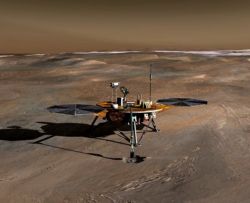
NASA's Mars Phoenix Lander - artist's impressionVia pretty much everywhere comes the news that NASA has pronounced the Phoenix Mars Lander “silent, presumed dead”. The Martian winter is settling in, and the resulting cold and darkness have put the plucky robot out of action, though there is a vague hope it might revive itself when the seasons change. [image courtesy NASA]

In addition to finally confirming the water-on-Mars matter, Phoenix has been a real (and much-needed) media success for NASA; they tapped into the right channels to keep the mission in the public consciousness, not just through a regular (but very sexy and content-laden) website, but through Twitter as well. It feels as if now, after two decades of disappointments, disasters and disillusionment, space is something to get excited about again. Let’s hope it stays that way, eh?