Tag Archives: neuroscience

The Body Politic

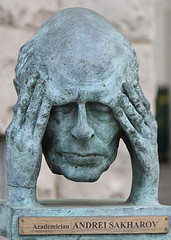
sakharovWe had a lively (but civil!) discussion about the psychology of political choices last week.  So how about physiologyScience published a report suggesting that people who respond most strongly to disturbing images seem to have political views that most people would call conservative.  The test used gadgets to measure skin moisture and blink intensity. Pictures included a big spider on a face and a guy covered with blood.

Yes, I’m skeptical too.  The subjects were Nebraskans, residents of one of the more conservative of these United States in terms of voting. And if you showed this arachnophobic left-leaning blogger some of those disturbing images he’d cry like — well, like a Wall Street banker, this week.

Meanwhile, in another poli-sci story: When vice-presidential candidate Sarah Palin’s email was easily hacked and screen-shots pasted all over the internets, she and her supporters immediately called for a repeal of the Patriot Act and warrantless surveillance, because now they know what it feels like to have their privacy invaded without warning and for no good reason.  Civil liberties enjoyed a resurgence in the U.S., and …

Sorry.  Dreaming on the job.

And just to confirm that, as The Posies sing, everybody is a frakking liar (video):

The world’s largest particle collider malfunctioned within hours of its launch to great fanfare, but its operator didn’t report the problem for a week.

[Bust of Dr. Andrei Dmitrievich Sakharov: photo by dbking]

Brain scans: an end to lying?

FMRI This is one of the most science fictional sounding news stories to surface in the past few days. From the New York Times:

India has become the first country to convict someone of a crime relying on evidence from this controversial machine: a brain scanner that produces images of the human mind in action and is said to reveal signs that a suspect remembers details of the crime in question.

For years, scientists have peered into the brain and sought to identify deception. They have shot infrared beams through liars’ heads, placed them in giant magnetic resonance imaging machines and used scanners to track their eyeballs. Since the Sept. 11 attacks, the United States has plowed money into brain-based lie detection in the hope of producing more fruitful counterterrorism investigations.

The technologies, generally regarded as promising but unproved, have yet to be widely accepted as evidence — except in India, where in recent years judges have begun to admit brain scans. But it was only in June, in a murder case in Pune, in Maharashtra State, that a judge explicitly cited a scan as proof that the suspect’s brain held “experiential knowledge” about the crime that only the killer could possess, sentencing her to life in prison.

Psychologists and neuroscientists in the United States, which has been at the forefront of brain-based lie detection, variously called India’s application of the technology to legal cases “fascinating,” “ridiculous,” “chilling” and “unconscionable.” (While attempts have been made in the United States to introduce findings of similar tests into court cases, these generally have been by defense lawyers trying to show the mental impairment of the accused, not by prosecutors trying to convict.)

If the technology actually works, it holds obvious promise in law enforcement and security efforts. Polygraph tests are notoriously unreliable, measuring anxiety rather than truth-telling, and so called “truth serum” just makes people babble. But:

After passing an 18-page promotional dossier about the BEOS test to a few of his colleagues, Michael S. Gazzaniga, a neuroscientist and director of the SAGE Center for the Study of the Mind at the University of California, Santa Barbara, said: “Well, the experts all agree. This work is shaky at best.”

Even if brain-scan lie-detection technology doesn’t work as advertised yet, though, that doesn’t mean it won’t work in the future, raising any number of issues that will vary from country to country depending on each nation’s particular legal system.

And if it becomes well established? Then those tempted to break the law could literally be warned, “Don’t even think about it.”

(Image: Wikimedia Commons.)

[tags]brain,security,law enforcement,neuroscience[/tags]

Another step forward: mapping the brain

There has been another development in the ongoing effort to map the human brain. Using a new technique called diffusion tensor imaging, scientists at Indiana University have created the first high resolution map of the human cortical network:

Diffusion imaging is a new twist on MRI that uses magnetic resonance signals to track the movement of water molecules in the brain. In gray matter, water tends to diffuse multidirectionally. But in white matter, it diffuses along the length of neural wires, called axons, and scientists can use these diffusion measurements to map the fibers.

Inside The Ear - Another Edited Anatomy Chart ScanAn intriguing discovery is that of a “core” area – so called by cognitive neuroscientist Olaf Sporns – of highly interconnected neurons near the back of the head:

The node lies on the shortest path between many different parts of the neural network. “It’s highly connected amongst itself, but also highly central with respect to the rest of the brain,” says Sporns. “Network studies in other fields, from the Internet to protein interaction networks, suggest that these kinds of highly connected nodes tend to be very important for determining what the network does as a whole.”

It’s interesting how research in diverse areas of science can inform each other: such that studies of the behaviour of networks, or waves, or mathematical ratios, can crop up again and again.

[story via Technology Review][image from Mikey G Ottowa on flickr]

Does science need art to answer fundamental questions?

Violin and Playing Cards, Cubist painting by Juan Gris That’s the question posed in this fascinating article by Jonah Lehrer at SEED Magazine. Riffing on the possibility that Niels Bohr may have been influenced by his interest in Cubism when he came up with his new model of the atom, Lehrer argues that science needs art in order to answer the most fundamental questions:

Physicists study the fabric of reality, the invisible laws and particles that define the material world. Neuroscientists study our perceptions of this world; they dissect the brain in order to understand the human animal. Together, these two sciences seek to solve the most ancient and epic of unknowns: What is everything? And who are we?

But before we can unravel these mysteries, our sciences must get past their present limitations. How can we make this happen? My answer is simple: Science needs the arts. We need to find a place for the artist within the experimental process, to rediscover what Bohr observed when he looked at those cubist paintings. The current constraints of science make it clear that the breach between our two cultures is not merely an academic problem that stifles conversation at cocktail parties. Rather, it is a practical problem, and it holds back science’s theories. If we want answers to our most essential questions, then we will need to bridge our cultural divide. By heeding the wisdom of the arts, science can gain the kinds of new insights and perspectives that are the seeds of scientific progress.

(Via Idea Festival.)

What do you think? Is he on to something, or is this just a romantic plea to an unromantic world to put art back on the pedestal of importance it once occupied?

(Image: “Juan Gris: Violin and Playing Cards (1995.403.14)”. In Timeline of Art History. New York: The Metropolitan Museum of Art, 2000–.)

[tags]art,science,physics, neuroscience[/tags]