Tag Archives: nuclear

A cure for radiation sickness?

radioactive materials hazard signHey, great news! A group of researchers have discovered a medicine that can alleviate the damaging effects of radiation sickness… at least in mice and monkeys:

The first series of tests included experiments on more than 650 monkeys. Each test featured two groups of monkeys exposed to radiation, but only one group was given the medication. The radiation dosage was equal to the highest dosage sustained by humans as result of the Chernobyl mishap.

The experiment’s results were dramatic: 70% of the monkeys that did not receive the cure died, while the ones that survived suffered from the various maladies associated with lethal nuclear radiation. However, the group that did receive the anti-radiation shot saw almost all monkeys survive, most of them without any side-effects. The tests showed that injecting the medication between 24 hours before the exposure to 72 hours following the exposure achieves similar results.

Isn’t that brilliant news? Think of all the great things we could achieve if we could prevent radiation from damaging the human body! As its lead hook, Ynetnews gleefully trumpets about the geopolitical edge that this medicine will give to Israel in dealing with their ongoing paranoia about uppity Muslims with nuclear weapons, but follows with a more broadly humanitarian application:

Gudkov’s discovery may also have immense implications for cancer patients by enabling doctors to better protect patients against radiation. Should the new medication enable cancer patients to be treated with more powerful radiation, our ability to fight the disease could greatly improve.

Think also of clean-up operations in locations with similar problems to Chernobyl, or time spent in space beyond the Earth’s handy and life-saving magnetosphere. The list of places that people can’t go just got shorter. [via SlashDot; image by 7263255]

Atomic fireballs: the man with the pics

tumbler_snapper_bombThought ya’ll might get a kick of the old sensawunda out of these “rapatronic” high-speed photos of nuclear bombs exploding:
The exposures were often as short as 10 nanoseconds, and each Rapatronic camera would take exactly one photograph.

A bank of four to ten or more such cameras were arranged at tests to record different moments of early fireball growth.

They provide technical information about the device’s disassembly.

Some really awesome images captured here. More on rapatronics here.

[via Sachs Report][image from the page]

Dan Brown’s antimatter bombs are nothing to worry about

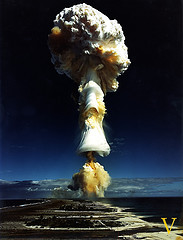
mushroom cloudI miss a lot of things about working in public libraries, but exposure to Dan Brown novels is not one of them. As such, I had no idea that Hollywood had made a movie from another of his books, Angels & Demons, but apparently they have.

Less surprising is the revelation that Brown has played fast and loose with the facts (and the writing, I fully expect); Wired UK takes a look at Brown’s antimatter-bomb-in-the-Vatican plot and points out that we’ve no need to worry about terrorists stealing the stuff from CERN:

And it’s true – scientists there really have  produced antimatter. But only in submicroscopic quantities. “If you add up all the antimatter we have made in more than 30 years of antimatter physics here at CERN, and if you were very generous, you might get 10 billionths of a gram,” CERN’s Rolf Landua, told New Scientist magazine recently. “Even if that exploded on your fingertip it would be no more dangerous than lighting a match.”

It would be possible to make more, of course, but not cheap:

The cost of antimatter is, by [NASA’s] estimates $62.5 million per microgram (£41 million). However, they suggest that a dedicated antimatter production facility, with a pricetag of $3 – $10 billion, would bring the price down to just $25,000 per microgram (a mere £16 million).

But even if that much were just lying around, the storage facilities don’t exactly lend themselves to a cat-burglar raid:

Positrons can be stored in a Penning Trap, a sort of magnetic bottle. (The Air Force bought a new positron trap in December – but only for a device to examine defects in semiconductors.) However, such traps are leaky and you can’t store your positrons indefinitely. There’s also the issue of what happens when the power fails. The trap stops working and all your positrons come into contact with the container walls, which could mean a big boom. Then there’s the question of how many positrons you can store. At the moment storing a microgram of positrons would require a Penning Trap of stupendous size. A 2004 report by the US National Research Council said that much greater energy densities were needed for positrons to be useful as an explosive. The study advised against heavy investment in such a high-risk, immature technology.

So, fear not – the Vatican is safe from antimatter, at least for now. Given the size of the place, I can’t imagine why you’d think you needed anything bigger than a small nuke to take it out… but that doesn’t sound quite as exotic, I guess, and exotic puts the ‘thrill’ into ‘technothriller’. Best leave the plausibility and scientific rigour to those science fiction nerds, eh? [image by V 2]

Seven great games to play with civilian nukes

old Russian nuclear bombHey, guess what – nuclear bombs can be used for more than just annihilating entire cities!Wired has an article rounding up a selection of seven proposed civilian deployments of nuclear weapons, most of which (unsurprisingly) leverage their ability to make a very big hole in something. [image by mikelopoulos]

But how’s this for a counterintuitive idea – why not use nuclear weapons to dispose of nuclear waste!

This scheme was originally proposed at Lawrence Livermore Laboratory. A hole is bored beneath the waste processing plant, and a nuclear bomb is set off in the hole. Then the radioactive waste is poured into the subterranean cavity so formed, over a 25-year filling period. The wastes heat up through their own activity, boil dry, and eventually melt themselves and some surrounding rock into a glassy ball. The cost is quite uncertain but was judged to be extremely attractive.

If you’re anything at all like me (i.e. not a nuclear scientist), you’re probably thinking that’s a batshit stupid idea. But apparently not:

“For excavation, we put a lot of time and effort and money into developing nuclear explosives which had minimal fissionable material so that you could carry out a 100-kiloton cratering explosion and release the radioactivity equivalent to a 20-ton explosive of fissionable material,” Nordyke said.

But despite the technical success of the Plowshare program, Nordyke doesn’t see nuclear weapons being used for excavation or mining anytime soon because it doesn’t seem politically feasible.

“I think its time came and went,” he said. “I think reconciling it with the enhanced environmental concerns today and the inherent association with weapons is difficult.”

My reaction proves his point, I suppose. Nukes are a Pandora’s Box technology, in that we can’t just pretend we don’t know they exist (which is one of George Dvorsky’s points regarding the risks of nuclear disarmament), but because we’ve been predominantly shown nuclear blasts doing things which are deeply nasty and lethal we have this knee-jerk reaction to the idea of them being used for a more creative purpose.

Then again, there’s a trust issue as well – a government-commissioned experimental mega-engineering project involving not just nuclear waste but nuclear weapons? Even if you could show me the calculations and experimental data that proved it could be done, I’m not sure I’d feel at all confident in the ability of a government – or a corporation, for that matter – not to screw up by cutting corners somewhere.

The potential perils of a world without nukes

nuclear fallout shelter signEven though we no longer live under the Cold War shadow of Mutually Assured Destruction (at least, not at the moment), there’s a whole lot of nuclear weapons sat around gathering dust, still just as lethal as they always were before.

I think many people would agree it’d be nice to be rid of nukes completely; the Obama administration seems keen on the idea, anyway, which – even if it’s just a symbolic political palm frond – is a reassuring change from the gung-ho realpolitik of the last decade.

But disarmament carries its own set of risks, as George Dvorsky points out:

There are a number of reasons for concern. A world without nukes could be far more unstable and prone to both smaller and global-scale conventional wars. And somewhat counter-intuitively, the process of relinquishment itself could increase the chance that nuclear weapons will be used. Moreover, we have to acknowledge the fact that even in a world free of nuclear weapons we will never completely escape the threat of their return.

[snip]

The absence of nuclear weapons would dramatically increase the likelihood of conventional wars re-emerging as military possibilities. And given the catastrophic power of today’s weapons, including the introduction of robotics and AI on the battlefield, the results could be devastating, even existential in scope.

So, while the damage inflicted by a restrained conventional war would be an order of magnitude lower than a nuclear war, the probably of a return to conventional wars would be significantly increased. This forces us to ask some difficult questions: Is nuclear disarmament worth it if the probability of conventional war becomes ten times greater? What about a hundred times greater?

And given that nuclear war is more of a deterrent than a tactical weapon, can such a calculation even be made? If nuclear disarmament spawns x conventional wars with y casualties, how could we measure those catastrophic losses against a nuclear war that’s not really supposed to happen in the first place? The value of nuclear weapons is not that they should be used, but that they should never be used.

It’s a tricky question; Dvorsky points out that he himself is very much in favour of disarmament, but the situation is not clear cut by any means. Idealism is shaky ground from which to argue against the destructive force of nuclear weapons. [image by brndnprkns]

Perhaps it will take some Watchmen-esque global existential threat to make the whole world put aside its differences at the same time as its nuclear arsenal… but the cynic in me suspects that the opposite would occur. After all, climate change hasn’t yet encouraged everyone to pull in the same political direction, has it?