
Tag Archives: physics

Magnetic monopoles spotted for the first time

1-magneticmonoThat staple of Larry Niven‘s Known Space series – magnetic monopoles – have finally been isolated in the laboratory:

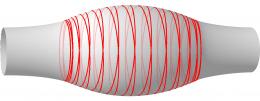
Magnetic monopoles are hypothetical particles proposed by physicists that carry a single magnetic pole, either a magnetic North pole or South pole. In the material world this is quite exceptional because magnetic particles are usually observed as dipoles, north and south combined. However there are several theories that predict the existence of monopoles. Among others, in 1931 the physicist Paul Dirac was led by his calculations to the conclusion that magnetic monopoles can exist at the end of tubes – called Dirac strings – that carry magnetic field. Until now they have remained undetected.

[from Physorg][image from Physorg]

Thrown off course by relativity

Cosmos1-2006-2A preview of space-flight issues of the future: how do you account for the effects of relativity when travelling long distances? A solar sail launched from close to the Sun would have to account for relativistic effects when navigating to the edges of the solar system:

And even though those effects are relatively minor to start with, they have a significant effect over long distances.

The calculations carried out by Kezerashvili and Vazquez-Poritz show that the effects of general relativity could push a solar sail off course by as much as a million kilometers by the time it reaches the Oort Cloud

The promise of solar sails as a propulsion mechanism is impressive:

By one calculation, a solar sail with a radius of about a kilometer and a mass of 300 kg (including 150 kg of payload) would have a peak acceleration of about 0.6 g if released on a parabolic trajectory about 0.1 astronomical unit (AU) from the sun (where the radiation pressure is higher).

That kind of acceleration would take it beyond the Kuiper belt to the heliopause, the boundary between the solar system and interstellar space (and a distance of 200 AU), in only 2.5 years.

In 30 years, a solar sail could travel 2,500 AU, far enough to explore the Oort Cloud.

Of course we need to actually build one of these things first.

[from Technology Review, via Technovelgy][image from Wikimedia]

Scriths and legends: hidden portals a possibility

hiddenResearchers in Hong Kong are developing technologies that could one day lead to hidden portals [1]:
In the research paper, the researchers from the Hong Kong University of Science and Technology and Fudan University in Shanghai describe the concept of a “a gateway that can block electromagnetic waves but that allows the passage of other entities”

The gateway, which is now much closer to reality, uses transformation optics and an amplified scattering effect from an arrangement of ferrite materials called single-crystal yttrium-iron-garnet that force light and other forms of electromagnetic radiation in complicated directions to create a hidden portal.

Previous attempts at an electromagnetic gateway were hindered by their narrow bandwidth, only capturing a small range of visible light or other forms of electromagnetic radiation. This new configuration of metamaterials however can be manipulated to have optimum permittivity and permeability – able to insulate the electromagnetic field that encounters it with an appropriate magnetic reaction.

Whilst I’m not entirely sure how this metamaterial in supposed to behave, or what is meant by “other entities” in this context, such a substance has overtones of the Ringworld construction material described in Larry Niven‘s Ringworld series, which IIRC was impermeable to 40% of neutrino emissions, and under the application of a particular instrument would allow people to walk through it.

[1]: The article is somewhat vague on how exactly this portal will work in reality, but I gather that it works either like a perfected “holographic mirror” that you can walk through, or else simply a glass-like sheet that can become reflective when required to. In any case

[from h+ Magazine][image from fdecomite on flickr]

Light in a bottle

microresonatorScientists have developed a technique for confining light within a bottle:

Similar to the motion of a charged particle stored in a magnetic bottle, i.e., a particular spatially varying magnetic field, the light oscillates back and forth along the fiber between two turning points. For this reason, this novel type of microresonator realized by the physicists in Mainz is referred to as a bottle resonator. Tuning the bottle resonator to a specific optical frequency can be accomplished by simply pulling both ends of the supporting glass fiber. The resulting mechanical tension changes the refractive index of the glass, so that depending on the tension, the round-trip of the light is lengthened or shortened.

This could lead to the creation of a glass fibre quantum interface between light and matter, which in turn is an important component of hypothetical quantum computers and quantum communication systems.

[from Physorg][image from Physorg]

Psychohistory in the real world

crowdResearchers at Indiana University believe that it may be possible to create a real-life version of Isaac Asimov’s concept of psychohistory:

Much as meteorologists predict the path and intensity of hurricanes, Indiana University’s Alessandro Vespignani believes we will one day predict with unprecedented foresight, specificity and scale such things as the economic and social effects of billions of new Internet users in China and India, or the exact location and number of airline flights to cancel around the world in order to halt the spread of a pandemic.

Psychohistory as described by Isaac Asimov holds that “while one cannot foresee the actions of a particular individual, the laws of statistics as applied to large groups of people could predict the general flow of future events.”

This certainly seems similar to the ideas of reality mining discussed here:

Vespignani writes that advances in complex networks theory and modeling, along with access to new data, will enable humans to achieve true predictive power in areas never before imagined. This capability will be realized as the one wild card in the mix — the social behavior of large aggregates of humans — becomes more definable through progress in data gathering, new informatics tools and increases in computational power.

It is an exciting direction, and offers the possibility of a black-swan style technological breakthrough. With improved data, through things like spimes and ubiquitous computing, combined with improved data processing techniques and communications there exists the possibility for a new and powerful way of studying, monitoring, and even controlling social and technological developments with precision.

[via Next Big Future][image from woodleywonderworks on flickr]