Tag Archives: physics

God of the gaps and the limits of science

thoughtAcademic Jon Taplin highlights this WSJ piece on quantum entanglement and the theories of French physicist Bernard d’Espagnat:

In March, the 87-year-old Frenchman won the prestigious $1.5 million Templeton Prize for years of work affirming “life’s spiritual dimension.”

Based on quantum behavior, Dr. d’Espagnat’s big idea is that science can only probe so far into what is real, and there’s a “veiled reality” that will always elude us.

Many scientists disagree. While Dr. d’Espagnat concedes that he can’t prove his theory, he argues that it’s about the notion of mystery. “The emotions you get from listening to Mozart,” he says, “are like the faint glimpses of ultimate reality we get” from quantum experiments. “I claim nothing more.”

I am not familiar with Prof. d’Espagnat’s work. Is he talking about the God of the gaps or the Popperian problem of induction?

[image from P/\UL on flickr]

‘Hidden’ photons might be able to communicate instantly through anything

The older I get, the more I tend to consider science in general (and physics in particular) to be something like an erratic genius uncle who turns up to family gatherings every once in a while and tells me something that completely screws with my head.

Today’s example: ‘hidden’ photons, which are… well, they’re like normal photons, but they don’t really interact much with ‘conventional’ matter. Which means they might be able to go right through things that normal photons can’t penetrate, and, er… look, I’ll leave the explaining to the professionals:

Hidden photons are a class of particles predicted by so-called supersymmetric extensions to the standard model of particle physics. Unlike normal photons, hidden photons could have a tiny mass and would be invisible because they would not interact with the charged particles in conventional matter. This means hidden photons would flit through even the densest materials unaffected.

The only place to spot them is in a vacuum, where they should sometimes “oscillate” into normal photons. There are already experiments searching for this effect: the idea is to shine a laser at a wall in a vacuum and see if any of the photons make it through to the other side by transforming into their hidden counterparts and back again. According to Ringwald’s group, if these experiments succeed it should be possible to scale up the apparatus so that the hidden photons become signal carriers and the “wall” becomes any stretch of ground or water.

Pretty cool, huh? Don’t get too excited, though; a hidden photon-based communication system would probably not be much more use than a telegraph link:

… Malcolm Fairbairn, a physicist at King’s College London, points out that over the 12,700-kilometre diameter of the Earth, the signal capacity would be just 1 bit per second: “At that speed it would take about a year to download an mp3 file, so I’m not sure who would use it.”

Dang. Still, I’ve got a five-spot bill here that says hidden photons will crop up in a Greg Bear novel within the next half decade…

Warp Factor Zero

Star Trek trikeThe science fictional faster-than-light warp drive, despite being a staple of books and movies in which scientific plausibility is at best a tertiary consideration, is actually based on a genuine scientific theory by a fellow called Miguel Alcubierre.

Unfortunately for those looking forward to boldly going where no human has gone before (and doubtless delivering colonial civilisation and moral homilies to aliens with suspiciously lumpy yet humanoid faces), an expansion of Alcubierre’s theory to include quantum mechanics suggests that the warp drive is not a phenomenon we’ll actually be able to use for space travel after all:

Alcubierre imagined a small volume of flat spacetime in which a spacecraft might sit, surrounded by a highly distorted bubble of spacetime which shrinks in the direction of travel, bringing your destination nearer, and stretches behind you. He showed that this shrinking and stretching could enable the bubble–and the spaceship it contained–to move at superluminal speeds.

The conclusion is the result of classical thinking using the ideas of general relativity but physicists have long wondered what would happen if you threw quantum mechanics into the mix? Now Finazzi and pals have worked it. For a start, they say that the inside of the bubble would be filled with Hawking radiation, making life rather uncomfortable for any spacecraft within it.

Not to mention for the occupants of said spacecraft… I guess we’ll just have to put off establishing the Galactic Federation and learn how to make do with what we have to hand, at least until some benevolent sponsor race gives us the key to the subatomic universe. Selah. [via FuturePundit and many others; image by Timm Williams]

"Hypermusic Prologue: A projective opera in seven planes"

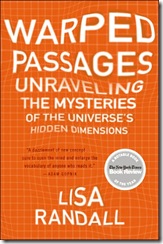
warped passages I like to post here (and yes, I do still post here, despite my occasional protracted absences…darn deadlines!) about those odd occasions when the theatrical world intersects with the science fictional or the scientific. But I don’t think I’ve ever run across anything quite like this: Lisa Randall, a theoretical physicist in Harvard’s Department of Physics, is writing an opera. (Via IdeaFestival.)

Randall is the author of a 2005 book called Warped Passages that, in the word of Samuel P. Jacobs, writing for the Boston Globe, “introduced nonscientific readers to the possibility of additional dimensions beyond the three we see, and how their existence could account for many of the physical world’s most perplexing phenomena.”

In response to that book Spanish composer Hector Parra, asked Randall if she would try writing a libretto for an opera about her work. Jacobs writes:

The resulting piece, a collaboration with the artist Matthew Ritchie, is scheduled to debut in Paris at the Georges Pompidou Centre this summer, then travel throughout Europe in the fall.

The opera is an intimate work – an hourlong show written for two performers – that carries uncomfortable ideas about our world and how we experience it. The piece has the puzzling title of “Hypermusic Prologue: A projective opera in seven planes,” the seven planes referring to space and to the opera’s seven acts. The work’s broader goal is to suggest new approaches to both science and art. The old-fashioned form of opera, Randall and her colleagues hope, can become a vehicle for modern science, using sound and voice to re-create the many dimensions that physicists now explore.

“It’s kind of mathematical, it is geometrical, and it is looking towards the future,” Randall, 46, says of the title.

Read the whole interview with Randall.

And if anyone actually sees the opera, let us know what you think!

(Image: Barnes & Noble.)

[tags]physics,opera,books,music[/tags]