Tag Archives: physics

Got Change for an Electron?

Ella at the whiteboardIsraeli scientists have sliced electrons into “quasiparticles,” each with a quarter charge of the electron.

Although electrons are indivisible, if they are confined to a two-dimensional layer inside a semiconductor, chilled down to a fraction of a degree above absolute zero and exposed to a strong magnetic field that is perpendicular to the layer, they effectively behave as independent particles, called quasiparticles, with charges smaller than that of an electron.

Quasis have been known for 20 years, but they were “odd fractionally charged” — one third of an electron, one fifth, etc. The quarter-charges behave differently and may be useful for computing.

Those of us who have trouble wrapping our heads around quantum stuff might sympathize with astronomers, who, the New York Times tells us, are finding cosmology just as puzzling.

As far as astronomers can tell, there is no relation between dark matter, the particles, and dark energy other than the name, but you never know.

Nevertheless, string theorist Brian Greene, promoting the World Science Festival, reminds us of something most readers of this site would probably find a truism, but is probably a new idea to a lot of people:

We must embark on a cultural shift that places science in its rightful place alongside music, art and literature as an indispensable part of what makes life worth living.

[Ella Delivers Her Lecture on String Theory by Phillip C]
CERN brings supergrid internet to the world

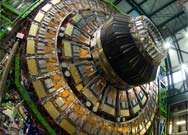
The CMS detector at CERN will process huge volumes of data every secondIn addition to searching for the ‘God’ particle that is the Higgs, CERN have been making a vast ‘supergrid’ to transfer the vast volumes of data created by the LHC supercollider every second to the universities studying it around the world (currently including myself). The sheer amount of data at the LHC – around 15 Petabytes a year – means a whole new system has been made to spread it to other institutions outside of the collider in Switzerland.

The grid still has some issues to work out but is showing signs of real potential to blow the current internet out of commission in a few years. The grid uses fibre-optic connections and high speed routers to transfer data. It could be as much as 10,000 times as fast as current broadband, allowing movie-sized files to transfer in seconds. Of course, this technology is currently only in use in the world of High Energy Particle Physics but, like the World Wide Web before it, what is invented at CERN tends to propagate out to the rest of us before too long.

[via The Times, image via CERN]

Black holes and litigations*

CERN Large Hadron Collider In a world replete with frivolous and silly lawsuits, the two guys pressing a lawsuit (in Hawaii) to stop the CERN Large Hadron Collider being turned on are surely leading the pack. They’re allegedly worried that the LHC will create a miniature black hole that will OMG SWALLOW TEH URTH!!1! [image by Spadger]

It appears that their fears are at least partly founded in reality, though. Phil “Bad Astronomy” Plait explains the potential risks of colliding subatomic particles … but he goes on to point out that the scientists in charge of the LHC project have already looked into the possibilities and concluded that the risk is so small as to be negligible.

Of course, they might be wrong. But given the choice of going with either the scientific method or the opinion of two guys who made a beeline for a Hawaiian courtroom, my money’s on the fellows wearing the lab-coats.

*See, Tomas – it’s not just you who can sneak obtuse references to British rock bands into Futurismic posts! 😉

Probing the six degrees of separation

Are you six degrees away from someone, or somewhat less?Discover has a good article this week about a couple of social scientists and their attempts to confirm Milgrim’s infamous ‘six degrees of separation’ experiment. Milgrim gave a number of people a letter and asked them to get it to a person they didn’t know directly though people they did know, then a person that person knew, etc. He found the chains averaged at 6 people, leading to the urban myth and the game ‘Six Degrees Of Kevin Bacon’, in which people link up actors in a similar way (from personal experience, it almost always seems to go via Dan Ackroyd). Kevin Bacon even has a website called Six Degrees, linking celebrities and people with charitable organisations.

The scientists found that in both Milgrim and their follow-up studies, the six degrees often held up but people only completed their chain of connections a small amount of the time. They found that although often the six degree connection was about right when the link was completed, the likelihood of them reaching their target usually depended on the willingness or hostility of the people inbetween. For instance, for someone like Morgan Spurlock looking for Osama Bin Laden the last couple of chains are probably extremely resistant to taking part, so it’ll be hard to find him! I’d be interested to see if, as internet networks grow in popularity and sophistication, whether the number of degrees actually decreases in a hyper-connected future.

Discover also has a look at six physicists who could be considered ‘the next Einstein’. Personally I think Richard Feynman should hold that title and anyone now should be considered ‘the next Richard Feynman’ but the article is a nice brief overview of some leading lights in theoretical physics all the same.

[story via Discover, image via Wikipedia Commons]

And the Oscar for "Best Short Film of a Sub-Atomic Particle" goes to…

Single frame from electron moviethis video of a single electron’s motion.

The movie, made at Lund University, Sweden, shows how an electron rides on a light wave after just having been pulled away from an atom. This is the first time an electron has ever been filmed. (Via EurekAlert.)

How do you film something that circles the nucleus of an atom once every 150 attoseconds? And how long is an attosecond, anyway?

To answer the second question first, an attosecond is 10 to the -18 of a second, or, as Johan Mauritsson, an assistant professor in atomic physics at the University, puts it, “an attosecond is related to a second as a second is related to the age of the universe.”

By using attosecond pulses created from intense laser light using recently developed technology, the researchers were able to guide the motion of an electron and capture a collision between it and an atom on film.

As you might guess, the encounter has been slowed down enormously so our slow-poke eyes and brains can register it.

OK, so it probably won’t win an Oscar at this Sunday’s Academy Awards, but it’s still pretty darn cool.

You can read the original scientific paper from Physical Review Letters here, and additional discussion of the achievement here.

(Image: Lund University.)

[tags]physics, particles, lasers, atoms[/tags]